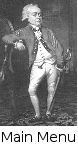
The Last Court Dwarf
by Armand Leroi
FROM THE WALLS OF THE PRADO, the Louvre and the National Gallery they stare balefully at us. As depicted by Velazquez, Argenti, Bronzino, Carracci, Van Dyck and another dozen now forgotten painters, the court dwarfs stand clad in rich and elaborate dress, miniature daggers at their sides, surrounded by the other possessions of rich and powerful men. In one painting, a princeling stands next to a dwarf, the better to display the boy's youthful elegance. In another, a dwarf is placed next to a glossy, pedigreed hound. The man's shoulders are level with the dog's withers.
'Towards the end of the seventeenth century,' wrote Isidore Geoffroy Saint-Hilaire, 'It was necessary to dream up amusements of a special sort for the leisure of princes and it was to dwarfs that fell the sad privilege of serving as the toys of the world's grandees.' But the court dwarfs were older than that. Most of the paintings that depict them date from a century earlier. Catherine de Medici (1519-89) had set the fashion. In the hope of breeding a race of miniature humans she had arranged a marriage between a pair of dwarfs. A few years later, the Electress of Brandenburg tried the same thing, but both couples proved childless. Peter the Great took the amusement to its extreme. In 1701 he staged a wedding between two dwarfs to which he invited not only his courtiers, but also the ambassadors of all the foreign powers posted to his capital. He also ordered all dwarfs within two hundred miles to attend. A dozen small men and women rode into the capital on the back of a single horse, trailed by a jeering mob. At court some of the dwarfs, perceiving that they were there to he ridiculed, refused to take part in the fun. Peter made them serve the others.
Were all the court dwarfs unhappy, degraded creatures stripped of all human dignity? Geoffroy, writing in 1832 thought so. So had Buffon fifty years earlier. Joseph Boruwlaski, however, would not have agreed. For him, being small was a gift. an opportunity. It had lifted him out of obscurity.
The Boruwlaskis were poor. Joseph was only nine years old when his father died, leaving the family destitute. Eighteenth-century rural
Ten brilliant years passed in this manner. And then Boruwlaski fell in love. He paid his court to an actress. She rejected him with scorn. Years later he would write: 'If I can upbraid nature with having refused me a body like that of other men, she has made me ample amends, by endowing me with a sensibility which, it is true, displayed itself rather late, but, even in my constitutional warmth, spread a taint of happiness, the remembrance of which I enjoy with gratitude and a feeling heart.' But by then he could reflect on his youthful passion with calm. For he had long won the heart of another, a dark-eyed young noblewoman named Isalina Borboutin. She too had laughed at him, toyed with him, treated him like a child. But he persisted. He wrote to her, often and passionately. He petitioned the King of Poland for a pension so that he could support her. He was given one and a title as well: she relented.
Joseph Boruwlaski died in his sleep on 5 December 1837 in the quiet English cathedral town of
© Armand Marie Leroi 2003.
Quoted with permission, which is gratefully acknowledged.