Gerard's Herbal - Part 3
|
|
|
| Fig. 941. Herb Twopence (1) |
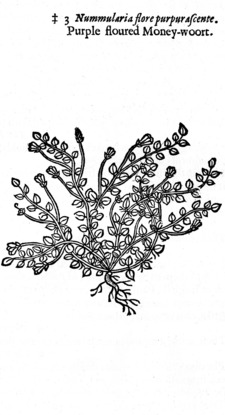
Fig. 942 Purple Moneywort (3) |
The Description.
1. Herb Twopence hath a small and tender root, spreading and dispersing itself far within the ground; from which rise up many little, tender, flexible stalks trailing upon the ground, set by couples at certain spaces, with smooth green leaves somewhat round, whereof it took his name: from the bosom of which leaves shoot forth small tender footstalks, whereon do grow little yellow flowers, like those of Cinquefoil or Tormentil.
2. There is a kind of Moneywort or Herb Twopence, like the other of his kind in each respect, saving it is altogether lesser, wherein they differ.
3. There is another kind of Moneywort which hath many very slender creeping branches which here and there put forth fibres, and take root again: the leaves are small and round, standing by couples one against another; and out of the bosoms come slender footstalks bearing pretty little whitish purple flowers consisting of five little leaves standing together in manner of a little bell-flower, and seldom otherwise: the seed is small, and contained in round heads. This grows in many wet rotten grounds and upon bogs: I first found it Anno 1626, in the Bishopric of Durham, and in two or three places of Yorkshire, and not thinking any had taken notice thereof, I drew a figure of it & called it Nummularia pusilla flore ex albo purpurascente; but since I have found that Bauhin had formerly set it forth in his Prodromus by the name of Nummularia flore purpurascente. It grows also on the bogs upon the heath, near Brentwood in Essex: it flowers in July and August.
The Place.
It groweth near unto ditches and streams, and other watery places, and is sometimes found in moist woods: I found it upon the bank of the river of Thames, right against the Queen's palace of Whitehall; and almost in every country where I have travelled.
The Time.
It flowereth from May till summer be well spent.
The Names.
Herb Twopence is called in Latin Nummularia, and Centummorbia: and of divers Serpentaria. It is reported that if serpents be hurt or wounded, they do heal themselves with this herb, whereupon came the name Serpentaria: it is thought to be called Centummorbia, of the wonderful effect which it hath in curing diseases; and it is called Nummularia of the form of money, whereunto the leaves are like: in Dutch, Penninckecruyt: in English, Moneywort, Herb Twopence, and Twopenny grass.
The Temperature.
That this herb is dry, the binding taste thereof doth show: it is also moderate cold.
The Virtues.
A. The flowers and leaves stamped and laid upon wounds and ulcers doth cure them: but it worketh most effectually being stamped and boiled in oil olive, with some rosin, wax, and turpentine added thereto.
B. The juice drunk in wine, is good for the bloody flux, and all other issues in blood of man or woman; the weakeness and looseness of the belly and lask; it helpeth those that vomit blood, and the whites in such as have them.
C. Boiled with wine and honey it cureth the wounds of the inward parts, and ulcers of the lungs, & in a word, there is no better wound herb, no not Tobacco itself, nor any other whatsoever.
D. The herb boiled in wine with a little honey, or mead, prevaileth much against the cough in children, called the chin cough.