Gerard's Herbal - Part 3
|
|
|
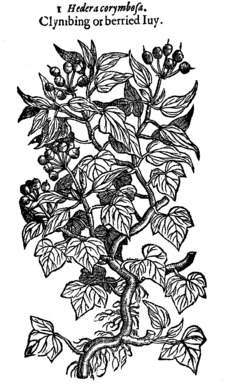
| Fig. 1271. Climbing Ivy (1) |
Fig. 1272. Creeping Ivy (2) |
The Kinds.
There be two kinds of Ivy, as Theophrastus witnesseth, reckoned among the number of those plants which have need to be propped up; for they stand not of themselves, but are fastened to stone walls, trees, and such like, and yet notwithstanding both of a woody substance, and yet not to be placed among the trees, shrubs, or bushes, because of the affinity they have with climbing herbs; as also agreeing in form and figure with many other plants that climb, and are indeed simply to be reckoned among the herbs that clamber up. But if any will cavil, or charge me with my promise made in the beginning of this history, where we made our division, namely, to place each plant as near as may be in kindred and neighbourhood; this promise I have fulfilled, if the curious eye can be content to read without rashness those plants following in order, and not only this climbing Ivy that lifteth herself to the tops of trees, but also the other Ivy that creepeth upon the ground.
Of the greater or the Climbing Ivy there are also many sorts; but especially three, the white, the black, and that which is called Hedera helix, or Hedera sterilis.
The Description.
1. The greater Ivy climbeth on trees, old buildings, and walls: the stalks thereof are woody, and now and then so great as it seems to become a tree; from which it sendeth a multitude of little boughs or branches every way, whereby as it were with arms it creepeth and wandereth far about: it also bringeth forth continually fine little roots, by which it fasteneth itself and cleaveth wonderful hard upon trees, and upon the smoothest stone walls: the leaves are smooth, shining especially on the upper side, cornered with sharp pointed corners. The flowers are very small and mossy; after which succeed bundles of black berries, every one having a small sharp pointel.
There is another sort of great Ivy that bringeth forth white fruit; which some call Acharnicam irriguam and also another lesser, the which hath black berries. This Pliny calleth Selinitium.
We also find mentioned another sort hereof spread abroad, with a fruit of a yellow saffron colour, called of divers Dionysias, as Dioscorides writeth: others Bacchica, of which the poets used to make garlands, as Pliny testifieth, lib. 6. cap. 34.
2. Barren Ivy is not much unlike unto the common Ivy aforesaid, saving that his branches are both smaller and tenderer, not lifting or bearing itself upward, but creeping along by the ground under moist and shadowy ditch banks. The leaves are most commonly three-square, cornered, of a blackish green colour, which at the end of summer become brownish red upon the lower side. The whole plant beareth neither flowers nor fruit, but is altogether barren and fruitless.
3. There is kept for novelty's sake in divers gardens a Virginian, by some (though unfitly) termed a Vine, being indeed an Ivy. The stalks of this grow to a great height, if they be planted nigh any thing that may sustain or bear them up: and they take first hold by certain small tendrils, upon what body soever they grow, whether stone, boards, brick, yea glass, and that so firmly, that oftentimes they will bring pieces with them if you pluck them off. The leaves are large, consisting of four, five, or more particular leaves, each of them being long, and deeply notched about the edges, so that they somewhat resemble the leaves of the Chestnut tree: the flowers grow clustering together after the manner of Ivy, but never with us show themselves open, so that we cannot justly say anything of their colour, or the fruit that succeeds them. It puts forth his leaves in April, and the stalks with the rudiments of the flowers are to be seen in August. It may as I said be fitly called Hedera virginiana.
The Place.
Ivy groweth commonly about walls and trees; the white Ivy groweth in Greece, and the barren Ivy groweth upon the ground in ditch banks and shadowy woods.
The Time.
Ivy flourisheth in autumn: the berries are ripe after the winter solstice.
The Names.
Ivy is called in Latin Hedera: in High Dutch, Epheu: in Low Dutch, Ueyle: in Spanish, Yedra: in French, Liarre.
The greater Ivy is called in Latin, Hedera attollens, or Hedera assurgens: Gaza interpreteth it Hedera excelsa. The later herbarists would have it to be Hedera arborea, or Tree Ivy, because it groweth upon trees, and Hedera muralis, which hangeth upon walls.
Creeping or barren Ivy is called in English, Ground-Ivy: yet doth it much differ from Hedera terrestris, or Ground-Ivy before described: of some it is called Clavicula, Hedera helix, and Hedera sterilis, and is that herb wherein the boar delighteth, according to Iohannes Khuenius.
The Temperature.
Ivy, as Galen saith, is compounded of contrary faculties; for it hath a certain binding earthy and cold substance, and also a substance somewhat biting, which even the very taste doth show to be hot. Neither is it without a third faculty, as being of a certain warm watery substance, and that is if it be green: for whilst it is in drying, this watery substance being earthy, cold, and binding consumeth away, and that which is hot and biting remaineth.
The Virtues.
A. The leaves of Ivy fresh and green boiled in wine, do heal old ulcers, and perfectly cure those that have a venomous and malicious quality joined with them; and are a remedy likewise against burnings and scaldings.
B. Moreover, the leaves boiled with vinegar are good for such as have bad spleens; but the flowers or fruit are of more force, being very finely beaten and tempered with vinegar, especially so used they are commended against burnings.
C. The juice drawn or sniffed up into the nose doth especially purge the head, stayeth the running of the ears that hath been of long continuance, and healeth old ulcers both in the ears and also in the nostrils; but if it be too sharp, it is to be mixed with oil of Roses, or salad oil.
D. The gum that is found upon the trunk or body of the old stock of Ivy, killeth nits and lice, and taketh away hair: it is of so hot a quality, as that it doth obscurely burn: it is as it were a certain waterish liquor congealed of those gummy drops. Thus far Galen.
E. The very same almost hath Dioscorides, but yet also somewhat more: for over and besides he saith, that five of the berries beaten small, and made hot in a Pomegranate rind, with oil of Roses, and dropped into the contrary ear, doth ease the tooth-ache; and that the berries make the hair black.
F. Ivy in our time is very seldom used, save that the leaves are laid upon little ulcers made in the thighs, legs, or other parts of the body, which are called issues; for they draw humours and waterish substance to those parts, and keep them from hot swellings or inflammations, that is to say, the leaves newly gathered, and not as yet withered or dried.
G. Some likewise affirm that the berries are effectual to procure urine; and are given unto those that be troubled with the stone and diseases of the kidneys.
H. The leaves laid in steep in water for a day and a night's space, help sore and smarting waterish eyes, if they be bathed and washed with the water wherein they have been infused.