
Gerard's Herbal Vol. 5
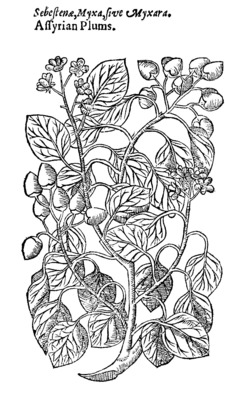
Fig. 2094. Senesten or Assyrian Plum
The Description.
Sebestens are also a kind of plums: the tree whereof is not unlike to the Plum tree, saving it groweth lower than the most of the manured Plum trees; The leaves be harder and rounder; the flowers grow at the tops of the branches, consisting of five small white leaves, with pale yellowish threads in the middle, like those of the Plum tree: after followeth the fruit like to little plums, fastened in little skinny cups, which when they be ripe are of greenish black colour, wherein is contained a small hard stone.The fruit sweet in taste, the pulp or meat is very tough and clammy.
The Place.
The Sebesten trees grow plentifully in Syria and Egypt, they were in times past foreign and strange in Italy, now they grow almost in every garden, being first brought thither in Pliny his time. Now do the Sebesten trees, saith he, in his 15th book, 18th chapter, begin to grow in Rome, among the Service trees.
The Time.
The time answereth the common Plums.
The Names.
Pliny calleth the tree Myxa, it may be suspected that this is the tree which Matron Paradus in his Attic Banquet in Athenæus doth call Amamelis, but we cannot certainly affirm it, and especially because divers have diversely deemed thereof. The berry or fruit is named Myxon and Myxarion, neither have the Latins any other name. The Arabians and the Apothecaries do call it Sebesten: which is also made an English name: we may call it the Assyrian Plum.
The Temperature and Virtues.
A. Sebestens be very temperately cold and moist, and have a thick and clammy substance; therefore they nourish more than most fruits do, but withal they easily stop the entrails, and stuff up the narrow passages, and breed inflammations.
B. They take away the ruggedness of the throat and lungs, and also quench thirst, being taken in lohoch or licking medicine, or prepared any other kind of way, or else taken by themselves.
C. The weight of ten drams, or of an ounce and a half of the pap or pulp hereof being inwardly taken, doth loose the belly.
D. There is also made of this fruit a purging electuary, but such an one as quickly mouldeth, and therefore it is not to be used but when it is new made.


