Gerard's Herbal Vol. 5
The Kinds.
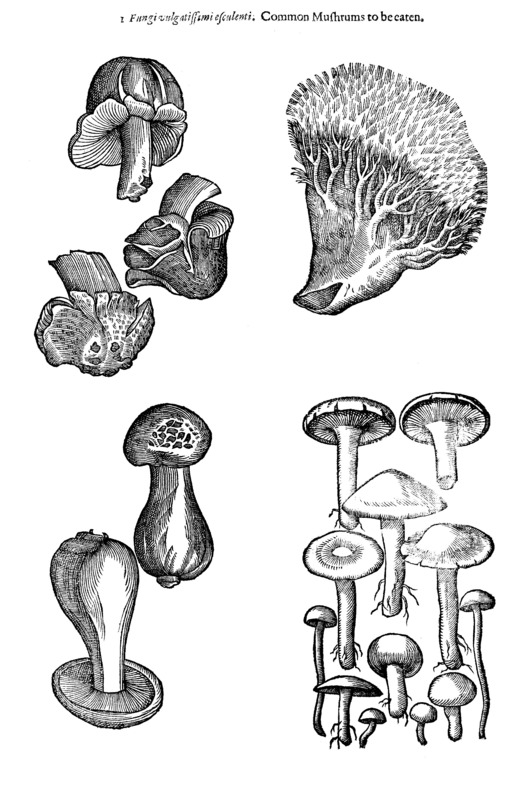
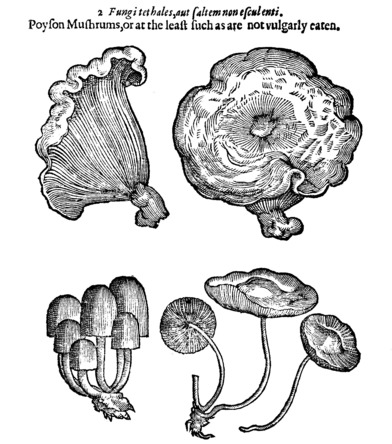
Some Mushrooms grow forth of the earth; other upon the bodies of old trees, which differ altogether in kinds. Many wantons that dwell near the sea, and have fish at will, are very desirous for change of diet to feed upon the birds of the mountains; and such as dwell upon the hills or champion grounds, do long after sea fish; many that have plenty of both, do hunger after the earthy excrescences, called Mushrooms: whereof some are very venomous and full of poison, others not so noisome; and neither of them very wholesome meat; wherefore for the avoiding of the venomous quality of the one, and that the other which is less venomous may be discerned from it, I have thought good to set forth their pictures with their names and places of growth. Because the book is already grown too voluminous, I will only give you the figures of such as my author hath here mentioned, with some few others, but not trouble you with any more history, yet distinguish between such as are eatable, and those that be poisonous, or at least not to be eaten; so the first figured amongst the poisonous ones, is that we call Jew's Ear, which hath no poisonous facility in it. Clusius (all whose figures I could have here given you) hath written a peculiar tract of these bastard plants, or excrescences, where such as desire it may find them sufficiently discoursed of.
The Description.
1. Ground Mushrooms grow up in one night, standing upon a thick and round stalk, like unto a broad hat or buckler, of a very white colour until it begin to wither, at what time it loseth his fair white, declining to yellowness: the lower side is somewhat hollow, set or decked with fine gutters, drawn along from the middle centre to the circumference or round edge of the brim.
2. All Mushrooms are without pith, rib, or vein: they differ not a little in bigness and colour; some are great, and like a broad brimmed hat; others smaller, about the bigness of a silver coin called a dollar: most of them are red underneath; some more, some less; others little or nothing red at all: the upper side which beareth out, is either pale or whitish, or else of an ill-favoured colour like ashes (they commonly call it ash colour) or else it seemeth to be somewhat yellow.
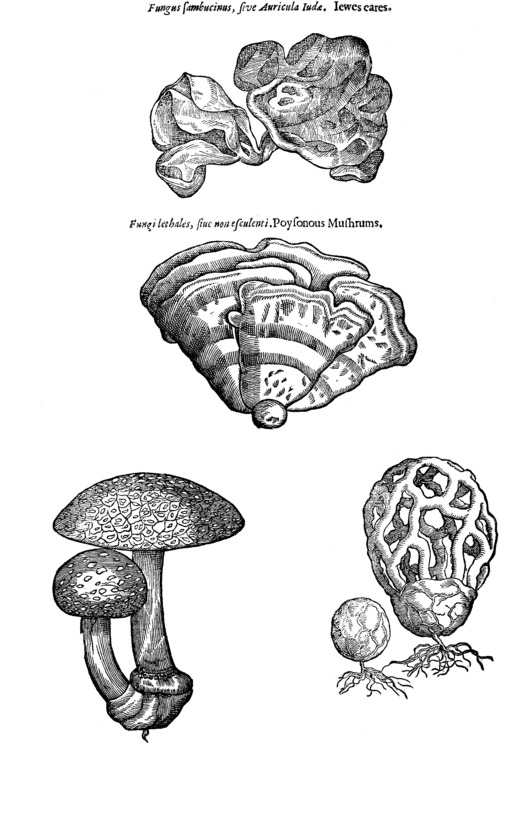
Fig. 2203. Poisonous Mushrooms
There is another kind of Mushrooms called Fungi parvi lethales galericulati: in English, deadly Mushrooms, which are fashioned like unto an hood, and are most venomous and full of poison.
There is a kind of Mushroom called Fungus clypeiformis lethalis, that is also a deadly Mushroom, fashioned like a little buckler.
There is another kind of Mushroom, which is also most venomous and full of poison, bearing also the shape of a buckler, being called Fungus venenatus clypeiformis: in English, the stinking venomous Mushroom.
The Mushrooms or Toodstools which grow upon the trunks or bodies of old trees, very much resembling Auricula Iudæ, that is Jew's ear, do in continuance of time grow unto the substance of wood, which the fullers do call touchwood, and are for the most half circled or half round, whose upper part is somewhat plain, and sometime a little hollow, but the lower part is plaited or pursed together. This kind of Mushroom is full of venom or poison as the former, especially those which grow upon the Ilex, Olive, and Oak trees.
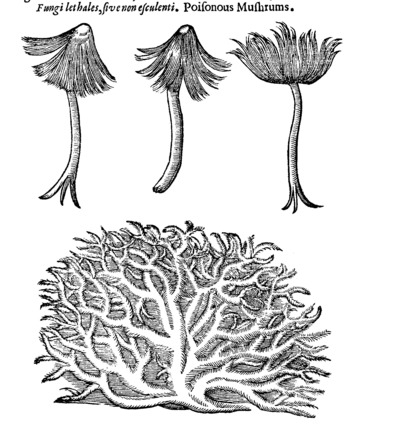
Fig. 2204. Poisonous Mushrooms
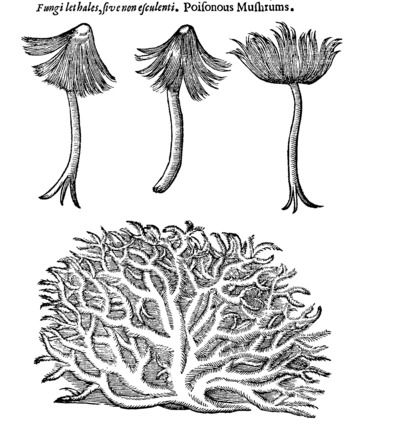
Fig. 2205. Honeycomb Mushroom, Prick Mushroom, and Puffball
There is likewise a kind of Mushroom called Fungus favaginosus, growing up in moist and shadowy woods, which is also venomous, having a thick and tuberous stalk, an handful high, of a duskish colour; the top whereof is compact of many small divisions, like unto the honeycomb.
There is also found another, set forth under the title Fungus virilis penis erecti forma, which we English, Prick Mushroom, taken from his form.
3. Fungus orbicularis, or Lupi crepitus, some do call it Lucernarum fungus: in English, Puffballs, Puck Fuss, and Bullfists, with which in some places of England they use to kill or smolder their bees, when they would drive the hives, and bereave the poor bees of their meat, houses, and lives: these are also used in some places where neighbours dwell far asunder, to carry and reserve fire from place to place, whereof it took the name, Lucernarum Fungus: in form they are very round, sticking and cleaving unto the ground, without any stalks or stems; at the first white, but afterward of a duskish colour, having no hole or breach in them, whereby a man may see into them, which being troden upon do breathe forth a most thin and fine powder, like unto smoke, very noisome and hurtful unto the eyes, causing a kind of blindness, which is called purblind, or sand-blind.
There is another kind of fungus, or Mushroom, which groweth in moist mesdows, and by ditch sides, five or six inches high, covered over with a skin like a piece of sheep's leather, of a russet colour; which being taken away there appeareth a long and white stump, in form not much unlike to an handle, mentioned in the title, or like unto the white and tender stalk of Aron, but greater this kind is also full of venom and poison.
There is likewise a kind of Mushroom, with a certain round excrescence, growing within the earth, under the upper crust or face of the same, in dry and gravelly grounds in Pannonia and the provinces adjoining, which do cause the ground to swel, and be full of hills like Mole-hills. The people where they grow, are constrained to dig them up and cast them abroad like as we do Mole-hills, spoiling their grounds, as Mole-hills are hurtful unto our soil: these have neither stalks, leaves, fibres nor strings annexed or fastened unto them, and for the most part are of a reddish colour, but within of a whitish yellow: the Grecians have called this tuberous excrescence, Idna, and the Latins Tubera: the Spaniards do call them Turmas de tierra: in English we may call them Spanish Puffballs.
The Place.
Mushrooms come up about the roots of trees, in grassy places of meadows, and lea land newly turned; in woods also where the ground is sandy, but yet dankish: they grow likewise out of wood, forth of the rotten bodies of trees, but they are unprofitable and nothing worth. Poisonsome Mushrooms, as Dioscorides saith, groweth where old rusty iron lieth or rotten clouts, or near to serpents' dens, or roots of trees that bring forth venomous fruit. Divers esteeme those for the best which grow in meadows, and upon mountains and hilly places, as Horace saith, Lib. Ser. 2. satyr. 4.
— pratensibus optima fungis
Natura est, aliis male creditur.
The Meadow Mushrooms are in kind the best.
It is ill trusting any of the rest.
Horace, Sermons II. 4. l. 20-21
The Time.
Divers come up in April, and last not till May, for they flourish but whilst April continues: others grow later, about August; yet all of them after rain; and therefore they are found one year sooner, and another later. Mushrooms, saith Pliny, grow in showers of rain: they come of the slime of trees, as the same author affirmeth.
The Names.
They are called in Latin; Fungi: in Italian, Fonghi: in Spanish, Hungos, Cugumenos: in French, Campinion, which word the Low-Country men also use, and call them Campernoellen: in High Dutch, Schwemme, Pfifferling: in English, Mushrooms, Toadstools, and Paddock-stools.
The Mushrooms that come up in April are called in Latin of some, Spongiolæ: of the Italians, Prignoli: and in High Dutch, Moschel.
They that are of a light red are called of some Boleti, among the later ones which rise and fall away in seven days. The white, or those which be somewhat yellow, are called in Latin, Suilli: which the later physicians name Porcini, or Swine Mushrooms. Suilli, saith Pliny, are dried, being hanged upon rushes, which are thrust through them. The dry ones are in our age also eaten in Bohemia and Austria: they that grow by the roots of Poplar trees are called of the Latins, Populnei, Poplar Mushrooms.
Puffs-fists are commonly called in Latin, Lupi crepitus, or Wolf's fists: in Italian, Vesci de Lupo: in English, Puff's-fists, Puffballs, and Fuss-balls in the North. Pliny nameth them Pezicæ, as though he should say, flat.
Tree Mushrooms be called in Latin, Fungi arborum, and Fungi arborei: in English, Tree Mushrooms, or Touchwood: in High Dutch also Schwemme. They are all thought to be poisonsome, being inwardly taken. Nicander writeth, that the Mushrooms of the Olive tree, the Ilex tree, and of the Oak tree bring death.
The Temperature and Virtues
A. Galen affirms, that they are all very cold and moist, and therefore do approch unto a venomous and murdering faculty, and engender a clammy, pituitous, and cold nutriment if they be eaten. To conclude, few of them are good to be eaten, and most of them do suffocate and strangle the eater. Therefore I give my advice unto those that love such strange and new fangled meats, to beware of licking honey among thorns, lest the sweetness of the one do not countervail the sharpness and pricking of the other.
B. Fuss-balls are no way eaten: the powder of them doth dry without biting: it is fitly applied to merry-galls, kibed heels, and such like.
C. In divers parts of England where people dwell far from neighbours, they carry them kindled with fire, which lasteth long: whereupon they were called Lucernarum Fungi.
D. The dust or powder hereof is very dangerous for the eyes, for it hath been often seen, that divers have been purblind ever after; when some small quantity thereof hath been blown into their eyes
E. The country people do use to kill or smother Bees with these Fuss-balls, being set on fire, for the which purpose it fitly serveth.
F. The fungous excrescence of the Elder, commonly called a Jew's Ear, is much used against the inflammations and all other sorenesses of the throat, being boiled in milk, steeped in beer, vinegar, or any other convenient liquor.