Poliphilus' Dream of Love
Poliphilus, after the discription of the huge pyramid and obelisk, discourseth of marvellous works in this chapter, namely of a horse of Colos, of an elephant, but especially of a most rare and strange porch.
 Rightly and lawfully may I have leave to write, that in the whole world there was never such another, so pompous, glorious, and magnificent a piece of work, by man's eyes seen or credibly reported. The wonderful excellency and rare strangeness whereof, as I beheld what with delight, and what with admiration, my senses were so captivated and tied thereunto, that no other solace or pleasure, did either occurr or take place in my swift flying thought.
But that when I applied my senses to consider, and addressed my eyes with diligent observation, curiously to overlook every particular part of this sweet composed object, and most rare and goodly imagery and virgin-like bodies, without crack or flaw, with a long-drawn breath, and somewhat opening my mouth, I set a deep sigh. In so much as my amorous and sounding breathing, by reason of the thickness of the air in this solitary and lone place, gave an echo and did put me in mind of my angelic and extreme desired Polia.
O hi me that so small or any intermission should cause that her lovely and celestial idea and shape was not still imprinted in my mind, and continued a daily companion, in whose breast my life is resolved to abide, and rest as under the protection of a most sure and approved shield and safe defence.
And by this way I was brought to a place where were divers and sundry excellent sorts of ancient devices and workmanships: first of all, I beheld a most fair porch, past all sense to describe (for the incredible curiousness thereof, as ever was built or devised) and the rather for that our mother tongue and vulgar speech, may not afford apt and peculiar words, for such a piece of artificial work.
Before this gorgeous and glorious porch, you shall understand that in the open air there was a four-square court of thirty paces by his diameter, paved with pure fine marble, pointed foot square, wrought chequerwise of divers fashions, and sundry best fitting colours: but in many places, by means of the ruin of the ancient walk, and old pillars, broken in pieces and overgrown.
And in the utmost parts of the aforesaid court, to the right hand, and the left, towards the mountains, there was two straight rows of pillars, with a space betwixt for the interject areostile, as the quantities of both columns required, the first course or order of setting the pillars beginning on both sides equal to the limbus or extreme part of the front of the porch, the space betwixt pillars and pillars xv. paces. Of which columns or great pillars, some and the greatest part or number were whole. With their capitals or heads, wrought with a waved shell work, and cyllery or drapery, their corners bearing out and inanulated or turned in like a curled lock of hair, or the upper head of a base vial above the pins, which strain the strings of the instrument to a musical concord; with their subject astragals, writhing and hanging here and there, making the capital thrice so big as the bottom thereof of the column, whereupon was placed the Epistyle or straight beam, the greatest part decayed and many columns widowed and deprived of their capitals, buried in ruin both astragals and shafts of the columns and their bases or feet.<62>
Fast joining to which order or set rows of pillars, there grew old plane trees, wild olives, pine apple, and pricking brambles. I conjectured that it was made for to ride horses in, to trot and gallop, the ring, to manage, curry, and curvet in, or else some open gallery, covered close over head, under-propped with pillars, and of a large wideness to walk dry in, and to take a temperate air in, not too subtle.

Illustration 6. A colossal and large-winged bronze horse, upon a pedestal, with charming little genii climbing upon its back or tumbling down from it.
Above in this great court paved as aforesaid, in the passage towards the porch, somme ten paces, I beheld a prodigious winged vaulting horse, of molten brass, of an exceeding bigness, his wings fanning out. His hooves standing upon a smooth plain base or frame, five foot broad, and nine feet in length, in height proportionable to the breadth and length: with his head at liberty and unbridled: having his two small ears, the one standing forward, and the other drawn back, with a long waved mane, falling from his crest on the contrary side; upon whose backs divers young youths assayed to ride, but not one was able to sit steadfast by reason of his swiftness and high bounding, from whom some were fallen down, lying wide open to the air, some grovelling, others falling headlong, betwixt the horse and the earth, the rest in vain holding by the hair of his mane, some forcing to get up upon him, and others endeavouring to recover themselves from under his feet.
Upon the upper part of the frame and base, there was infixed and fastened with lead, a footing or thick crust, of the same metal that the horse was, and upon the which he stood, and those that were overthrown did lie, somewhat shorter and narrower than the base or subject frame; the whole mass or composition cast of a piece and of the same metal, marvellously founded. Lastly you could not perceive that any were contented with his roughness, as appeared by their framed countenances, showing a discontent which they could not utter being senseless images, not differing otherways through the excellent cunning of the craftsman from living creatures, and by his surpassing imitation of nature.
Perillus there might go put up his pipes, and blush with his devised Bull, and Hiram the Jew must here give place, or what founders else soever.<63>
The pagma base or subject for this metaline machine to stand upon, was of one solid piece of marble (of fit and convenient breadth, heighth, and length, for that purpose accordingly proportioned) full of streaming veins, sundry coloured, and diversely spotted, marvellous pleasant to the eye, in infinite commixtures, confusedly disposed.
Upon the breast or foremost part, and end of the marble base, that was opposite against the porch, there was a garland of green marble, like the leaves of bitter Alexander, commixed with dead leaves of Maidenweed, of a hair colour, within the which there was a smooth round, pure, white stone, wherein was engraven these capital Roman letters.

Illustrations 7 and 8.—The two ends of the pedestal of the bronze horse; one decorated with a garland of marjoram and ferns, the other with a garland of orpine. The inscriptions are—DEIS AMBIGUIS DEDICATUS, and EQUUS INFELICITATIS. <64>
At the hinder end in like sort was a garland of deadly wolfwort, with this inscription, Equus Infelicitatis. And upon the right side there was engraven certain figures, shapes, and representments of men and women dancing together, biformed or faced, the foremost smiling, the hindmost weeping: and dancing in a ring, with their arms spread abroad, and handfasted, man with man and woman with woman. One arm of the man under that of the woman, and the other above, and thus closing together, and holding by the hands, they flung about one after another, that always still in one place, a smiling countenance encountered a foregoing sad. Their number was seven and seven, so perfectly and sweetly counterfeited with lively motions, their vestures whisking up and flying abroad, that the workman could not be accused of any imperfection, but that one had not a lively voice to express their mirth, and the other brinish tears to manifest their sorrow: the said dance was in fashion of two semicircles, with a separating partition put betwixt.<65>

Illustration 9.-One of the sides of the pedestal of the bronze horse, with a relief of two-faced youths and nymphs dancing. The front-faces of these dancers are supposed to be laughing, the back ones weeping.
Under which hemial figure, there was inscribed this word TEMPUS. On the contrary side I beheld many of green adolescenty of like proportion to the former, and in such like compass or space, the grounds of both beautified and set forth with an exquisite foliature or work of leaves and flowers, this company was plucking and gathereing of the flowers of sundry herbs and tender bushing stalks and branches: and with them divers fair nymphs pleasantly devising, and sportingly snatching away their gathered flowers, and in such sort as abovesaid under the figure were engraven certain capital letters, to show this one word AMISSIO,<66> containing the ninth part to the diameter of the quadrature.<67>

Illustration 10. The other side of the pedestal. A similar representation. A young man, in the costume of a Roman warrior, crownd with a wreath, distributes flowers among the young couples, which another youth is plucking for him.
At the first sight hereof I was amazed and astonished, but with better regard & great delight curiously reoverlooking the huge founded machine in the shape and form of a horse made by human industry and skill most commendable, for that every member without defect had his perfect harmony, and every limb his desired proportion, I straight called to remembrance the unfortunate horse of Seian.<68>
And thus held still to behold the same artificial mystery another spectacle and object no less worthy to be looked upon than the former, offered itself to my sight, which was a mighty elephant, whereunto with a desirous intent I speedily hied me to approach and come near.
In which meanwhile on another side I heard a mournful noise and human groaning, as proceeding from a sick body even unto death: whereat I stood still at the first, my hairs standing right up, but presently without further stay, I addressed my steps towards the place from whence I heard this woful noise and doleful lament, forcing myself up upon a heap of ruinated, broken and down-fallen marbles. Thus willingly going forward, I came to a vast and wonderful large colossus, the feet thereof bare, and their soles hollow, and the legs as if their flesh had been wasted, consumed and fallen way. From thence with horror I came to look upon the head, where I did conjecture and imagine that the air and wind getting in and coming forth of his wide open mouth and the hollow pipes of his throat, by a divine invention did cause this moderated noise and timid groans: it lay with the face upward all of molten metal, like a man of middle age, and his head lifted up as with a pillow, with a resemblance of one that were sick, breathing out at his mouth, sighs and groans gaping, his length was three score paces. By the hairs of his beard you might mount up to his breast, and by the rent and torn pieces of the same to his still lamenting mouth, which groaningly remained wide open and empty, by the which, provoked by the spur of curious desire, I went down by divers degrees into his throat, from thence to his stomach, and so forth by secret ways, and by little and little to all the several parts of his inward bowels, oh wonderful conceit. And every part of man's body having upon it written his proper appellation in three idioms, Chaldee, Greek and Latin, that you might know the entrails, sinews, bones, veins, muscles and the enclosed flesh, and what disease is bred there: the cause thereof, the cure and remedy. Unto which inglomerated and winding heap of bowels, there was a convenient coming unto and entrance in: with small loopholes and wickets in sundry places diversely disposed, yielding through them a sufficient light to behold the several parts of the artificial anatomy, not wanting any member that is found in a natural body.
When I came to the heart, I did see and read how love at his first entrance begetteth sorow, and in continuance sendeth out sighs, and where love doth most grievously offend: wherewithal I was moved to renew my passion, sending out from the bottom of my heart deep set and groaning sighs invocating and calling out upon Polia, in such sort as that the whole colossus and machine of brass did resound, striking me into a horrible fear: an exquisite art beyond all capacity, for a man to frame his like not being an anatomy indeed.
Oh the excellency of past wits, and perfect golden age, when Virtue did strive with Fortune, leaving only behind him for an heritage to this our world, blind, ignorant, and grudging desire of worldly pelf.
Upon the other side I perceived of like bigness to the former colossus, the upper part of a woman's head some deal bare, and the rest buried with the decayed ruins, as I thought, of such like workmanship as the other, and being forbidden by incomposite and disordered heaps of decayed and fallen down stones, to view the same, I returned to another former object, which was (and not far distant from the horse straight forward) a huge elephant of more black stone than the obsidian, powdered over with small spots of gold and glimpses of silver, as thick as dust glistering in the stone. The extreme hardness whereof the better did show his clear shining brightness, so as every proper object therein did represent itself, except in that part where the metal did bear a contrary colour. Upon his large back was set a saddle or furniture of brass, with two girths going under his large belly, betwixt the which two being straight buckled up with buckles of the same stone, there was interset a quadrangle corespondent to the breadth of the obelisk placed upon the saddle, and so justly set, as no perpendicular line would fall on either side the diameter. Upon three parts or sides of the four-square obelisk, were engraven Egyptian characters. The beast so exactly and cunningly proportioned, as invention could devise, and art perform. The aforesaid saddle and furniture set forth and beautified with studs, hanging jewels, stories and devices, and holding up as it were a mighty obelisk of green coloured stone of Lacedemonia, upon the even square, two paces broad, and seven in height, to the sharp point thereof, waxing smaller and smaller, upon which point there was fixed a trigon or round ball of a shining and glistering substance.

Illustration 12.-A colossal elephant of black stone, with gold and silver dots. Upon the back of this prodigious animal is placed an obelisk of verde-antique.<69>
This huge beast stood straight upon all fours, of an exquisite workmanship upon the plain level, and upper part of the base, hewn and cunningly fashioned, being of porphyry stone. With two large and long teeth, of pure white stone, and clear appact, and fastened. And to the fore girth on either side was buckled a rich and gorgeous poitrel beautified with divers ornaments and variety of jewels, the subject whereof was of the same substance of the saddle: upon the midst whereof was graven in Latin Cerebrum est in capite.<70> And in like manner brought about the outsides of his neck to the foretop of his large and big head, it was there fastened together with an artificial knot; from the which a curious ornament and very notable, of goldsmith's work, hung down, overspreading his spacious face: the same ornament being twice so long as broad, bordered about, in the table whereof I beheld certain letters Ionic and Arabic, in this sort.

Illustration 11. Saddle-cloth of the elephant, with inscription in Greek and Arabic, meaning—Labour and Industry.
His devouring trunk rested not upon the level of the base, but some deal hanging down, turned up again towards his face. His rigged large ears like a fox-hound slappingly pendent, whose vast stature was little less, than a very natural elephant. And in the about compass, and long sides of the base, were engraven certain hieroglyphs, or Egyptian characters, being decently and orderly polished, with a requisite rebatement, lataster, gula, torus, orbicle, astragals or neptrules, with a turned down cyma at the foot of the base, and turned up aloft with writhin trochils and denticles, agreeable and fit to the due proportion of so large a substance, in length 12 paces, in breadth five, and in height three, the superficial and outward part whereof was hewn in form of a hemicycle.
In the hinder part of which base and stone, whereupon this mighty beast did stand, I found an ascending place of seven steps, to mount up to the plain superficies of the base, whereupon the elephant did stand. And in the reserved quadrangle perpendicularly straight under the aforesaid brazen saddle, there was cut out and made a little door and hollowed entrance, a wonderful work in so hard a substance, with certain steps of brass, in manner of stairs, by the which a convenient going up into the body of the elephant was offered me.
At the sight whereof I extremely desired to see the whole device & so going in, I ascended up to the height of the base whereupon the cavernate, hollow, vast, large and predigious monster did stand, except that same part of the obelisk, which was contained within the void body of the beast, and so passing to the base, leaving towards both sides of the elephant so much space as might serve for any man to pass, either toward the head or hinder haunches.
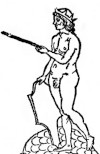
And within from the bending down of the chine or back of the beast, there hung by chains of copper an everlasting lamp, and incarcerate light, through the which in this hinder part I saw an ancient sepulchre of the same stone, with the perfect shape of a man naked, of all natural parts, having upon his head a crown of black stone as jet: his teeth eyes and nails silvered and standing upon a sepulchre covered like an ark, of scale work, and other exquisite lineaments, pointing with a golden sceptre, and holding forward his arm to give direction to the former part.
On his left side he held a shield in fashion like to the keel of a ship, or the bone of a horse head, whereupon was inscribed in Hebrew, Attic, and Latin letters, this sentence that is placed on the other side with the figure .
NUDUS ESSEM, BESTIANIME TEXISSET. QUAERE,ET INVENIES. ME SINITO.<71>

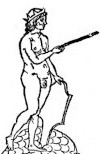
Illustrations 13 & 14. two sarcophagi, each with a cover decorated with scales, surmounted by the nude figure of a King and of a Queen
At which uncouth and strange sight I stood not a little amazed and somewhat doubtful what to imagine, turning my eyes to the contrary part, I saw in like sort another, as before burning light, and passing through betwixt the side of the beast, and the therein enclosed part of the obelisk, I came towards the forepart of the elephant, where in like manner I found such another fashioned sepulchre as the former, with a stature or image standing thereupon as the other, saving that it was a queen, who, lifting up her right arm with her foremost finger, pointed towards that part behind her shoulders, and with the other she held a little table fast in her hand, in which was written in three languages this epigram.
QUISQUIS ES, QUANTUNCUNQUE LIBUERIT THESAURI. SUME ADMONEO AUFER CAPUT, CORPUS NE TANGITO.<72>
This novelty worthy to be manifested, and secret riddle often to be read over, was not known to me, so as I rested doubtful what the interpretation of this sophism should signify, not daring to try the conclusion. But stricken with fear in this dark unlightsome place, notwithstanding the dim burning lamp, I was more desirous to behold and peruse that triumphant porch and gate as more lawful to remain there than otherwhere. Whereupon without more ado, I determined to leave this place until another time, that I might more quietly at leisure look upon the same, and to prepare myself to behold the wonderful work of the gate: and thus descending down I issued forth of the unbowelled monster, an invention past imagination, and an excessive labour and bold attempt to evacuate such a hard substance over that other stones be, the workmanship within as curious as that without. Lastly, returned clean down, I beheld in the porphyry last along the sides notably insculpt and graven these hieroglyphs.

Illustration 15. A cut representing so-called hieroglyphics; among these devices is a decorated casket of great elegance.
First, the horned scalp of an ox, with two tools of husbandry fastened to the horns.
An altar standing upon goat's feet, with a burning fire aloft, on the foreside whereof there was also an eye and a vulture.
After that a basin and an ewer.
A spindle full of twine
An old vessel fashioned with the mouth stopped and tied fast.
A sole and an eye in the ball thereof, and two branches traversed; one of olive, another of palm tree.
An anchor and a goose.
An old lamp, and a hand holding of it.
An ewer of ancient form with a fruitful olive branch fastened to the handle.
Two grappling irons or hooks.
A dolphin and an ark close shut.
These hieroglyphs were passing well cut on this manner. Which ancient maner of writing, as I take it, is thus to be understood.
EX LABORE DEO NATURAE SACRIFICA LIBERALITER PAULATIM REDUCES ANIMUM DEO SUBJECTUM. FIRMAM CUSTODIAM VITAE TUAE, MISERICORDITER GUBERNANDO TENEBIT, INCOLUMEMQUE SERVABIT.<73>
Letting pass this most excellent rare, strange, and secret device and work: Let us return again to the prodigious horse, whose head was lean and little, of a small proportion and yet fitting the body, which seemed continually staring, fierce and impatient, the flesh in his muscles trembling and quaking, in such sort as that he seemed rather alive than a feigned imitation, with this Greek word in his face ΓΕΝΕΑ: (Genea).<74> There were also other great pieces and fragments of divers and sundry lineaments among the broken and decayed ruins, which I looked not on, still running and sliding, time giving me only leave to consider and peruse these four rare wonders, the porch or gate, the horse, the colossus and the elephant.
Oh reverend artists of times past, what despite hath gotten the upper hand of your cunning that the same is buried with you, and none left for us to inherit in this age!
At length being come to this ancient porch, a work worthy the looking upon, marvellously composed by exquisite rules, and by art notably beautified, with divers and sundry sorts of cuttings, which did inflame a desire in me to understand and find out the lineaments and practice of the architect. I began after this manner, making a square from the two columns on either side in a perfect sort, in the which I took the due proportion of the whole porch.
A tetragon figure A.B.C.D divided by three lines straight, and three overthwart equally distant one from another will make sixeteen quadrates, then add to the figure half as much more in like proportion, dividing the adjunct you shall find four and twenty squares. This figure shall serve of cordicels to make the inlepturgy and brief demonstration that followeth.
Draw then in the first figure A.B.C.D. two diagonals, make also in the same two lines, one straight down, and the other overthwart, which make four quadrates mutually intersect.
Then in the void over the isopleures make four median pricks, drawing lines from one to another, and they will make the rhombus.
When I had drawn this figure after this manner I straightway mused with myself, what reason should move many of our workmen in these days either to think well of themselves, or take the art of building in hand, not knowing what it is? Making such gross faults in churches and great men's houses, defaming art, and so ignorant, that they seem as though they could not consider what nature herself doth teach us in beholding of her works.
And what part soever is not agreeable with his principle, is foul and naught. For take away order and rule, and what thing can any man make, either beautiful to the eye, or of commendable proportion and durable: then it must needs follow, that the cause of such inconvenient errors doth proceed from ignorance, and hath his beginning from illiterature. And this notwithstanding, that although the perfection of this art doth not vary, & fall from his rectitude, yet the discreet and cunning architect to grace the object, to the beholders: may lawfully either with adjection or diminution, beautify his work, keeping whole the solid part, with his universal composition.
I call that solid which is the body of the frame, which is the principal intent, invention, foresetting down, and symmetric, or due proportion of the building without any additions, rightly examined, and perfectly composed, which will manifest the skill of the workman, and the same afterwards to adorn and beautify, which adjuncts is an easy matter. Wherein is also to be considered, the due ordering and placing of every thing, and not to set a crown upon the feet, but upon the head, and so ovalling and denticulating, and other cuttings of sundry sorts in their several and best fitting places, the chief invention and disposing whereof, resteth in the rare and cunning architect, but the labour and working thereof to the vulgar and common sort of manualists and servants to the architect, who if he will do well, he must in no wise be subject to avarice.
And besides his skil he must be honest, no prattler full of words, but courteous, gentle, benign, tractable, patient, merry & pleasant, full of new devices, a curious searcher into all arts, and well advised in his proceeding, lest with rashness he commit a fault or absurdity in his work. And hereof thus much shall suffice.