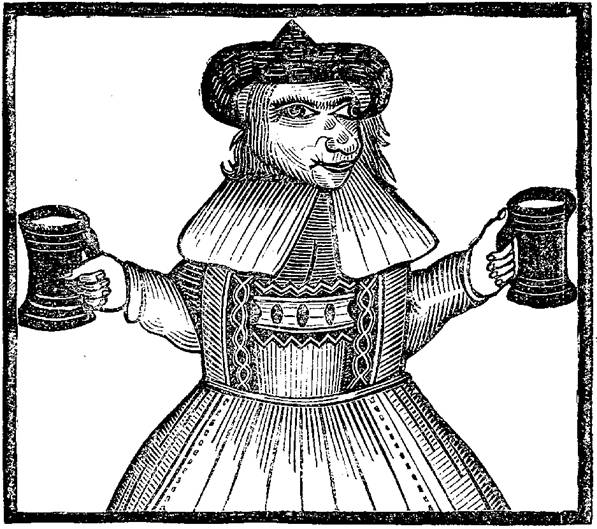
Illustration: Portrait of Elynour Rumming
"When Skelton wore the Laurel Crown,
My Ale put all the Ale-wives down."
George Steevens having heard that a copy of Rand's edition was in the Library of Lincoln Cathedral, prevailed on the Dean to bring it to London; and having made a drawing of the title-page, gave it to Richardson the print-seller, who engraved and published it. Steevens, soon after, contributed to the European Magazine for May, 1794, vol. xxv. 334,— "Verses meant to have been subjoined (with the following Motto) to a Copy from a scarce Portrait of Elynour Rumming, lately published by Mr. Richardson, of Castle-street,
Ne sit ancillae tibi amor pudori
Xanthia Phoceu! prius insolentem
Serva Briseis niveo colere
Movit Achillem.
Movit Ajacem Telamone natum
Forma captivm dominum Tecmessae;
Arsit Atrides medio in triumpho
Virgine rapta
HORACE.
("Phocian Xanthis, don’t be ashamed of love for your serving-girl. Once before, Briseis the Trojan slave with her snow-white skin aroused angry Achilles.
Captive Tecmessa’s loveliness troubled her master
"Eleonora Rediviva."
To seek this nymph among the glorious dead,
Tir'd with his search on earth, is Gulston fled:—
Still for these charms enamour'd Musgrave sighs;
To clasp these beauties ardent Bindley dies;—
For these (while yet unstag'd to public view)
Impatient Brand o'er half the kingdom flew;—
These, while their bright ideas round him play,
From classic Weston force the Roman lay:—
Oft too, my Storer! heaven has heard thee swear,
Not Gallia's murder'd Queen was half so fair:—
'A new Europa!' cries the exulting Bull,
'My Granger now (I thank the gods) is full:'
Even Cracherode's self, whom passions rarely move,
At this soft shrine has deign'd to whisper love.—
Haste then, ye swains, who Rumming's form adore,
Possess your Elynour, and sigh no more.
W. R."
The Marquis of Bute told Dallaway that he gave twenty guineas for the original engraving of Elynour: see Dallaway's Letheraeum, 1821, p. 6.
Skelton's Ghost.
To all tapsters and tiplers,
And all ale house vittlers,
Inn-keepers and cooks,
That for pot-sale looks,
And will not give measure,
But at your own pleasure,
Contrary to law,
Scant measure will draw
In pot and in can,
To cozen a man
Of his full quart a penny,
Of you there's too many:
For in King Harry's time,
When I made this rime
Of Elynour Rumming
With her good ale tunning,
Our pots were full quarted,
We were not thus thwarted
With froth-can and nick-pot
And such nimble quick shot,
That a dozen will score
For twelve pints and no more.
Full
We had in that age;
The Dutchman's strong beer
Was not hopped over here,
To us t'was unknown
Bare ale of our own
In a bowle we might bring
To welcome the king,
And his grace to beseech,
With, Wassall my Liege.
Nor did that time know
To puff and to blow
In a piece of white clay,
As you do at this day,
With fire and coal,
And a leaf in a hole;
As my ghost hath late seen,
As I walked between
Westminster Hall
And the church of Saint Paul,
And so through the city,
Where I saw and did pity
My countrymen's cases,
With fiery-smoke faces,
Sucking and drinking
A filthy weed stinking,
Was ne'er known before
Till the devil and the Moor
In th' Indies did meet,
And each other there greet
With a health they desire
Of stink, smoke, and fire.
But who e'er doth abhor it,
The city smokes for it;
Now full of fire-shops
And foul spitting chops,
So neesing and coughing,
That my ghost fell to scoffing,
And to myself said,
Here's filthy fumes made;
Good physick of force
To cure a sick horse.
Nor had we such slops,
And shag-hair on our tops:
At wearing long hair
King Harry would swear,
And gave a command
With speed out of hand
All heads should be polled,
As well young as old,
And his own was first so,
Good ensample to show.
Y'are so out of fashion,
I know not our nation;
Your ruffs and your bands,
And your cuffs at your hands,
Your pipes and your smokes,
And your short curtail cloaks;
Scarfs, feathers, and swords,
And thin bodkin beards;
Your waists a span long,
Your knees with points hung,
Like morris-dance bells;
And many toys else,
Which much I distaste:
But Skelton's in haste.
My masters, farewell;
Read over my Nell,
And tell what you think
Of her and her drink:
If she had brewed amiss,
I had never wrote this.
At the end of the poem is, from the same hand,
Skelton's Ghost to the Reader.
Thus, countrymen kind,
I pray let me find,
For this merry glee,
No hard censure to be.
King Henry the Eight
Had a good conceit
Of my merry value,
Though duncical plain
It now nothing fits
The time's nimble wits:
My laurel and I
Are both withered dry,
And you flourish green
In your work's daily scene,
That come from the press,
Well writ I confess;
But time will devour
Your poets as our,
And make them as dull
As my empty skull.
I give these. lines from the Harl. Miscel., the copy of
Concerning Elynour Rumming and the poem by which Skelton has rendered her famous, Dallaway has the following remarks,–his account of the circumstances which introduced Skelton to her acquaintance being a mere hypothesis!! "When the Court of Henry viii was frequently kept at the palace of Nonsuch (about six miles distant), the laureate, with other courtiers, sometimes came to Leatherhead for the amusement of fishing, in the river Mole; and were made welcome at the cabaret of Elynour Rumming, whom Skelton celebrated in an equivocal encomium, in a short [?—it consists of 623 lines—] poem, remarkable only for a very coarse jest, after a manner peculiar to the author and the times in which he lived, but which has been more frequently reprinted than his other works. The gist or point of this satire had a noble origin, or there must be an extraordinary coincidence of thought in the Beoni, or Topers, a ludicrous effusion of the great Lorenzo de Medici, when a young man. [*Note: Dallaway was led to this remark by the following passage in Spence's Anecdotes, &c.; "Skelton's poems are all low and bad: there's nothing in them that's worth reading.– P. [Mr. Cleland, who was by, added, that the Tunning of Elynour Rumming, in that author's works, was taken from a poem of Lorenzo de' Medici's]." p. 173, ed. 1820.—"I Beoni," observes Mr. D'Israeli, referring to Roscoe's Life of Lorenzo de' Medici, i. 290, "was printed by the Giunti in 1568, and therefore this burlesque piece could never have been known to Skelton." Amen. of Lit. ii. 79. ]
Her domicile, near the bridge, still exists. The annexed etching was made from a drawing taken previously to late repairs, but it still retains its first distinction as an ale-house."
[Illustration: Elynour Rumming's Ale-house]

"Some of her descendants occur in the parish register in the early part of the last century." Letheraeum, 1821, pp. 4-6.
"An ye will a while be still,
I shall tell you how they wrought."
p. 74. Bann. ed
and the Prol. to King Alisaunder;
"If ye willen sit still,
Full fele I will you tell."
Weber's Met. Rom. i. 5.
6. goundy] i.e. sore running eyes. So Lydgate;
"A goundy eye is deceived soon,
That any colour chooseth by the moon."
Wars of Troy, B. ii. sig. H iii. ed. 1555.
7. With simper-the-cocket] So Heywood in his Dialogue;
"Upright as a candle standeth in a socket,
Stood she that day, so simper decocket."
Sig. F,—Works, ed. 1598.
and Jonson in his Masque, The Gipsies Metamorphosed;
"Lay by your wimbles,
Your boring for thimbles,
Or using your nimbles,
In diving the pockets,
And sounding the sockets
Of simper-the-cockets."
Works (by Gifford), vii. 376.
In a note on the latter passage, Whalley quotes from Cotgrave's Dict.: "Coquine, a beggar-woman, also a cockney, simper de cocket, nice thing." Gifford (ibid.) remarks, "Cocket was a fine species of bread, as distinguished from common bread; hence, perhaps, the name was given to an overstrained affectation of delicacy. To simper at, or over, a thing, is to touch it as in scorn." Nares (Gloss. in v. ) doubts (justly, I think) the connexion of simper-the-cocket with cocket bread, and explains it, "quasi simpering coquette," observing,that "one of Cotgrave's words in rendering 'coquette' is cocket." I may add, that in Gloss. of Prov. and Loc. Words by Grose and Pegge, ed. 1839, is, "Cocket, brisk, apish, pert," and "Simper, to mince one's words." ["An affected mealy-mouthed girl." Cotgrave. "A simper-de-cocket, coquine, fantastica. Howell, 1660. Halliwell.]
"My cloak it was a very good cloak,
It hath been always true to the wear,
But now it is not worth a groat;
I have had it four and forty year."
Take thy old cloak about thee,—Percy's Rel. of A. E. P. i. 206. ed. 1794.
9. Her kirtle Bristow red]—Bristow i.e.
"
Barclay's Fourth Egloge, sig. C iiii. ed. 1570.
"At Bristow is the best water to dye red."
Hormanni Vulgaria, sig. V ii. ed. 1530.
that the Ghost
"stole from piteous Abraham
Ane whorl and ane whim-wham."
—Laing's An. Pop. Poetry of
Whim-wham is used by Gray, Works, iii. 123. ed. Mitford, and by Lamb, Prose Works, ii. 142.
"And a hundred trim-trams mo."
Sig. B iiii. ed. Copland.
12. Capped about] Lant's ed. "Lapped"–rightly, perhaps.
14. She dwelt in
15. tunnish gyb] The epithet tunnish is perhaps derived from her occupation of tunning (see note 2 above), or perhaps it may allude to her shape: gib is properly a male cat (see note 7 to Philip Sparrow); but the term, as here, is sometimes applied to a woman;
"And give a thousand by-words to my name,
And call me Beldam, Gib, Witch, Night-mare, Trot."
Drayton's Epistle from Elinor Cobham to Duke Humphrey,—Poems, p. 175. ed. 1619. fol.
"For we can neither swink nor sweat"
Piers Plowman, sig. I ii. ed. 1561.
18. Now away the mare] Skelton has the same expression in his Magnificence, v. 1342. Compare The Friar and the Boy;
"Of no man he had no care,
But sung, hey how, away the mare."
Ritson's An. Pop. Poetry, p. 37.
and Jyl of Braintford's Testament, n. d.;
"Ah sirrah, marry, away the mare,
The devil give thee sorrow and care."
sig. B ii.
and A new Comedy &c. of the beauty & good properties of women, &c. n. d.
"Tush, sir, be merry, let pass away the mare."
Sig. A ii.
The words are doubtless a portion of some song or ballad. In Ravenscroft's Melismata, Musical Fancies, &c. 1611, is a song (No. 6) supposed to be sung by "Servants out of Service" who "are going to the City to look for new;"
"Heigh ho, away the Mare,
Let us set aside all care,
If any man be disposed to try,
Lo here comes a lusty crew,
That are enforced to cry
A new Master, a new,"
19. With, Fill the cup, fill] So in The High Way to the Spital House, by Copland, n. d.;
"With, Fill the pot, fill, and go fill me the can."
Utterson's Early Pop. Poet. ii. 15.
20. It wigs and it wags] Qy. "that . . . that"?
"[Envy] was as pale as a pellet; in the palsy he seemed
And clothed in Caurymaury," &c.
sig. F ii. ed. 1561.
22. tegs] A term found again in our author's first poem Against Garnesche;
"Your windy shaking shanks, your long loathy legs
Brings you out of favour with all female tegs."
v. 29.
In what sense Skelton uses teg, I cannot pretend to determine. In Warwickshire and Leicestershire, a teg means a sheep of a year old; and Ray gives, "A Tagge, a Sheep of the first Year, Suss." Coll. Of Words, &c., p. 88, appended to Proverbs, ed. 1768. [Palsgrave (p. 279) applies the term to a young deer: "teg, a pricket saillant;" properly the doe in its second year. Halliwell.] [Ex-classics editor's note: OED gives a fleece of a year-old sheep as one sense of the word, which seems most likely here]
23. Like rotten eggs] Lydgate in a satirical description of a lady has
"Coloured like a rotten eey [i.e. egg]."
MS. Harl. 2255. fol. 156.
24. Him that me bought] i.e. Jesus Christ.
"For, be there never so great press,
They are set up at the high dais."
Harl. Miscell. ix. 51.
[To go to the high dais seems here to mean only to take the best place].
26. God give it ill preving
Cleanly as evil chieving]—preving, i.e. proving; cleanly, i.e. wholly
"And preachest on thy bench, with evil preve; "(i.e. evil may it prove!)
Chaucer's Wife of
– evil chieving, i.e. evil ending, bad success.
"God give it evil chieving."
See also Cock Lorelles boat, sig. B i., Towneley Myst. p. 108, and Chaucer's Canon's Yeoman's Tale, v. 16693. ed. Tyr.
27. patch] I know not how to explain.
28. In lust and in liking] See note 6 to Divers Ballads and Ditties Solacious.
"Though I be the last that take my leave,
Yet fair mulling take it not at no grieve."
MS. Cott. Vesp. D viii. fol. 91.
Compare also Hormanni Vulgaria: "This is a fair and sweet mulling. Blandus est puerulus insigni festivitate." Sig. dd vii. ed. 1530.
Miting—Eds. of King and
"Hail, so as I can, hail, pretty miting!"
p. 96.
and Jamieson gives miting as a fondling designation for a child, Et. Dict. of Scot. Lang.—In our author's third poem Against Garnesche, "miting"—(but used as a term of contempt)—is, here, the rhyme to "witing."
Since writing the above note, I have met with a passage in the comedy called Wily Beguiled which might be adduced in support of the reading, "niting;" but I still think that "miting" is the true one: the dramatist evidently recollected Skelton's poem, in the ed. of which he had found "nytyng," "nittinge," or "nittine:"—"Comely Peg, my nutting, my sweeting, my love, my dove, my honey, my bonnie, my duck, my dear and my darling." Sig. C 4. ed. 1606.
31. His nobs and his coney] coney, i.e. rabbit. So in a song in The Trial of Treasure, 1567;
"My mouse, my nobs, and coney sweet." Sig. E..
32. Thus make I my fellow fonny] fonny i.e. to be foolishly amorous; compare—
"As freshly then thou shalt begin to fonne
And dote in love."
Chaucer's Court of Love,—Works, fol. 329. ed. 1602.
33. Instead of coin and money &c.] In Skelton's Works, 1736, the passage is given thus
"Some instead of coin and money
Will come and bring her a coney
Or else a pot with honey
Some a knife and some a spoon
Some bring their hose, some their shoon.
34. slaty or slither] i.e. miry or slippery.
36. She sweared by the rood of rest]—rood, i.e. cross: see note 10 to Ware the Hawk.
"That is hardly said, man, by the rood of rest."
Barclay's First Egloge, sig. A iii. ed. 1570.
37. To offer to the ale tap] So in Jack Hare, a poem attributed to Lydgate;
"And with his winnings he maketh his offering
At the ale stakes."
MS. Harl. 2251. fol. 14.
38. And pipe Tirly Tirlow] Compare a Song belonging to the Tailors' and Shearmen's Pageant;
"They sang terly terlow."
Sharp's Diss. on
"A great company of gossips, gathered on a rout,
Went to besiege an ale house round about;
Some brought a distaff & some a reel,
Some brought a shovel & some a pail,
Some brought drink & some a tankard,
And a gallon pot fast they drew thitherward," &c.
Though no edition of Elynour Rumming has come down to us printed anterior to Christ Cross me Speed, the evident imitation of the former in the passage just quoted, shows that it must have existed.
41. But drink, still drink,
And let the cat wink] So in The World and the Child, 1522;
"Manhood. Now let us drink at this comnaunt,
For that is courtesy.
Folly. Marry, master, ye shall have in haste
A ha, sirs, let the cat wink," &c.
Sig. C ii.
See also three epigrams by Heywood Of the Winking Cat,—Works, sig. P 4. ed. 1598.
"Bulwarks were made in all the haste."
Hormanni Vulgaria, sig. z iii. ed. 1530.
"the right way
To London they took in all the haste."
Smith's XII Merry Jests of the Widow Edith, ed. 1573. sig. H iiii.
43. I swear by all hallow] i.e. by all the saints.
"And if my skill not fails me, her I'll make
A Stale, to take this Courtier in a brake."
Act ii. sc. 1. sig. D 3.
Compare too an epigram by Heywood;
"Take time when time cometh: are we set time to take ?
Beware time, in mean time, take not us in brake."
Works, sig. Q 3. ed. 1598.
and Cavendish's Life of Wolsey; "At last, as ye have heard here before, how divers of the great estates and lords of the council lay in a-wait with my Lady Anne Boleyn, to espy a convenient time and occasion to take the cardinal in a brake." p. 147. ed. 1827.—In our text, and in the passages just quoted, brake seems to be used for trap: among its various significations, it means a strong wooden frame for confining the feet of horses, preparatory to their being shod; see Gifford's note on Jonson's Works, iii. 463.
45. Angry as a waspy] So Heywood;
"Now merry as a cricket, and by and by,
Angry as a wasp."
Dialogue, sig. C 4,-Works, ed. 1598.
46. go bet] apparently an old hunting cry, "go better," i.e. faster. Compare;
"Arundel, quoth Bevis tho,
For my love go bet, go."
Sir Bevis of
"Go bet, quod he, and ask readily,
What corps is this," &c.
Chaucer's Pardoner's Tale, v. 12601. ed. Tyrwhitt,—
who observes that in the following lines of Chaucer's Legend of Dido (288), go bet seems to be a term of the chase;
"The herd of harts founden is anon,
With hey, go bet, prick thou, let gone, let gone."
"He hath made me dance, maugre my head,
Among the thorns, hey go bet."
The Friar and the Boy,—An. Pop. Poetry,p. 46. ed. Ritson,—
who supposes the words to be the name of some old dance.
"She let no fart nor yet fiest truly."
The Pastime of pleasure, sig. Q viii. ed. 1555.
"A fiest, Tacitus flatus."
Withals's Dict. p. 343. ed. 1634.
"At saint Cornelius, at saint James in Gales,
And at saint Winifred's well in Wales," &c.
Sig. A ii. ed. n. d.
52. Snivelling in her nose,
As though she had the pose] pose—i.e a head cold. So Chaucer;
"he speaketh in his nose,
And sneezeth fast, and eke he hath the pose."
The Manciple's Prol. v. 17010. ed. Tyr.
See also The Reeve's Tale, v. 4149.
53. new ale in corns] i.e. ale just drawn off the malt. So in Thersytes, n. d.;
"I will make thee drink worse than good ale in the corns."
p. 56. Rox. ed.
"New ale in corns. Cervisia cum recrementis"
Baret's Alvearie, in v. Ale.
54. donny]
55. Margery Milkduck] So again in our author's Magnificence;
"What, Margery Milk Duck, marmoset!"
v. 462.
Compare one of the Coventry Mysteries;
"Malkin Milkduck and fair Mabel."
MS. Cott. Vesp. D viii. fol. 74.
56. Her kirtle she did uptuck
An inch above her knee] So in our old ballad poetry;
"Then you must cut your gown of green,
An inch above your knee."
Child Waters,—Percy's Rel. of A. E. P. iii. 56. ed. 1794.
61. sheer shaking nought] i.e. sheer worthless. So again our author in his Magnificence;
"From qui fuit aliquid to sheer shaking nought."
62. an old ribibe] Chaucer, in The Friar's Tale, says,
"This Sompnour, waiting ever on his prey,
Rode forth to summon a widow, an old ribibe."
v. 6958. ed. Tyrwhitt,—
who says he cannot guess how this musical instrument came to be put for an old woman, "unless perhaps from its shrillness." The word so applied occurs also in Jonson's Devil is an Ass, act i. sc. 1, where Gifford observes, "Ribibe, together with its synonym rebeck, is merely a cant expression for an old woman. A ribibe, the reader knows, is a rude kind of fiddle, and the allusion is probably to the inharmonious nature of its sounds." Works, v. 8.
64. on God's half] i.e. for God's sake: half, i.e. behalf, like halben in German.
66. bullyfant] A mock derivation from bull, in imitation of elephant.
67. The line which rhymes with the previous one has dropped out
68. A straw, said Belle, stand utter]—stand utter, i.e. stand more out, back.
"Straw, quod the third, ye ben lewd and nice."
Chaucer's Canon's Yeoman's Tale, v. 16393. ed. Tyr.
Stand utter, fellow! where doest thou thy courtesy preve?"
The World and the Child, 1522. sig. B iv.
"That counterfeits and paints
As they were very saints."
v. 922.
71. a lege de moy] So again in our author's Colyn Cloute;
"And how Parys of
Danced a lege de moy,
Made lusty sport and joy
With dame Helen the queen."
v. 952.
I have not found elsewhere the term lege de moy. Mace, in his Musick's Monument, 1676, mentions a Tattle de Moy,—"a New Fashion'd Thing, much like a Seraband; only It has more of Conceit in It, as (in a manner) speaking the word (Tattle de Moy)," &c. p. 129.
72. ill hail] i.e. ill health,—ill luck,—a common imprecation in our old poetry;
"Ill hail, Alein, by God thou is a fonne."
Chaucer's Reeve's Tale, v. 4087. ed. Tyr.
See too Chester Mysteries (De Del. Noe), p. 27. Roxb. ed.
75. Bien m'en souvient.] "I remember it well."