Gerard's Herbal - Part 3
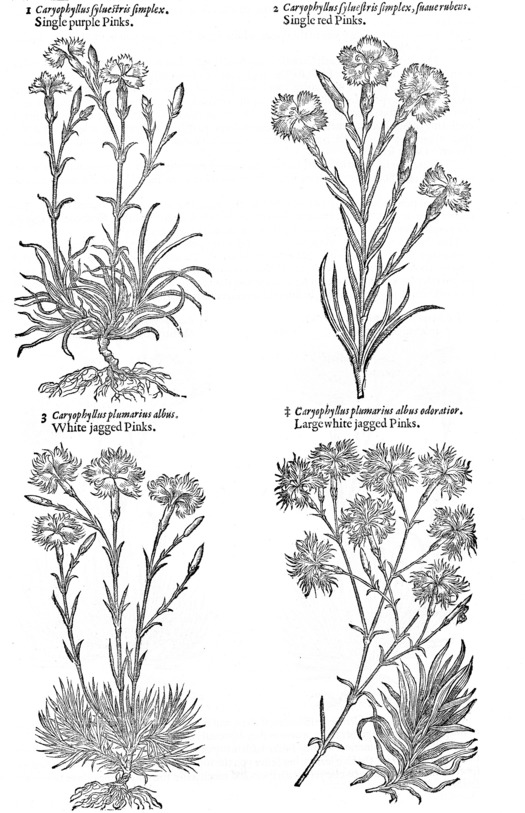
Fig. 883. Kinds of Pink (1-3)
The Description.
1. The double purple Pink hath many grassy leaves set upon small jointed stalks by couples, one opposite against another, whereupon do grow pleasant double purple flowers of a most fragrant smell, not inferior to the Clove-Gillyflower. The root is small and woody. There is also a single one of this kind, whose figure I here give you.
2. The single red Pink hath likewise many small grassy leaves lesser than the former. The flowers grow at the top of the small stalks single, and of a sweet bright red colour.
3. The white jagged Pink hath a tough woody root: from which rise immediately many grassy leaves, set upon a small stalk full of joints or knees, at every joint two, one against another even to the top; whereupon do grow fair double purple flowers of a sweet and spicy smell, consisting of five leaves, sometimes more, cut or deeply jagged on the edges, resembling a feather: whereupon I gave it the name Plumarius, or feathered Pink. The seed is soft, blackish, and like unto Onion seed. There is another variety of this, with the leaves somewhat larger and greener than the last mentioned: the flowers also are somewhat bigger, more cut in or divided, and of a much sweeter smell.
|
|
|
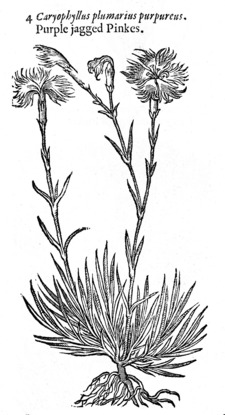
| Fig. 884. Purple Jagged Pink (4) |
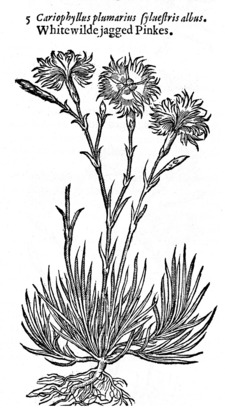
Fig. 885. Wild White Jagged Pink (5) |
4. This purple coloured Pink is very like the precedent in stalks, roots, and leaves. The flowers grow at the top of the branches lesser than the last described, and not so deeply jagged, of a purple colour tending to blueness, wherein consisteth the difference.
There be divers sorts of Pinks more, whereof to write particularly were to small purpose, considering they are all well known to the most, if not to all. Therefore these few shall serve at this time for those that we do keep in our gardens: notwithstanding I think it convenient to place these wilder sorts in this same chapter, considering their nature and virtues do agree, and few or none of them be used in physic, besides their nearness in kindred and neighbourhood.
5. This wild jagged Pink hath leaves, stalks, and flowers like unto the white jagged Pink of the garden, but altogether lesser, wherein they especially differ.
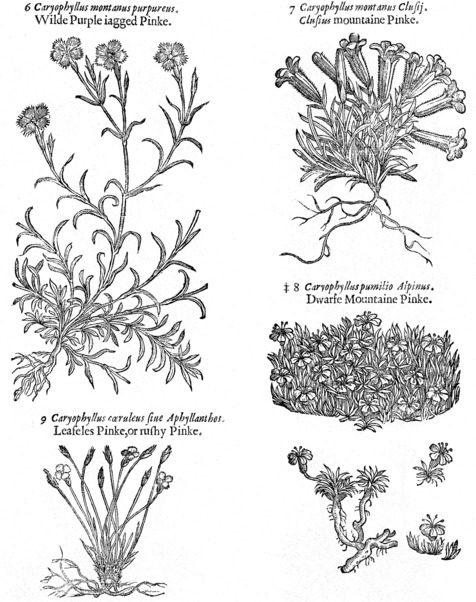
Fig. 886. Kinds of Pink (6-9)
6. The purple mountain or wild Pink hath many small grassy leaves: among which rise up slender stalks set with the like leaves, but lesser; on the top whereof do grow small purple flowers, spotted finely with white or else yellowish spots, and much lesser than any of the others before described.
7. The mountain Pink of Clusius his description hath many leaves growing into a tuft like unto those of Thrift, and of a bitter taste: amongst which rise up small slender footstalks, rather than stalks or stems themselves of the height of two inches; whereupon do grow such leaves as those that were next the ground; but lesser, set by couples one opposite to another: at the top of each small footstalk doth stand one red flower without smell, consisting of five little leaves set in a rough hairy husk or hose five-cornered, of a greenish colour tending to purple. The root is tough and thick, casting abroad many shoots, whereby it greatly increaseth.
8. This for his stature may justly take the next place; for the stalk is some inch high, set with little sharp pointed green grassy leaves: the flowers which grow upon these stalks are composed of five little flesh-coloured leaves a little divided in their upper parts: the seed is contained in black shining heads, and it is small and reddish, and shaped somewhat like the fashion of a kidney, whereby it comes nearer to the Lychnides, than to the Caryophylli or Pinks. The root is long, black, and much spreading, whereby this little plant covers the ground a good space together like as a moss, and makes a curious show when the flowers are blown. It grows naturally on divers places of the Alps. Gesner called it Muscus floridus: Pona, Ocimoides Muscosus: and Clusius, Caryophyllus pumilo alpinus 9.
9. This leafless Pink (as the Greek word doth seem to import) hath many small rushy or benty leaves rising immediately from a tough rushy root: among which rise up stalks like unto rushes, of a span high, without any joint at all, but smooth and plain; on the top whereof groweth a small flower of a bluish or sky colour, consisting of four little leaves somewhat jagged in the edges, not unlike those of wild flax. The whole plant is very bitter, and of a hot taste.
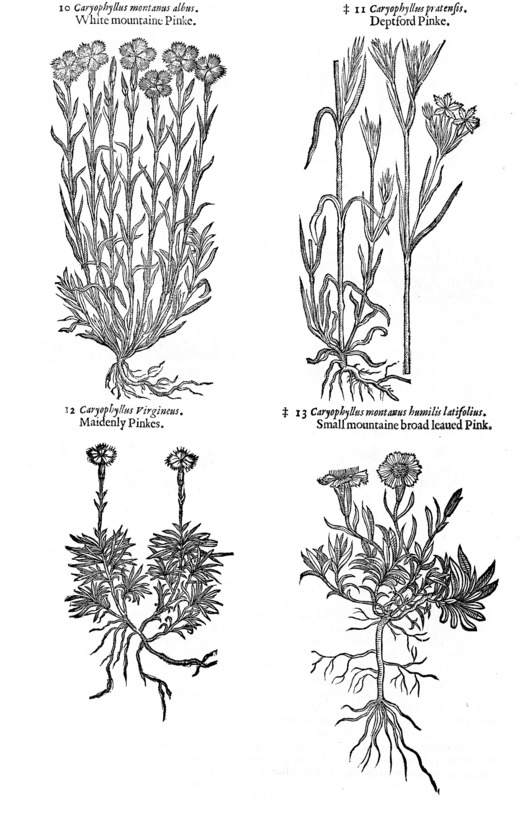
Fig. 887. Kinds of Pink (10-13)
10. The White Mountain Pink hath a great thick and woody root; from the which immediately rise up very many small and narrow leaves, finer and lesser than grass, not unlike to the smallest rush: among which rise up little tender stalks, jointed or kneed by certain distances, set with the like leaves even to the top by couples, one opposite against another: at the top whereof grow pretty sweet smelling flowers composed of five little white leaves. The seed is small and blackish.
11. There is a wild creeping Pink which groweth in our pastures near about London, and in other places, but especially in the great field next to Deptford, by the path side as you go from Redriffe to Greenwich; which hath many small tender leaves shorter than any of the other wild Pinks, set upon little tender stalks which lie flat upon the ground, taking hold of the same in sundry places, whereby it greatly increaseth; whereupon grow little reddish flowers. The root is small, tough, and long lasting.
12. This hath tender stalks some span high, set with two long narrow hard sharp pointed leaves at each joint. The flowers (which grow commonly but one on a stalk) consist of five little snipped leaves of a light purple colour, rough, and deeper coloured about their middles, with two little crooked threads or horns: the seed is chaffy and black: the root long, and creeping: it flowers in April and May, and is the Flos caryophylleus sylvestris 1 of Clusius.
13. Clusius mentions also another whose stalks are come three inches high: the leaves broader, softer, and greener than than the former: the flowers also that grow upon the top of the stalks are larger than the former, and also consist of fine leaves of a deeper purple than the former, with longer hairs finely intermixed with purple and white.
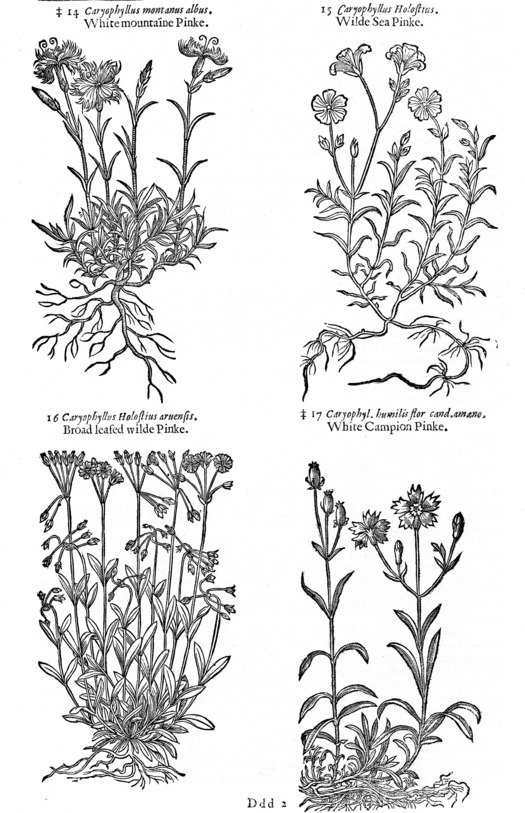
Fig. 888. Kinds of Pink (14-17)
14. This from a hard woody root, sends up such stalks as the former; which are set at the joints with short narrower and dark green leaves: the flowers are white, sweet-smelling, consisting of five much divided leaves, having two threads or horns in their middle. It flowers in May, and it is the Caryophyllus sylvestris quintus of Clusius.
15. This wild sea Pink hath divers small tender weak branches trailing upon the ground, whereupon are set leaves like those of our smallest garden Pink, but of an old hoary colour tending to whiteness, as are most of the sea plants. The flowers grow at the top of the stalks in shape like those of Stitchwort, and of a whitish colour. Neither the seeds nor seed-vessels have I as yet observed: the root is tough and single.
16. There is another of these wild Pinks which is found growing in ploughed fields, yet in such as are near unto the sea: it hath very many leaves spread upon the ground of fresh green colour; amongst which rise up tender stalks of the height of a foot, set with the like leaves by couples at certain distances. The flowers grow at the top many together, in manner of the Sweet-William, of a white, or sometimes a light red colour. The root is small, tough, and long lasting. This is a kind of Gramen leucanthemum, or Holasteum ruellii, described in the 38th chapter of the first book.
17. Chlsius makes this a Lychnis: and Lobel (whom I here follow) a Pink, calling it Caryophyllus minimus humilis alter exoticus flore candido amœno. This from creeping roots sendeth up every year many branches some handful and better high, set with two long narrow green leaves at each joint: the flowers which grow on the tops of the branches are of a pleasing white colour, composed of five jagged leaves without smell. After the flowers are gone there succeed round blunt pointed vessels, containing a small blackish flat seed like to that of the other Pinks. This hath a viscous or clammy juice like as that of the Muscipulas or Catch-flies. Clusius makes this his Lychnis sylvestris decima.
The Place.
These kinds of Pinks do grow for the most part in gardens, and likewise many other sorts, the which were over long to write of particularly. Those that be wild do grow upon mountains, stony rocks, and desert places. The rest are specified in their descriptions.
The Time.
They flower with the Clove-Gillyflower, and often after.
The Names.
The Pink is called of Pliny and Turner, Cantabrica and Stactice: of Fuchsius and Dodonæus, Vetonica altera, and Vetonica altilis: of Lobelius and Fuchsius, Superba: in French, Gyrofflees, Oeilletz, and Violettes herbes: in Italian, Garofoli, and Garoni: in Spanish, Clavis: in English, Pinks, and Small Honesties.
The Temperature.
The temperature of the Pinks is referred unto the Clove-Gillyflowers.
The Virtues.
A. These are not used in physic, but esteemed for their use in garlands and nosegays. They are good to be put into vinegar, to give it a pleasant taste and gallant colour, as Ruellius writeth. Fuchsius saith, that the roots are commended against the infection of the plague and that the juice thereof is profitable to waste away the stone, and to drive it forth: and likewise to cure them that have the falling sickness.