Gerard's Herbal - Part 3
|
|
|
| Fig. 889. White Saint Johns (1) |
Fig. 890. Double White and Red Saint Johns (2) |
The Description.
1. Sweet Johns have round stalks as have the Gillyflowers, (whereof they are a kind) a cubit high, whereupon do grow long leaves broader than those of the Gillyflower, of a green grassy colour: the flowers grow at the top of the stalks, very like unto Pinks, of a perfect white colour.
2. The second differeth not from the other but in that, that this plant hath red flowers, and the other white.
We have in our London gardens a kind hereof bearing most fine and pleasant white flowers, spotted very confusedly with reddish spots, wnich setteth forth the beauty thereof; and hath been taken of some (but not rightly) to be the plant called of the later writers Superba austriaca, or the Pride of Austria. It is now commonly in most places called London-Pride.
We have likewise of the same kind bringing forth most double flowers, and these either very white, or else of a deep purple colour.
|
|
|
| Fig. 891. Broad-Leaved Sweet-William (3) |
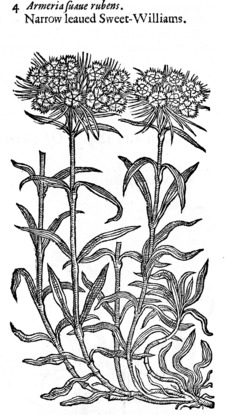
Fig. 892. Narrow-Leaved Sweet-William (4) |
3. The great Sweet-William hath round jointed stalks thick and fat, somewhat reddish about the lower joints, a cubit high, with long broad and ribbed leaves like as those of the Plantain, of a green grassy colour. The flowers at the top of the stalks are very like to the small Pinks, many joined together in one tuft or spoky umbel, of a deep red colour: the root is thick and woody.
4. The Narrow-Leaved Sweet-William groweth up to the height of two cubits, very well resembling the former, but lesser, and the leaves narrower: the flowers are of a bright red colour, with many small sharp pointed grassy leaves standing up amongst them, wherein especially consisteth the difference.
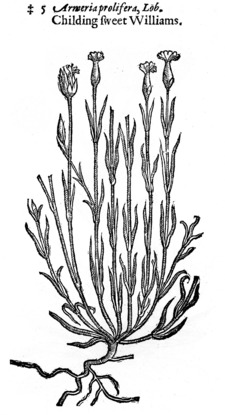
Fig. 893. Childing Sweet-William (5)
5. This little fruitful Pink hath a small whitish woody root, which sends forth little stalks some handful and better high; and these at each joint are set with two thin narrow little leaves: at the top of each of these stalks grows a single skinny smooth shining husk, out of which (as in other Pinks) grows not one only flower, but many, one still coming out as another withers; so that oft times out of one head come seven, eight, or nine flowers one after another, which as they fade leave behind them a little pod containing small black flattish seed. The flower is of a light red, and very small, standing with the head somewhat far out of the hose or husk.
The Place.
These plants are kept and maintained in gardens more for to please the eye, than either the nose or belly.
The Time.
They flourish and bring forth their flowers in April and May, somewhat before the Gillyflowers, and after bear their flowers the whole summer.
The Names.
The Sweet John, and also the Sweet-William are both comprehended under one title, that is to say, Armeria: of some, superba, and Caryophyllus sylvestris: of some herbarists, Veronica agrestis, or sylvestris: of some, Herba tunica: but it doth no more agree herewith than the Clove-Gillyflower doth with Veronica altera, or Polemonium. In Frehch, Armoires: hereupon Ruellius nameth them Armerii Flores: in Dutch, Keykens: as though you should say, a bundle or cluster, for in their vulgar tongue bundles of flowers or nosegays they call keykens: doubtless they are wild kinds of Gillyflowers: In English the first two are called Sweet Johns; and the two next, Sweet-Williams, Tolmeiners, and London Tufts.
The Temperature and Virtues.
These plants are not used either in meat or medicine, but esteemed for their beauty to deck up gardens, the bosoms of the beautiful, garlands and crowns for pleasure.