Gerard's Herbal - Part 3
|
|
|
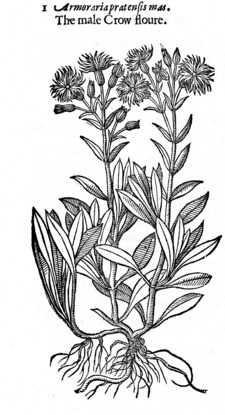
| Fig. 894. Male Crow-Flower (1) |
Fig. 895. Double Crow-Flower (3) |
The Description.
1. Besides these kinds of Pinks before described, there is a certain other kind, either of the Gillyflowers or else of the Sweet-Williams, altogether and everywhere wild, which of some hath been inserted amongst the wild Campions; of others taken to be the true Flos cuculi. NotwithstandingI am not of any of their minds, but do hold it for neither: but rather a degenerate kind of wild Gillyflower. The Cuckoo flower I have comprehended under the title of Sisimbrium: Englished, Ladies' Smocks; which plant hath been generally taken for Flos cuculi. It hath stalks of a span or a foot high, whereupon the leaves do stand by couples out of every joint; they are small and bluntly pointed, very rough and hairy. The flowers are placed on the tops of the stalks, many in one tuft, finely and curiously snipped in the edges, lesser than those of Gillyflowers, very well resembling the Sweet-William (whereof no doubt it is a kind) of a light red or scarlet colour.
2. This female Crow-Flower differeth not from the male, saving that this plant is lesser, and the flowers more finely jagged like the feathered Pink, whereof it is a kind.
3. Of these Crow-Flowers we have in our gardens one that doth not differ from the former of the field, saving that the plant of the garden hath many fair red double flowers, and those of the field single.
The Place.
These grow all about in meadows and pastures, and dankish places.
The Time.
They begin to flower in May, and end in June.
The Names.
The Crow-Flower is called in Latin Armoraria sylvestris, and Armoracia: of some, Flos cuculi, but not properly; is also called Tunix: of some, Armeria, Armerius flos primus of Dodonæus, and likewise Caryophillus minor sylvestris foliis latioribus: in Dutch, Craeynbloemkens: that is to say, Cornicis flores: in French, Cuydrelles: ln English, Crow-flowers, Wild Williams, Marsh Gillyflowers, and Cuckoo Gillyflowers,
The Temperatures and Virtues.
These are not used either in medicine or in nourishment: but they serve for garlands & crowns, and to deck up gardens.