Gerard's Herbal Vol. 5
The Kinds.
The ancient herbarists have set down four kinds of Cherry trees, the first is great and wild, the second tame or of the garden: the third, whose fruit is sour: the fourth is that which is called in Latin Chamæcerasus, or the dwarf Cherry tree. The later writers have sound divers sorts more, some bringing forth great fruit, others lesser; some with white fruit, some with black, others of the colour of black blood, varying infinitely according to the climate and country where they grow.
The Description
1. The English Cherry tree groweth to an high and great tree, the body whereof is of a mean bigness, which is parted above into very many boughs, with a bark somewhat smooth, and of a brown crimson colour, tough and pliable: the substance or timber is also brown in the middle, and the outward part is somewhat white. The leaves be great, broad, long, set with veins or nerves, and slightly nicked about the edges: the flowers are white, of a mean bigness, consisting of five leaves, and having certain threads in the middle, of the like colour: the cherries be round, hanging upon long stems or footstalks, with a stone in the midst which is covered with a pulp or soft meat; the kernel thereof is not unpleasant to the taste, though somewhat bitter.
2. The Flanders Cherry tree differeth not from our English Cherry tree in stature or form of leaves or flowers; the difference consisteth in this, that this tree bringeth forth his fruit sooner, and greater than the other: wherefore it may be called in Latin, Cerasus precox, sive belgica.
3. The Spanish Cherry tree groweth up to the height of our common Cherry tree: the wood or timber is soft and loose, covered with a whitish scaly bark: the branches are knotty, greater, fuller of substance than any other Cherry tree: the leaves are likewise greater and longer than any of the rest, in shape like those of the Chestnut tree: the flowers are like the others in form, but whiter of colour: the fruit is greater and longer than any, white for the most part all over, except those that stand in the hottest place where the sun hath some reflection against a wall: they are also white within, and of a pleasant taste.
4. The Gascon Cherry tree groweth very like to the Spanish Cherry tree in stature, flowers, and leaves: it differeth in that it bringeth forth very great cherries, long, sharp pointed, with a certain hollowness upon one side, and spotted here and there with certain prickles of purple colour as small as sand: the taste is most pleasant, and excelleth in beauty.
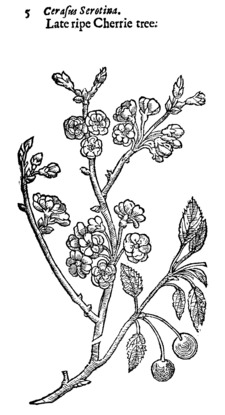
5. The Late-Ripe Cherry tree groweth up like unto our wild English Cherry tree, with the like leaves, branches, and flowers, saving that they are sometimes once doubled: the fruit is small, round, and of a dark bloody colour when they be ripe, which the Frenchmen gather with their stalks, and hang them up in their houses in bunches or handfuls against winter, which the physicians do give unto their patients in hot and burning fevers, being first steeped in a little warm water, that causeth them to swell and plump up as full and fresh as when they did grow upon the tree.
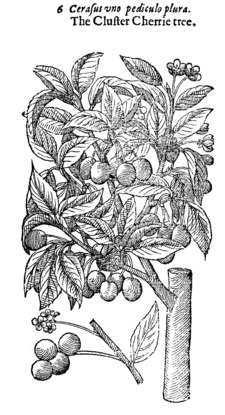
6. The Cluster Cherry tree differeth not from the last described either in leaves, branches, or stature: the flowers are also like, but never cometh any one of them to be double. The fruit is round, red when they be ripe, and many growing upon one stem or footstalk in clusters, like as grapes do. The taste is not unpleasant, although somewhat sour.

Fig. 2101. Kinds of Cherry (7-10)
7. This Cherry tree with double flowers grows up unto a small tree, not unlike to the common Cherry tree in each respect, saving that the flowers are somewhat doubled, that is to say, three or four times double; after which cometh fruit (though in small quantity) like the other common Cherry.
8. The Double-Flowered Cherry tree grows up like unto an hedge bush, but not so great nor high as any of the others; the leaves and branches differ not from the rest of the Cherry trees. The flowers hereof are exceeding double, as are the flowers of Marigolds, but of a white colour, and smelling somewhat like the Hawthorn flowers; after which come seldom or never any fruit, although some authors have said that it beareth sometimes fruit, which myself have not at any time seen; notwithstanding the tree hath grown in my garden many years, and that in an excellent good place by a brick wall, where it hath the reflection of the South sun, fit for a tree that is not willing to bear fruit in our cold climate.
9. The Bird Cherry tree, or the Black Cherry tree, that bringeth forth very much fruit upon one branch (which better may be understood, by sight of the figure, than by words) springeth up like an hedge tree of small stature, it groweth in the wild woods of Kent, and are there used for stocks to graft other Cherries upon, of better taste, and more profit, as especially those called the Flanders Cherries: this wild tree grows very plentifully in the North of England, especially at a place called Heggdale, neer unto Rosgill in Westmorland, and in divers other places about Crosby Ravenswaithe, and there called Hegberry tree: it groweth likewise in Martome Park, four miles from Blackburn, and in Harward near thereunto; in Lancashire almost in every hedge: the leaves and branches differ not from those of the wild Cherry tree: the flowers grow alongst the small branches, consisting of five small white leaves, with some greenish and yellow thrums in the middle: after which come the fruit, green at the first, black when they be ripe, and of the bigness of sloes; of an harsh and unpleasant taste.
10. The other Bird Cherry tree differeth not from the former in any respect, but in the colour of the berries; for as they are black; so on the contrary, these are red when they be ripe, wherein they differ.
11. The common Black Cherry tree grows up in some places to a great stature: there is no difference between it and our common Cherry tree, saving that the fruit hereof is very little in respect of other Cherries, and of a black colour.
12. The dwarf Cherry tree grows very seldom to the height of three cubits: the trunk or body small, covered with a dark coloured black: whereupon do grow very limber and pliant twiggy branches: the leaves are very small, not much unlike to those of the Privet bush: the flowers are small and white: after which come cherries of a deep red colour when they be ripe, of taste somewhat sharp, but not greatly unpleasant: the branches laid down in the earth, quickly take root, whereby it is greatly increased.
Myself with divers others have sundry other sorts in our gardens, one called the Hart Cherry, the greater and the lesser one of a great bigness, and most pleasant in taste, which we call Luke Ward's Cherry, because he was the first that brought the same out of Italy; another we have called the Naples Cherry, because it was first brought into these parts from Naples: the fruit is very great, sharp pointed, somewhat like a man's heart in shape, of a pleasant taste, and of a deep blackish colour when it is ripe as it were of the colour of dried blood.
We have another that bringeth forth cherries also very great, bigger than any Flanders cherry, of the colour of jet, or burnished horn, and of a most pleasant taste, as witnesseth Mr Bull, the Queen's Majesty's Clockmaker, who did taste of the fruit (the tree bearing only one Cherry, which he did eat; but myself never tasted of it) at the impression hereof. We have also another, called the Agriot Cherry, of a reasonable good taste. Another we have with fruit of a dun colour, tending to a watchet. We have one of the dwarf Cherries, that bringeth forth fruit as great as most of our Flanders Cherries, whereas the common sort hath very small cherries, and those of an harsh taste. These and many sorts more we have in our London gardens, whereof to write particularly would greatly enlarge our volume, and to small purpose: therefore what hath been said shall suffice. I must here (as I have formerly done, in pears, apples and other such fruits) refer you to my two friends Mr John Parkinson, and Mr John Millen, the one to furnish you with the history, and the other with the things themselves, if you desire them.
The Time.
The Cherry trees bloom in April; some bring forth their fruit sooner; some later: the red cherries be always better than the black of their own kind.
The Names.
The Cherry tree is called in Greek, Kerasos: and also in Latin, Cerasus: in High Dutch, Kirschenbaum: in Low Dutch, Kersemboome, and Crieckenboom: in French, Cerisier: in English, Cherry tree.
The fruit or cherries be called in Greek Kerasa: and in Latin likewise, Cerasa; in English, cherries: the Latin and English names in their several titles shall suffice for the rest that might be said.
The Temperature and Virtues.
A. The best and principal cherries be those that are somewhat sour: those little sweet ones which be wild and soonest ripe be the worst: they contain bad juice, they very soon putrefy, and do engender ill blood, by reason whereof they do not only breed worms in the belly, but troublesome agues, and often pestilent fevers: and therefore in well governed commonwealths it is carefully provided, that they should not be sold in the markets in the plague time.
B. Spanish cherries are like to these in faculties, but they do not so soon putrefy: they be likewise cold, and the juice they make is not good.
C. The Flanders or Kentish cherries that are thorough ripe, have a better juice, but watery, cold and moist: they quench thirst, they are good for an hot stomach, and profitable for those that have the ague: they easily descend and make the body soluble: they nourish nothing at all.
D. The late ripe cherries which the Frenchmen keep dried against winter, and are by them called Morelle, and we after the same name call them Morell cherries, are dry, and do somewhat bind; these being dried are pleasant to the taste, and wholesome for the stomach, like as prunes be, and do stop the belly.
E. Generally all the kinds of cherries are cold and moist of temperature, although some more cold and moist than others: the which being eaten before meat do soften the belly very gently, they are unwholesome either unto moist and rheumatic bodies, or for unhealthy and cold stomachs.
F. The common black cherries do strengthen the stomach, and are wholesomer than the red cherries, the which being dried do stop the lask.
G. The distilled water of cherries is good for those that are troubled with heat and inflammations in their stomachs, and prevaileth against the falling sickness given mixed with wine.
H. Many excellent Tarts and other pleasant meats are made with cherries, sugar, and other delicate spices, whereof to write were to small purpose.
I. The gum of the Cherry tree taken with wine and water, is reported to help the stone; it may do good by making the passages slippery, and by tempering & allaying the sharpness of the humours; and in this manner it is a remedy also for an old cough. Dioscorides addeth, that it maketh one well coloured, cleareth the sight, and causeth a good appetite to meat.