Gerard's Herbal Vol. 5
The Description.
1. The common Mulbery tree is high, and full of boughs: the body whereof is many times great, the bark rugged; & that of the root yellow: the leaves are broad and sharp pointed, something hard, and nicked on the edges; instead of flowers, are blowings or catkins, which are downy: the fruit is long, made up of a number of little grains, like unto a blackberry, but thicker, longer, and much greater, at the first green, and when it is ripe black, yet is the juice (whereof it is full) red: the root is parted many ways.
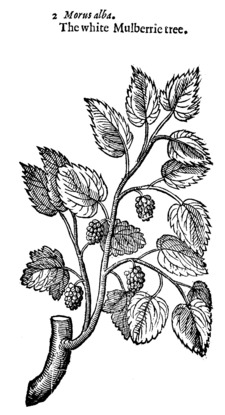
2. The White Mulberry tree groweth until it be come unto a great and goodly stature, almost as big as the former: the leaves are rounder, not so sharp pointed, nor so deeply snipped about the edges, yet sometimes sinuated or deeply cut in on the sides, the fruit is like the former, but that it is white and somewhat more tasting like wine.
The Place.
The Mulberry trees grow plentifully in Italy and other hot regions, where they do maintain great woods and groves of them, that their silkworms may feed thereon. The Mulberry tree is fitly set by the slip; it may also be grafted or inoculated into many trees, being grafted in a white Poplar, it bringeth forth white Mulberies, as Berytius in his Geoponics reporteth. These grow in sundry gardens in England.
The Time.
Of all the trees in the orchard the Mulberry doth last bloom, and not before the cold weather is gone in May (therefore the old writers were wont to call it the wisest tree) at which time the silkworms do seem to revive, as having then wherewith to feed and nourish themselves, which all the winter before do lie like small grains or seeds, or rather like the dunging of a flesh fly upon a glass, or some such thing, as knowing their proper time both to perform their duties for which they were created, and also when they may have wherewith to maintain and preserve their own bodies unto their business aforesaid.
The berries are ripe in August and September. Hegesander in Athenæus affirmeth, that the Mulbery trees in his time did not bring forth fruit in twenty years together, and that so great a plague of the gout then reigned and raged so generally, as not only men, but boys, wenches, eunuchs, and women were troubled with that disease.
The Names
This tree is named in Greek Moria, and in Latin, Morus: in shops, Morus Celsi: in high Dutch, Maulberbaum: in Low Dutch, Moerbesseboom: in French, Meurier: in English, Mulberry tree.
The fruit is called in Greek Moron: and in Latin, Morum: in shops, Morum Celsi: in High Dutch, Moerbesie: in Italian, Moro: in French, Meure: in Spanish, Moro and Mores: in English, Mulberry.
The Temperature and Virtues.
A. Mulberries being gathered before they be ripe, are cold and dry almost in the third degree, and do mightily bind; being dried they are good for the lask and bloody flux, the powder is used in meat, and is drunk with wine and water
B. They stay bleedings, and also the reds; they are good against inflammations or hot swellings of the mouth and jaws, and for other inflammations newly beginning.
C. The ripe and new gathered Mulberries are likewise cold and be full of juice, which hath the taste of wine, and is something drying, and not without a binding quality: and therefore it is also mixed with medicines for the mouth, and such as help the hot swellings of the mouth, and almonds of the throat; for which infirmities it is singular good.
D. Of the juice of the ripe berries is made a confection with sugar, called Diamorum: that is, after the manner of a syrup, which is exceeding good for the ulcers and hot swellings of the tongue, throat, and almonds, or uvula of the throat, or any other malady arising in those parts.
E. These Mulberries taken in meat, and also before meat, do very speedily pass through the belly, by reason of the moisture and slipperiness of their substance, and make a passage for other meats, as Galen saith.
F. They are good to quench thirst, they stir up an appetite to meat, they are not hurtful to the stomach, but they nourish the body very little, being taken in the second place, or after meat, for although they be less hurtful than other like fruits, yet are they corrupted and putrefied, unless they speedily descend.
G. The bark of the root is bitter, hot and dry, and hath a scouring faculty: the decotion hereof doth open the stoppings of the liver and spleen, it purgeth the belly, and driveth forth worms.
H. The same bark being steeped in vinegar helpeth the toothache: of the same effect is also the decoction of the leaves and bark, saith Dioscorides, who showeth that about harvest time there issueth out of the root a juice, which the next day after is found to be hard, and that the same is very good against the toothache; that it wasteth away Phyma, and purgeth the belly.
I. Galen saith, that there is in the leaves and first buds of this tree a certain middle faculty, both to bind and scour.