Gerard's Herbal Vol. 5
The Description.
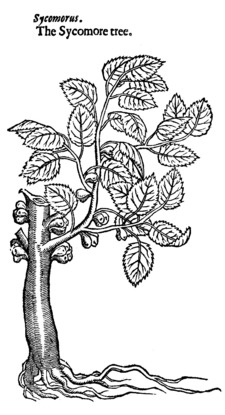
The Sycomore tree is of no small height, being very like to the Mulbery tree in bigness & show, as also in leaf: the fruit is as great as a fig, and of the same fashion, very like in juice and taste to the wild fig, but sweeter, and without any grains or seeds within, which groweth not forth of the tender boughs, but out of the body and great old arms very fruitfully: this tree hath in it plenty of milky juice, which so soon as any part is broken or cut, doth issue forth.
The Place.
It growth, as Dioscorides writeth, very plentifully in Caria and Rhodes, and in sundry places of Egypt, as at the great Cairo or Alkaire, and in places that do not bring forth much wheat, in which it is an help, and sufficeth instead of bread & corn when there is scarcity of victuals. Galen writeth, that he saw a plant of the Sycomore tree like to the wild Fig tree, fruit and all.
The Time.
It bringeth forth fruit three or four times in one year, and oftener if it be scraped with an iron knife, or other like instrument.
The Names
This tree is called in Greek Sykomoros, of the Fig tree and the Mulbery tree: in Latin, Sycomorus: Cornelius Celsus nameth it backward Morosycos: the Egyptians of our time do call it Ficus pharaonis, or Pharaoh his Fig tree, as witnesseth Bellonius: and it is likewise termed Ficus ægyptia, Egyptian Fig tree, and also Morus ægyptia, or Egyptian Mulberry tree. We call it in English, Sycomore tree after the Greek and Latin, and also Mulberry Fig Tree, which is the right Sycomore tree, and not the great Maple, as we have said in the chapter of the Maple.
The fruit is named in Greek Sycomoron, and in Italian, Sycomoro and Fico d'Egitto.
The Temperature and Virtues.
A. The fruit of the Sycomore tree hath no sharpness in it at all, as Galen saith. It is somewhat sweet in taste, and is of temperature moist after a sort, and cold as be Mulberries.
B. It is good, saith Dioscorides, for the belly; but it is arophos, that is, without any nourishment, and troublesome to the stomach.
C. There issueth forth of the bark of this tree in the beginning of the spring, before the fruit appeareth, a liquor, which being taken up with a sponge, or a little wool, is dried, made up into fine cakes, and kept in gallipots: this mollifieth, closeth wounds together, and dissolveth gross humours.
D. It is both inwardly taken and outwardly applied against the bitings of serpents, hardness of the milt or spleen, and pain of the stomach proceeding of a cold cause: this liquor doth very quickly putrefy.