Gerard's Herbal Vol. 5
The Description.
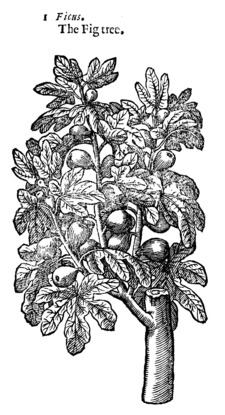
1. The garden Fig tree becometh a tree of a mean stature, having many branches full of white pith within, like Elder pith, and large leaves of a dark green colour, divided into sundry sections or divisions. The fruit cometh out of the branches without any flower at all that ever I could perceive, which fruit is in shape like unto Pears, of colour either whitish, or somewhat red or of a deep blue, full of small grains within, of a sweet and pleasant taste; which being broken before it be ripe, doth yield most white milk, like unto the kinds of Spurge, and the leaves also being broken do yield the like liquor; but when the figs be ripe, the juice thereof is like honey.
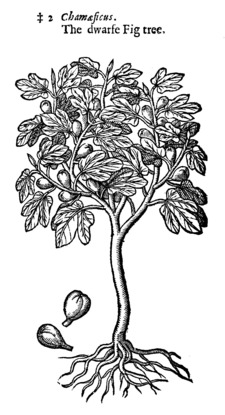
2. The Dwarf Fig tree is like unto the former in leaves and fruit, but it never groweth above the height of a man, and hath many small shoots coming from the roots, whereby it greatly increaseth.
There is also another wild kind, whose fruit is never ripe; Theophrastus nameth it Erineos; Pliny Caprificus.
The Place.
The Fig trees do grow plentifully in Spain and Italy, and many other countries, as in England; where they bear fruit, but it never cometh to kindly maturity, except the tree be planted under an hot wall, whereto neither North, nor Northeast winds can come.
The Time.
The Dwarf Fig tree groweth in my garden, and bringeth forth ripe and very great fruit in the month of August, of which figs sundry persons have eaten at pleasure.
In England the Fig trees put not forth their leaves until the end of May, where oftentimes the fruit cometh forth before the leaves appear.
The Names
The Fig tree is called in Greek, Sykos, and of divers, for difference sake between it and the wild Fig tree, Sykos emeros: in Latin, Ficus, and Ficus sativa, and urbana: in High Dutch, Feygenbaum: in Low Dutch, Vijgheboom: in French, Figuier: in Italian, Feco: in Spanish, Higuera: in English, Fig tree
The fruit is named in Greek, Sykon: in Latin, Ficus: and the unripe fruit Grossus: that which is dried is called in Latin, Carica: in High Dutch, Feygen: in Low Dutch, Vijghen: in French, Figues: in Italian, Fiche: in Spanish, Higos: in English, Fig: the little seeds which are found in them are named by Galen Cechramides.
The Temperature.
The green figs new gathered are somewhat warm and moist: the dry and ripe figs are hot almost in the third degree, and withal sharp and biting.
The leaves also have some sharpness, with an opening power, but not so strong as the juice.
The Virtues.
A. The dry figs do nourish better than the green or new figs; notwithstanding they engender not very good blood, for such people as do feed much thereon do become lousy.
B. Figs be good for the throat and lungs, they mitigate the cough, and are good for them that be short winded: they ripen phlegm, causing the same to be easily spat out, especially when they be sodden with Hyssop, and the decoction drunk.
C. Figs stamped with salt, Rue, and the kernels of nuts withstand all poison and corruption of the air. The King of Pontus, called Mithridates, used this preservative against all venom and poison.
D. Figs stamped and made into the form of a plaster with wheat meal, the powder of Fenugreek, and linseed, and the roots of Marsh Mallows, applied warm, do soften and ripen impostumes, phlegmons, all hot and angry swellings and tumors behind the ears: and if you add thereto the roots of Lilies, it ripeneth and breaketh venereous impostumes that come in the flank, which impostume is called Bubo, by reason of his lurking in such secret places: in plain English terms they are called botches.
E. Figs boiled in Wormwood wine with some barley meal are very good to be applied as an emplaster upon the bellies of such as have the dropsy.
F. Dry figs have power to soften, consume, and make thin, and may be used both outwardly and inwardly, whether it be to ripen or soften impostumes, or to scatter, dissolve, and consume them.
G. The leaves of the Fig tree do waste and consume the King's Evil, or swelling kernels in the throat, and do mollify, waste, and consume all other tumours, being finely pounded and laid thereon: but after my practise, being boiled with the roots of marsh Mallows until they be soft, and so incorporated together, and applied in form of a plaster.
H. The milky juice either of the figs or leaves is good against all roughness of the skin, lepries, spreading sores, tetters, smallpox, measles, pushes, wheals, freckles, lentils, and all other spots, scurviness, and deformity of the body and face, being mixed with barley meal and applied: it doth also take away warts and such like excrescences, if it be mingled with some fatty or greasy thing.
I. The milk doth also cure the toothache, if a little lint or cotton be wet therein, and put into the hollowness of the tooth.
K. It openeth the veins of the hemorrhoids, and looseneth the belly, being applied to the fundament.
L. Figs stamped with the powder of Fenugreek, and vinegar, and applied plasterwise, do ease the intolerable pain of the hot gout, especially the gout of the feet.
M. The milk thereof put into the wound proceeding of the biting of a mad dog, or any other venomous beast, preserveth the parts adjoining, taketh away the pain presently, and cureth the hurt.
N. The green and ripe figs are good for those that be troubled with the stone of the kidneys, for they make the conduits slippery, and open them, and do also somewhat cleanse: whereupon after the eating of the same, it happeneth that much gravel and sand is conveyed forth.
O. Dry or barrel figs, called in Latin Caricæ, are a remedy for the belly, the cough, and for old infirmities of the chest and lungs: they scour the kidneys, and cleanse forth the sand, they mitigate the pain of the bladder, and cause women with child to have the easier deliverance, if they feed thereof for certain days together before their time.
P. Dioscorides saith, that the white liquor of the Fig tree, and juice of the leaves, do curdle milk as rennet doth, and dissolve the milk that is cluttered in the stomach, as doth vinegar.
Q. It bringeth down the menses, if it be applied with the yolk of an egg, or with yellow wax.