Camden's Britannia
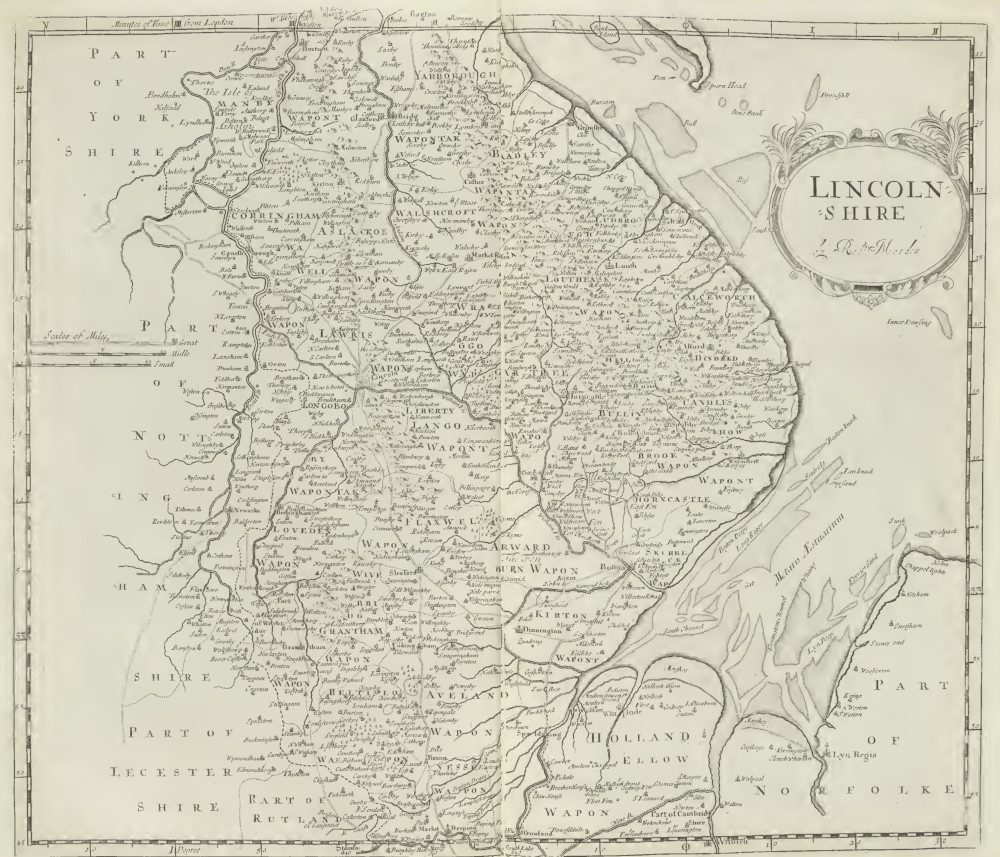
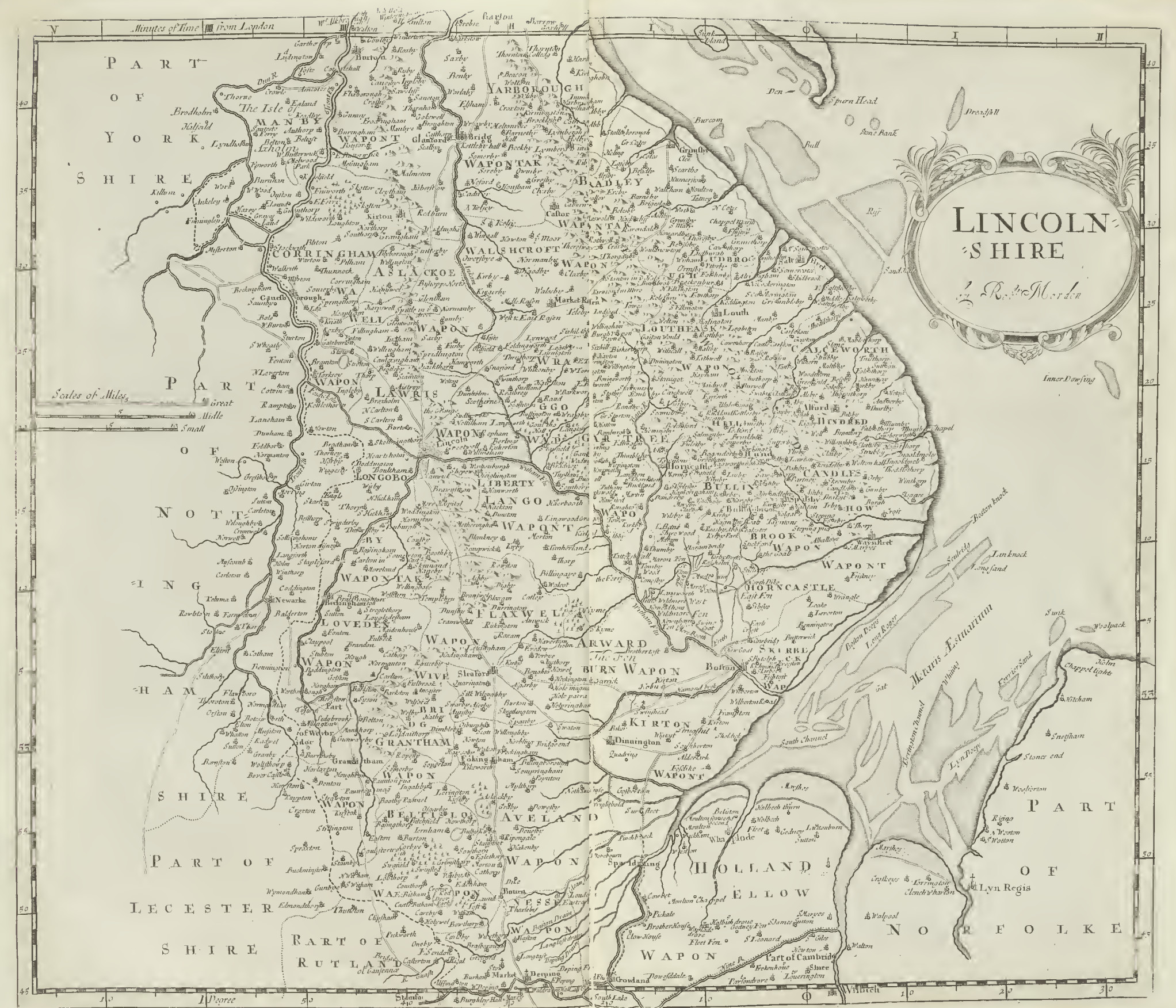
Illustration: Lincolnshire
(Click here for larger version)
this county of Lincoln borders upon Rutland on the East, called by the Saxons Lincollscyre, by the Normans upon their first entrance into this island (by a transposal of letters) Nicolshire, but commonly now Lincolnshire. 'Tis a very large county, being almost sixty miles long, and in some places above thirty broad, fitted by the mildness of the air for the produce of corn and feeding of cattle, adorned with many towns and watered with many rivers. On the East side it shoots out a foreland of great compass, which bounds upon the German Ocean; on the North it reaches as far as the Abus or Humber, an arm of the sea; on the West it joins to Nottinghamshire, and on the South 'tis parted from Northamptonshire by the river Welland. The whole county is divided into three parts, Holland, Kesteven, and Lindsey as we in our language call it.
Holland, which Ingulphus calls Hoiland, is next the sea, and like Holland in Germany, is so very moist in many places, that the print of one's foot remains in it, and the surface itself shakes if stamped on, from whence it may seem to have took its name; unless with Ingulphus one would have Hoiland to be the right name, and that it derived it from the hay made here .
all this part lies upon that estuary which Ptolemy calls Metaris instead of Maltraith, at this day the Wash. This estuary is very large and famous, covered with water at every flowing of the tide, and passable again at every ebb, though not without danger; as King John to his own loss experienced: for whilst in the Barons' War, he attempted to pass here, he lost all his carriages and furniture near Fosse Dyke and Wellstream, by a sudden inundation, as Matthew of Westminster tells us. This part of the county, called Silt, which the inhabitants from the great heaps of sand, believe to have been forsaken by the sea, is so assaulted on one side with the ocean, and on the other with a mighty flood of waters, which drain from the higher country, that all the winter they constantly watch it, and can hardly with their cast-up banks defend themselves against those dangerous enemies. The ground produceth very little corn, but much grass, and is well stored with fish and sea-fowl; but the soil is so soft that they work their horses unshod, and you shall not find so much as a little stone, which has not been brought from some other place: yet however the churches here are beautiful, and well built of square stone. 'Tis very evident from the banks cast up against the waters, now distant two miles from the shore, and from the hills near sutterton which they call Salt Hills, that the sea came further up. Here is great want of fresh water in all places, having no other supply but the rain water in pits; which if deep, soon turn the water brackish; if shallow, grow presently dry. Here are many quick-sands; and the shepherds and their flocks are often with great danger made sensible, that they have a wonderful force in sucking in anything that comes upon them, and retaining it fast.
this Holland is divided into two parts, the lower and the upper. The lower has in it filthy bogs and unpassable marshes which the inhabitants themselves cannot go over with the help of their stilts. And because its situation is very low, it is defended on one side from the ocean, on the other from the waters that overflow the upper part of the Isle of Ely, by huge banks thrown up against them. Southybank is the most noted, which the inhabitants take great care of, being continually fearful lest a breach should be made in it by that great flood of waters that fall from the South parts, when the rivers swell and lay all afloat by their inundation. To drain away these waters, the neighbouring inhabitants began in the year 1599 to dig a new channel at Cloughs Cross. Near this bank I saw Crowland, which is also called Croyland, a very noted town among the fen-people, which (as Ingulphus Abbot of this place interprets it) signifies raw and muddy land: a place (as they write) haunted in times past with I know not what frightful apparitions, before that Guthlacus a very pious man led an hermit's life there. In whose memory, and in honour of God, Ethelbald King of the Mercians founded a monastery at great charge in the year 716, very famous for religion and riches; concerning which if the reader pleases he may divert himself with those verses of Felix, a pretty ancient monk, in the life of Guthlacus:
nunc exercet ibi se munificentia Regis,
et magnum templum magno molimine condit.
at cum tam mollis, tam lubrica, tam male constans
fundamenta palus non ferret saxea, palos
praecipit infigi quercino robore caesos,
leucarumque novem spatio rate fertur arena;
inque solum mutatur humus, suffultaque tali
cella basi, multo stat consummata labore.
now here the prince's bounteous mind was shown,
and with vast charge a stately pile begun.
but when the trembling fens, the faithless moor
sinking betrayed the stony mass they bore;
at his command huge posts of lasting oak
down the soft earth were for a basis struck:
nine leagues the labouring barges brought the sand:
thus rotten turf was turned to solid land;
and thus the noble frame does still unshaken stand.
If out of the same author I should describe the devils of Crowland with their blubber lips, fiery mouths, scaly faces, beetle heads, sharp teeth, long chins, hoarse throats, black skins, hump shoulders, big bellies, burning loins, bandy legs, tailed buttocks, &c. that formerly haunted these places, and very much troubled Guthlacus and the monks, you'd laugh perhaps at the story, and much more at my madness in telling it. Since the situation and nature of the place is strange and different from all others in England, and the monastery particularly famous in former times, I shall give you the description of it somewhat at large. This Crowland lies in the fens, so enclosed and encompassed with deep bogs and pools, that there is no access to it but on the North and East side, and these by narrow causeways. This monastery, and Venice (if we may compare things of such different size and proportion) have the same situation. It consists of three streets, separated each from the other by water-courses, planted with willows, built on piles driven into the bottom of the pool; having communication by a triangular bridge curiously built, under which the inhabitants say there was a very deep pit, digged to receive the concourse of waters there. Beyond the bridge (where, as one words it, the bog is become firm ground,) stood formerly that famous monastery, of very small compass, about which, unless on that side where the town stands, the ground is so rotten and boggy, that a pole may be thrust down thirty foot deep; there is nothing round about it but reeds, and next the church a grove of alders. However, the town is pretty well inhabited, but the cattle are kept far from it, so that when the owners milk them, they go in boats (that will carry but two) called by them skerries. Their greatest gain is from the fish and wild ducks that they catch; which are so many, that in August they can drive at once into a single net 3000 ducks: they call these pools their corn fields: for there is no corn grows within five miles. For this liberty of taking of fish and fowl they formerly paid yearly to the Abbot, as they do now to the King, three hundred pounds sterling.
'Tis not necessary to write the private history of this monastery, for 'tis extant in Ingulphus, now printed; yet I am willing to make a short report of that which Peter Blesensis, Vice-Chancellor to King Henry the Second, among other things related concerning the first building of this monastery in the year 1112. To the end that by one single precedent we may learn by what means and supplies so many rich and stately religious houses were built in all parts of this kingdom. Joffrid the Abbot obtained of the archbishops and bishops of England an indulgence to everyone that helped forward so religious a work, for the third part of the penance enjoined for the sins he had committed. With this he sent out monks everywhere to pick up money, and having enough, he appointed St. Perpetua's and Felicity's day to be that in which he would lay the foundation, to the end the work from some fortunate name might be auspiciously begun. At which time, the nobles and prelates with the common people met in great numbers. Prayers being said and anthems sung, the Abbot himself laid the first corner stone on the East side; after him every nobleman according to his degree laid his stone: some laid money; others writings, by which they offered their lands, advowsons of churches, tenths of sheep, and other church-tithes, certain measures of wheat, a certain number of workmen or masons; on the other side, the common people as officious, with emulation and great devotion offered, some money, some one day's work every month till it should be finished, some to build whole pillars, others pedestals, and others certain parts of the walls. The Abbot afterwards made a speech, commending their great bounty in contributing to so pious a work, and by way of requital made everyone of them a member of that monastery, and gave them a right to partake with them in all the spiritual blessings of that church. At last, having entertained them with a plentiful feast, he dismissed them in great joy. But I will not insist upon these things .
from Crowland between the river Welland and the deep marshes, there is a causeway with willows set on each side, leading to the North; on which two miles from Crowland, I saw a fragment of a pyramid with this inscription.
AIO HANC
PETRAM
GVTHLACVS
HABET SI-
BI METAM.
this rock I say is Guthlack's utmost bound.
up higher on the same river is Spalding, a town which on every side is enclosed with rivulets and canals, and indeed neater than can be reasonably expected in this county among so many lakes. Here Ivo Tailboys, called somewhere in Ingulphus Earl of Anjou, granted to the monks of Anjou an ancient cell. From hence as far as Deeping which is ten miles off, Egelric Abbot of Crowland, afterwards Bishop of Durham, made a firm causeway for the sake of travellers through the midst of a vast forest and deep marshes, as Ingulphus says, of wood and gravel, which was called from his name, Elrich Road: but at this day 'tis not to be seen.
in the Upper Holland which lies more to the North, the first place is Kirkton, so called from the church which is indeed very fine: afterwards, where the river Witham, enclosed on both sides with artificial banks, runs with a full stream into the sea, stands the flourishing town of Boston, more truly Botolph's Town, for it took that name, as Bede testifies, from Botolph a pious Saxon, who had a monastery at Icanhoe. 'Tis a famous town, and built on both sides the river Witham, over which there's a very high wooden bridge; it has a commodious and well frequented haven, a great market, a beautiful and large church, the tower of which is very high, and does as it were salute travellers at a great distance, and direct mariners. It was miserably ruined in Edward the First's reign; for in that degenerate age, and universal corruption of manners throughout the kingdom, certain warlike men, whilst a tournament was proclaiming at fair-time, came under the disguise of monks and canons, set the town on fire in many places, broke in upon the merchants with sudden violence, and carried away many things, but burnt more: insomuch that our historians write (as the ancients did of Corinth when it was demolished) that veins of gold and silver ran mixed together in one common current. Their ring-leader Robert Chamberlain, after he had confessed the fact, and detested the crime, was hanged; but could not by any means be brought to discover his accomplices. However, Boston recovered itself again, and a staple<292> for wool, which they call Woolstaple, was here settled; which very much enriched it, and drew hither the merchants of the Hanse Company, who fixed here their guild. At this time 'tis a fair-built, and a trading rich town; for the inhabitants apply themselves wholly to merchandise and grazing. Near this was the Barony de Craon or Credon, OF which family was Alanus de Craon, who founded the priory of Frieston: at last Petronilla the heiress of the family being twice married, brought no small inheritance, first to the Longchamps, which came to the Pedwardins; secondly to John Vaux, from whom the barons of Ross are descended. This Holland reaches scarce six miles further, and was entirely given by William the First to Yvo Tailboys of Anjou, whose insolences were such that Hereward could never endure him; an Englishman, very ambitious, fiery, and resolute, the son of Leofric Lord of Brane or Burne, who seeing his own and his country's safety now at stake, and having a soldier's belt put on him by Bran Abbot of Peterborough (that was also enraged at the Normans) broke out into open war against him, often conquered him, and at last took him prisoner, and would not suffer him to be ransomed, unless he himself might be received into the King's favour: so he lived and died in his allegiance. And indeed his valour, which is a quality we honour in our very enemies, deserved as much. His daughter was married to Hugh Enermeve Lord of Deeping, and enjoyed his possessions; which afterwards, as I have been informed, came to the Barons de Wake, a family very much enriched by the estate of the Estotevilles, very eminent, and men of great interest in these parts till Edward the Second's time; for then, by an heir female, their inheritance fell by right of marriage to Edmund of Woodstock Earl of Kent, youngest son to King Edward the First. From the younger sons, the ancient and famous family of the Wakes of Blisworth in Northamptonshire yet remaining, is descended.
the second part of this county, commonly called Kesteven, but by Ethelwerd an ancient author Ceostefnewood, borders upon Holland on the West, happy in an air much more wholesome, and a soil no less fruitful. This division is larger than the other, and is everywhere adorned with more towns. On the borders by the river Welland, stand Stamford, in Saxon Steanford, "built of free-stone," from which it has its name. It is a town of good resort, endowed with divers privileges, and walled about; paying geld (as Domesday Book has it) for twelve hundreds and a half to the army, and towards the navy, and danegeld;<316> and had in it six wards. When King Edward the Elder fortified the Southern banks of the river to hinder the Danish inroads from the North; he built also on the South bank over against it a very strong castle, called now Stamford Baron, as Marianus has it. But at this day 'tis not to be seen; for the common report is, and the foundation-plot itself still witnesses, that that castle which Stephen fortified in the civil war against Henry of Anjou, stood in the very town. Soon after, when this Henry was King of England, he gave the whole village of Stamford, being his demesne, excepting the fees of the barons and knights of the said village, to Richard de Humez, or Humetz who was Constable to our Lord the King, to hold of him by homage and other service. And afterwards, the same was held by William Earl of Warren by the favour of King John. In Edw. 3's reign, an university for liberal arts and sciences was begun here, which the inhabitants look upon as their greatest glory: for when the hot contests at Oxford broke out between the students of the North and South, a great number of them withdrew and settled here. However, a little after, they returned to Oxford , and thus soon put an end to this new university they had so lately began; and from thence forward it was provided by an oath, that no Oxford man should profess at Stamford. Notwithstanding, trade itself supported the town, till in the heat of the civil war betwixt the houses of Lancaster and York, it was took by the northern soldiers, who utterly destroyed it with fire and sword. Since that it could never perfectly recover and come up to its former glory, though 'tis pretty well at this time. It is governed by an alderman and 24 burgesses, contains about 7 parish churches, and a very fair old hospital founded by William Brown a citizen, besides a new one on this side the bridge lately built by that Nestor of Britain William Cecil Baron of Burghley after he had finished that stately house at Burghley, of which I have already spoke in Northamptonshire. He lies buried here in a splendid tomb in St. George's parish church: a man, to say no more of him, that lived long enough to nature, and long enough to glory, but not long enough to his country.
Though there are in this place some remains of antiquity, and the Roman highway out of this town into the North, clearly shows that there was formerly a ferry here, yet they do not prove that this was that Gausennae which Antoninus places at some small distance from hence. But since the little village Bridge Casterton (which by its very name appears to be ancient) is situated but a mile off, where the river Gwash or Wash crosses the highway; the nearness of the name Gwash to Gausennae, and the distance being not inconsistent, makes me apt to believe, till time shall bring the truth to light, that Gausennae is at present called Bridge Casterton. If I should think Stamford sprang from the ruins of this town, and that this part of the county is called Kesteven from Gausennae, as the other part is named Lindsey from the city Lindum, I would have the reader take it as a bare opinion, and pass what judgment he thinks fit. 'Tis the current belief, that this Gausennae was demolished, as Henry Archdeacon of Huntingdon relates, when the Picts and Scots ravaged this whole county as far as Stamford; where our Hengist and his Saxons, with great pains and gallantry, stopped their progress, and forced them to fly in great disorder, leaving many dead, and far more prisoners behind them. But to proceed.
in the East part of Kesteven, which lies towards Holland as we travel northwards, there succeeds in order first Deeping, that is, as Ingulphus says, a deep meadow, where Richard de Rulos Chamberlain to William the Conqueror, by throwing up of a great bank, excluded the river Welland, which used often to overflow; built on the said bank many houses, which in all made a large village. This Deeping or deep meadow is indeed very properly so called; for the plain which lies beneath it, of many miles in compass, is the deepest in all this marshy country, and the rendezvous of many waters; and what is very strange, the channel of the River Glen, which is pent in by its banks, and runs from the West, lies much higher than this plain. Next, Bourne, remarkable for the inauguration of King Edmund, and a castle of the Wakes, who got a grant of King Edw. 1 for this to be a market town. More to the East stands Irnham, heretofore the barony of Andrew Luttrell, and then Sempringham, now famous for a very fine house built by Edward Baron Clinton, afterwards Earl of Lincoln; but heretofore for the holy order of the Gilbertines, instituted by one Gilbert Lord of the place. For he, as they write, being a man very much admired, and of singular reputation for educating women, by the authority of Eugenius the 3rd, pope of Rome, in the year of our Lord 1148, (although contrary to the constitutions of Justinian, who forbade all double monasteries, that is, of men and women promiscuously) introduced an order of men and women, which increased to that degree, that he himself founded 13 convents out of it, and lived to see in them 700 Gilbertine friars and 1100 sisters: but their modesty was not to be bragged of, if we may believe Nigellus a satyrist of that age, who thus upbraids them;
harum sunt quaedam steriles, quaedam parientes,
virgineoque tamen nomine cuncta tegunt.
quae pastoralis baculi dotatur honore,
illa quidem melius, fertiliusque parit.
vix etiam quaevis sterilis reperitur in illis,
donec eis aetas talia posse neget.
some are good breeders here, and others fail,
but all is hid beneath the sacred veil.
she that with pastoral staff commands the rest,
as with more zeal, so with more fruit is blessed.
nor anyone the courtesy denies,
till age steals on, and robs them of their joys.
next is Folkingham, a barony likewise of the Clintons, But once of the Gaunts descended from Gilbert de Gandavo or Gaunt, nephew to Baldwin Earl of Flanders, on whom William the Conqueror very liberally bestowed great possessions; for thus an old manuscript has it, Memorandum, that there came in with William the Conqueror one Gilbert de Gaunt, to whom the said William (having dispossessed a woman named Dunmoch) granted the manor of Folkingham, with the appurtenances thereto belonging, and the honour annexed to it. The said Gilbert had Walter de Gaunt his son and heir, who had Gilbert de Gaunt his son and heir, and Robert de Gaunt his younger son; and the said Gilbert the son and heir had Alice his daughter and heiress, who was married to Earl Simon, and gave many tenements to religious men, but died without issue by her. The inheritance then descended to the aforesaid Robert de Gaunt her uncle, who had Gilbert his son and heir, who had another Gilbert his son and heir, who had also another Gilbert his son and heir, by whom the manor of Folkingham, with its appurtenances, was given to Edward the son of Henry King of England. This Gilbert, as it is in the plea-rolls, out of which this genealogy is proved, sued for service against William de Scremby. At last the King gave it to Henry de Bellomonte; for nothing is more clear than that he enjoyed it in Edward the Second's reign. Near this is Threekingham, remarkable for the death of Aelfric the second Earl of Leicester, killed by Hubba the Dane. Which place, 'tis very probable, Ingulphus speaks of, when he writes, In Kesteven three Danish petty kings were slain, and they interred them in a certain village heretofore called Laundon, but now Three-King-ham, by reason of the burial of the three kings. More to the East is Hather, famous for nothing but the name of the Busseys or Busleys, who live here, and derive themselves from Roger de Busli cotemporary with the Conqueror, and then Sleaford a castle of the bishops of Lincoln, erected by Alexander the bishop; where also John Hussy, the first and last Baron of that name , built himself a house, but lost his head for rashly engaging in the common insurrection in the year 1537, when the feuds and difference about religion first broke out in England. A few miles from hence stands Kime, From whence a noble family called de Kime had their name; but the Umfravilles, three of whom were summoned to sit in the House of Lords by the name of Earls of Angus in Scotland, became at last possessors of it. The sages of the common law would not allow the first of these (forasmuch as Angus was not within the bounds of the kingdom of England) to be an Earl, before he produced in open court, the King's writ by which he was summoned to parliament under the title of Earl of Angus. From the Umfravilles this came to the Tailboys, one of which family, named Gilbert, was by Henry the Eighth created Baron of Tailboys, whose two sons died without issue; so that the inheritance went by females to the family of the Dymokes, Inglebys, and others. More to the West stands Temple Bruer, that is, as I take it, temple in the heath: it seems to have been a preceptory of the Templars, for there are to be seen the ruinous walls of a demolished church, not unlike those of the new temple in London. Near it is Blankney, once the barony of the Deincourts, who flourished in a continued succession, from the coming in of the Normans Deincourts to the times of Henry 6. For then their heir male failed in one William, whose two sisters and heirs were married, the one to William Lovell, the other to Ralph Cromwell. I have the more readily taken notice of this family, because I would willingly answer the request of Edmund Baron Deincourt, who was long since so very desirous to preserve the memory of his name: having no issue male he petitioned K. Ed. 2. For liberty "To make over his manors and arms to whomsoever he pleased; For he imagined that both his name and arms would go to the grave with him, and was very solicitous they should survive and be remembered." accordingly, the King complied, and he had letters patents for that end. Yet this surname, so far as my knowledge goes, is now quite extinct, and would have been drowned in oblivion, if books and learning had not saved it.
in the West part of Kesteven, where this county borders on Leicestershire, on a very steep, and, as it seems, artificial hill, stands Belvoir or Beauvoir Castle, so called, whatever the name was formerly, from its pleasant prospect; which, with the little monastery adjoining, was built, as 'tis given out, by Todeneius a Norman; from whom, by the Albenys Britons and by the Rooses barons, it came to be the inheritance of the Manners, Earls of Rutland; by the first of whom, named Thomas, it was, as I have heard, rebuilt, after it had laid in ruins many years. For William Lord Hastings, in spite to Thomas Lord Roos who sided with Henry 6, almost demolished it, and upon the attainder of Baron Roos, had it granted him by Edward 4, with very large possessions. But Edmund Baron Roos, the son of Thomas, by the bounty of Henry 7 regained this his ancestors' inheritance. About this castle are found the stones called astroites, which resemble little stars linked one with another, having five rays in every corner, and in the middle of every ray a hollow. This stone among the Germans had its name from victory; for they think, as Georgius Agricola writes in his sixth book of minerals, that whosoever carries this stone about him, shall be successful against his enemies. But I have not yet had an opportunity to make the experiment, whether this stone of ours, when put in vinegar, will move out of its place and whirl round, like that in Germany. The vale beneath this castle, commonly called from it, the Vale of Belvoir, is pretty large and exceeding pleasant, by reason of the corn-fields and pastures there. It lies part in Nottinghamshire, part in Leicestershire, and part in Lincolnshire.
if not in this very place, yet for certain very near it, stood formerly that Margidunum which Antoninus makes mention of next to Vernometum; and this may sufficiently be proved, both by its name and distance from Vernometum, and the town Ad Pontem, otherwise Ponton, for Antoninus places it between them. It seems to have taken this ancient name from Marga, and the situation of it. For marga among the Britons is a sort of earth with which they manure their grounds; and dunum, which signifies a hill, is applicable only to high places. But I do for all that very much question this etymology, seeing there is very little marl in this place (the not searching for it being perhaps the reason;) except the Britons by the name of marga understand gypsum, which is, as I am informed, dug up not far from hence, and was (as Pliny declares in his natural history) in great request among the Romans, who used it in their plasterings and ceilings.
Through this part of the shire runs Witham, a little river, but very full of pikes; and the northern parts are bounded by it. Its spring head is at a little town of the same name, not far from the ruins of Bytham Castle, which, as we find in an old pedigree, was by William the First given to Stephen Earl of Albemarle and Holderness, to enable him to feed his son, as yet a little infant, with fine white bread, (for at that time nought was eaten in Holderness but oat-bread,) although 'tis now very little used there. This castle nevertheless in the reign of Edward 3 was (when William de Fortibus Earl of Albemarle, like a rebel, fortified it, and plundered the whole neighbourhood) laid almost level with the ground. Afterwards this became the seat, and as it were, the head of the barony of the Colevilles, who lived for a long time in very great honour, but failed in Ed. 3's time; so that the Gernons and those Bassets of Sapcot, had this inheritance in right of their wives.
a little way from the head of the river Witham stands Ponton, that boasteth very much of its antiquity; chequered pavements of the Romans are very often dug up in it, and there was here formerly a bridge over the river. For both the name Panton, and its distance not only from Margidunum, but also from Croco-Calana, do evince that this is that Ad Pontem which Antoninus places 7 miles from Margidunum. For Antoninus calls that town Croco-Calana which we name Ancaster, being at this time only one direct street along the military way; one part of which not long since belonged to the Vescis, the other to the Cromwells. In the entrance on the South, I saw a trench, and 'tis very evident 'twas a castle formerly; as also on the other side towards the West, are to be seen certain summer camps of the Romans. It seems to have had that British name from its situation, for it lies under a hill, and we read in Giraldus Cambrensis, and in Nennius, that among the Britons cruc maur signified a great hill, and cruc occhidient, a Mount in the West; but I leave others to find out the meaning of the word colana. The antiquity of this town appears by Roman coins, by the vaults that are often discovered, by its situation on the highway, and by the fourteen miles distance between this and Lincoln (the road lying through a green plain, called Ancaster Heath) for just so many Antoninus makes it to be between Croco-Calana and Lindum. But let us follow the river.
next to Ponton is to be seen Grantham, a town of no small resort; adorned with a school, built by Richard Fox Bishop of Winchester, and with a fair church having a very high spire steeple, remarkable for the many stories that are told of it. Beneath this town near the little village Herlaxton, in the last age, was a brazen vessel ploughed up, in which they found an old fashioned gold helmet, studded with jewels, which was presented to Katharine of Spain, Queen dowager to Henry the Eighth. From hence Witham, (after a long course northwards) runs near Somerton Castle, built by Anthony Bec Bp. of Durham, by whom 'twas given to Edward the First; but a little after to William de Bellomont, who about that time came into England: of him is descended the family of the Viscounts de Bellomonte, which in the last age was almost extinct, the sister and heiress of the last Viscount being married to John Lord Lovell de Titchmarsh; but we have spoken already of this family in Leicestershire. From hence the river winds towards the South-east, through a fenny country, and discharges itself into the German Sea, a little below Boston, after it has bounded Kesteven on the North. Although this river falls from a steep descent and large channel into the sea, yet by the great floods in the winter, it overflows the fens on each side, with no small loss to the country; however, these waters are drained in the spring by the sluices, called by them gotes.
on the other side of Witham, lies the third part of this county, called Lindsey, by Bede Lindissi, from the chief city of this shire: 'tis bigger than Holland or Kesteven, jetting out into the ocean with a large front, which has the sea continually plying upon its East and North shores; on the West lies the river Trent, on the South 'tis parted from Kesteven by the Witham, and the Fosse Dyke (seven miles in length) cut by Henry the First between the Witham and the Trent, for the conveniency of carriage from Lincoln.
At the entrance of this dyke into the Trent, stands Torksey, in Saxon Turcesig, now a little mean town, but heretofore very noted; for there were in it before the Norman times (as 'tis in Domesday Book.) two hundred burgesses, who enjoyed many privileges, on condition that they should carry the King's ambassadors as often as they came that way, down the river Trent in their own barges, and conduct them as far as York. At the joining of this dyke to Witham, stands the metropolis of this county called by Ptolemy and Antoninus Lindum, by the Britons Lindcoit, from the woods, (instead whereof 'tis in some places falsely written Luitcoit.) Bede calls it Lindecollinum, and the city Lindecollina, but whether it be from its situation on a hill, or because 'twas formerly a colony, I will not undertake to determine; the Saxons call it Lindo-Collyne, Lind-Cyllanceaster, the Normans Nichol, we Lincoln, the Latins Lincolnia. From whence Alexander Necham in his treatise De Divina Sapientia:
lindisiae columen Lincolnia, sive columna,
munifica foelix gente, repleta bonis.
her pillar thee, great Lincoln, Lindsey owns,
famed for thy store of goods, and bounteous sons.
others believe it had its name from the river Witham, which, say they, was formerly called Lindis; but they have no authority, so this is a bare conjecture. For my part I cannot agree with them; for Necham himself, who wrote four hundred years ago, contradicts them, and calls this river, Witham, in these verses:
trenta tibi pisces mittit, Lincolnia, sed te
nec dedigneris, Withama parvus adit.
Trent, Lincoln, sends the fish that load thy halls,
and little Witham creeps along thy walls,
and waits on thee himself: ah! Be not proud,
nor scorn the visit of the humble flood.
I should rather derive it from the British word llin, which with them signifies a lake; for I have been informed by the citizens, that Witham was wider formerly at Swanpool below the city, although 'tis at this day very broad. I need take no notice of Lindaw in Germany (standing by the lake Acronius) to confirm it, nor of Linternum in Italy, situated upon a lake; since tall-hin, glan-lhin, linlithquo are towns in our country of Britain standing upon lakes. The city itself is very large, and much resorted to, being built on the side of a noted hill; where the Witham winds about towards the East, and being divided into three channels, watereth the lower part of it. That the ancient Lindum of the Britons, stood on the very top of the hill, of a very difficult ascent, and lay much further extended in length northward, than the gate Newport, is evident by the plain signs of a rampart, and deep ditches still visible. Vortimer that warlike Briton, who had very often routed the Saxons, died in this city, and was here interred, although he left commands to the contrary; for he (as 'tis related by Nennius, Eluodugus's disciple) hoped, and was fully persuaded that his ghost would defend Britain from the Saxons, if he should be buried on the sea-shore. But yet the Saxons, after they had demolished this old Lindum, first inhabited the South side of the hill , and fortified it with the ruins of the former town; afterwards they went down near the river, built in a place called Wickanforde, and walled it on that side where it was not guarded by the water. At which time Paulinus, as Bede affirms, preached the word of God in the province of Lindesey, and first of all converted the governor of the city Lindcolnia, whose name was Blecca (with his whole family). He built in this city a curious church of stone, the roof whereof is either fallen down for want of repairing, or beat down by force of some enemy; for the walls are yet to be seen standing. Afterwards the Danes won it twice by assault; first when those pillaging troops took it, from whom Edmund Ironside wrested it by force; secondly when Canute took it, from whom 'twas retaken by Etheldred, who on his return out of Normandy, valiantly drove Canute out of this town, and beyond all expectation recovered England, which was very nigh lost. In Edward the Confessor's reign there was in it, as 'tis set down in Domesday Book, one thousand and seventy inns for entertainment, and twelve lagemen having their sac and soc.<294> 'Twas indeed in the Norman times, as Malmesbury relates, one of the most populous cities of England, and a mart for all goods coming by land and water; for at that time there were taxed in it, as 'tis in the said Domesday Book, nine hundred burgesses; and many dwelling houses, to the number of one hundred sixty and six, were destroyed for the castle, with 74 more without the limits of the castle, not by the oppression of the sheriff and his ministers, but by misfortune, poverty, and fire. William the First, to strengthen it and to keep the citizens in awe, built a very large and strong castle on the ridge of the hill, and about the same time Remigius Bishop of Dorchester, to grace it, transferred hither from Dorchester, a little town in the farthest part of his diocese, his bishop's see. And when the church erected by Paulinus, was utterly decayed, The aforesaid Remigius bought in the very highest part of the city several houses, with the ground thereto belonging, near the castle that overtops all, (as Henry of Huntingdon notes) with its mighty towers, and built in a strong place a strong and fine church, dedicated to the virgin Mary, and endowed it with 44 prebends; at which the Archbishop of York was very angry, for he claimed for himself the property of the ground". This church being disfigured by fire, was afterwards repaired, as the said Henry mentions, with very great art by Alexander that bountiful Bishop of Lincoln; of whom the aforesaid William of Malmesbury speaks thus; Seeing he was looked upon as a prodigy, by reason of his small body; his mind strove to excel and be the more famous in the world: and among other things a poet of that age wrote thus;
qui dare festinans gratis, ne danda rogentur,
quod nondum dederat, nondum se credit habere.
still with frank gifts preventing each request,
what is not yet bestowed he thinks not yet possessed.
and not only these two, but Robert Bloet, who was predecessor to Alexander, and R. de Beaumeis, Hugo Burgundus, and their successors contributed to advance this work (which was too much for one bishop) to its present state and grandeur. The whole pile is not only very costly, but indeed very beautiful, and excellent for its workmanship; especially that porch on the West side, which attracts and delights every beholders eye. Although there be many tombs of bishops and others in this church, yet the only ones worth our notice, are, that of brass in which the entrails of the most excellent Queen Eleanor, wife to Edward the First , are interred, and that of Nicholas de Cantelupo, with one or two belonging to the family of Burghersh, also that of Katharine Swinford third wife to John of Gaunt Duke of Lancaster, and mother of the Somerset family, with whom lies buried her daughter Joan, second wife to Ralph Neville the first Earl of Westmorland, who had many children by her.
the diocese of the bishops of Lincoln being of a far greater extent than that of the bishops of Sidnacester (who in the primitive Saxon church presided in this county,) contained under it so many counties, that its greatness was a burden to it; and although Henry the Second took out of it the diocese of Ely, and Henry the Eighth those of Peterborough and Oxford, yet 'tis still counted the largest bishopric in England, both for jurisdiction and number of shires, and contains no less than 1247 parish churches. Many excellent bishops have governed this see, since Remigius; but to be particular in reckoning them is beyond my design, and therefore I make no mention of Robert Bloet, on whom King William Rufus set an amercement of 50000 pounds, alleging that the bishop's title to the city of Lincoln was defective; Nor, of that bountiful Alexander, who was ever extravagantly fond of prodigious buildings; nor yet of Hugo Burgundus, who being canonized, had his corpse carried to the grave, as my author says, on the shoulders of King John and his nobles, out of respect and duty to God, and the sainted prelate. I must not however omit mentioning two persons. The one Robert Grosseteste, a better scholar and linguist than could be expected from the age he lived in; An awe to the Pope, a monitor to the King, a lover of truth, a corrector of prelates, a director of priests, an instructor of the clergy, a maintainer of scholars, a preacher to the people, and a diligent searcher of scripture, a mallet to the Romanists, &c. The other is the most reverend father Thomas Cooper, very deserving both from the commonwealth of learning, and from the church, whom I am bound always to honour, for that he was the master, in whose school I must gratefully own I had my education. The city itself also flourished for a long time, being made by Edward the Third a staple, as they call it, that is, a mart for wool, leather, lead, &c. Though it cannot have reason to complain of great misfortunes, yet it has been once burnt, once besieged, and that in vain, by King Stephen, who was there overthrown, and taken prisoner; and once taken by Henry the Third, defended then against him by his rebellious barons, who had called in Louis of France, to take upon him the government of England; however, he did not do it much damage. Since that, 'tis incredible how much it hath sunk and decayed, under the weight of time and antiquity; for of fifty churches that were remembered in it by our grandfathers, there are scarce now eighteen remaining. 'Tis distant (that I may also make that remark) 53 degrees and 12 minutes from the equator, and 22 degrees and 52 minutes from the farthest point westward.
as that Roman highway leads us directly from Stamford to Lincoln, so from hence it goes northward in a high and straight, but yet here and there discontinued causeway, for about 10 miles, as far as a little village called the Spital-in-the-Street, and somewhat further. When I was about three miles from Lincoln, I also observed another military highway, calld Ouldstreet, going very plainly out of this towards the West; I suppose 'tis that which led to Agelocum the next garrison to Lindum. But I will follow the road I am upon.
the Witham being now past Lindum runs down near Wragby, a part of the barony called Trusbutt, which title was by the barons of Roos conveyed to the Manners now Earls of Rutland. After, it passes by the old ruined walls of Beardena, or Peartaneu, commonly called Bardney, heretofore a famous monastery. Here King Oswald was interred, and had a banner of gold and purple over his tomb, as Bede writes. The historians of the foregoing ages, did not account it enough to extol this most Christian hero Oswald, unless to his glorious exploits they added ridiculous miracles, which I willingly omit. But that his hand remained here uncorrupted for many hundred years, our ancestors have believed, and a very ancient poet has thus told us:
nullo verme perit, nulla putredine tabet
dextra viri, nullo constringi frigore, nullo
dissolvi fervore potest, sed semper eodem
immutata statu persistit, mortua vivit.
secure from worm and rottenness appears
the wondrous hand; nor cold nor heat it fears,
nor e'er dissolved with cold or parched with heat,
lives after death, and keeps its former state.
this monastery, as Petrus Blesensis writes, being sometime burnt down by the fury of the Danes, and for many years together not inhabited, Gilbert de Gaunt the noble and devout Earl of Lincoln rebuilt it, and very bountifully annexed to it the tithes of all his manors wheresoever in England, besides many other possessions. Afterwards Witham is increased by the little River Bain, which rising in the middle of Lindsey, runs first by Horncastle, sometime belonging to Adeliza de Conde, but laid even with the ground in King Stephen's reign: after that it was a barony of Gerard de Rodes, but now, as I have been informed, of the bishops of Carlisle. And then by Scrivelsby a manor of the Dymokes, who had this by descent from the Marmions by J. Ludlow, King's Champion, and hold it by service of grand serjeanty (I speak in the lawyers terms) viz. That whensoever any King of England is to be crowned, the Lord of this manor for the time being, or some in his name if he should be unable, shall come well armed for war, upon a good war-horse, in the presence of our Lord the King, on the day of his coronation, and shall cause it to be proclaimed, that if anyone shall say that our said Lord the King has not a right to his crown and kingdom, he will be ready and prepared to defend with his body, the right of the King and kingdom, and the dignity of his crown, against him and all others whatsoever. The Bain, a little lower at Tattershall (a small town pretty commodiously situated in a marshy country, built for the most part of brick, as is also its castle, and noted for its barons) runs into the Witham. 'Tis related, that Eudo and Pinso, Norman noblemen, having entered into a kind of mutual brotherly alliance, had by the bounty of William 1 many possessions given them in these parts; which they so divided, that Tattershall fell to Eudo, who held it by barony; from whose posterity it came by Dryby and the Bernakes to Ralph de Cromwell, whose son, of the same name, was Lord Treasurer of England in Henry 6's reign, and died without issue. And Eresby, which is not far off, fell to Pinso; from whose children the inheritance came by the Becs to the Willoughbys, who had very large inheritances by their wives, not only from the Uffords Earls of Suffolk, but also from the lords de Wells, who brought with them the great estate of the de Engains, an ancient noble family, and of great power in this county, from the first coming in of the Normans. The most eminent man of those Willoughbys, was Robert Willoughby in Henry 5's reign, who for his great courage and bravery, was made Earl of Vendôme in France. From these, by the mother's side, descended Peregrine Berty, Baron Willoughby of Eresby, a man famous for his great soul and warlike gallantry. Witham being now near the sea, receives out of the North another nameless little river, at the springhead of which, in a very low ground, lies Bolingbroke Castle, built by William de Roumare Earl of Leicester, of a brittle sandy stone; taken from Alice Lacy by Edward 2 for that she married against his consent: 'tis famous for the birth of Henry 4, who from it had the name of Henry de Bolingbroke, in whose time it began to be counted one of the honorary manors, called honours. The Witham having received this river below Boston, (as we have said) discharges itself into the sea.
from the mouth of Witham, as far as Humber Firth, the shore lies out with a great bent into the German ocean, chopped everywhere so as to admit little arms of the sea. It has but few towns, by reason there are but few havens in it, and many shelves of sand along the shore. Yet some of them are remarkable, particularly Wainfleet, as being the birth-place of William Wainfleet Bishop of Winchester, founder of Magdalen college in Oxford, and a great patron of learning. Next is Alford, memorable for its market, for which it is beholden to Leon Lord Wells, who obtained it this privilege of Henry 6. This family of the Wells was indeed very ancient and very honourable, but the last of them married King Edward 4's daughter, and was made Viscount Wells by Henry 7. He died without issue, so that the inheritance came by females to the Willoughbys, Dymokes, de la Launds, Hoys, &c. then Louth, a little market town of good resort, taking its name from Lud a little river that runs by Cockerington, heretofore the head of the Barony de Scoteney. And lastly Grimsby, which our Sabines, lovers of their own conceits, will have so called, from one Grime a merchant, who brought up a little child of the Danish blood-royal (named Havelock) that was exposed; for which he is much talked of, as is also that Havelock his pupil, who was first a scullion in the King's kitchen, but afterwards for his eminent valour had the honour to marry the King's daughter. He performed I know not what great exploits, which for certain are fitter for tattling gossips in a winter night, than a grave historian .
scarce six miles from hence, further in the country, is to be seen the ancient castle, called at this time Caister, in Saxon Duang-Caster and Thong-Caster, in British Caer-Egarry; but in both languages it takes the name from the thing, viz. From a hide cut in pieces, as Byrsa the most noted Carthaginian castle did. For 'tis affirmed in our annals that Hengist the Saxon, having conquered the Picts and Scots, and got very large possessions in other places, begged also of Vortigern as much ground in this place as he could encompass with an ox's hide cut out in very small thongs, where he built this castle: whence, one who has writ a breviary of the British history in verse, transposed Virgil's verses in this manner,
accepitque solum facti de nomine Thongum,
taurino quantum poterat circundare tergo
took, and called Thong, in memory of the deed,
the ground he compassed with an ox's hide.
from Grimsby the shore gives back with great winding, and admits the estuary Abus or Humber by Thornton, heretofore a college for divine worship, founded by William Crassus Earl of Albemarle, and by Barton, where we pass into the county of York, by a very noted ferry. Next this lies Ancholme, a little muddy river, and for that reason full of eels, which at last runs into the Humber: near the springhead of it, stands Market Rasen, so called from a pretty throng market there. A little higher stands Angotby, now corruptly called Osgodby, belonging heretofore to the family of St. Medard, from whom the Airmoines had it by inheritance; and Kelsey which was sometime the estate of the Hansards, very eminent in this shire; from whom it came to the Ashcoughs knights, by marriage. Afterwards the Ancholme is joined with a bridge to Glanford a little market town, called by the common people Brigg, from the bridge, the true name being almost quite forgotten. Near this town, within a park, is to be seen Kettleby the seat of the famous family of the Tirwhitts knights , but formerly the dwelling-place of one Ketellus, as the name itself intimates, which was very common among the Danes and Saxons. For in Saxon by signifies an habitation, and byan to inhabit; which is the reason why so many places all over England, but especially in this county, end in by.
this county is at certain seasons so stocked with fowl (to say nothing of fish) that one may very justly admire the numbers and variety of them; and those not common ones, and such as are of great value in other countries, namely, teal, quails, woodcocks, pheasants, partridge, &c., but such as we have no Latin words for, and that are so delicate and agreeable, that the nicest palates always covet them, viz. peewits, godwits; knots, that is, as I take it, Canute's birds, for they are believed to fly hither out of Denmark; dotterels, so called from their dotish silliness: for the mimic birds are caught at candlelight by the fowler's gestures; if he stretch out his arm, they imitate him with their wing; if he holds out his leg, they likewise will do the same with theirs: to be short, whatsoever the fowler does they do after him, till at last they let the net be drawn over them. But I leave these to be observed either by such as delight curiously to dive into the secrets of nature, or that squander away their estates in luxury and epicurism.
more westward, the river Trent, (after a long course within its sandy banks, which are the bounds to this shire,) falls from the Fosse Dyke into the Humber, having first of all ran pretty near Stow, where Godiva Earl Leofric's wife, built a monastery, which, by reason of its low situation under the hills, is said, by Henry of Huntingdon, to lie under the Promontory of Lincoln. Then by Knaith, now the seat of the Lord Willoughby of Parham, formerly of the family of the barons of Darcy, who had great honours and possessions by the daughter and heir of Meynell. This family of the Darcys came from one more ancient, to wit, from one Norman de Adrecy or Darcy of Nocton, who was in high esteem under Henry 3. His posterity endowed the little monastery at Alvingham in this county. But this honour was in a manner extinct; when Norman, the last of the right and more ancient line, left only two sisters, the one married to Roger Penwarden, the other to Peter de Limbergh.
afterwards the Trent runs down to Gainsborough, a little town, famous for being the harbour of the Danish ships, and for the death of Sweyn Tiugskege, a Danish tyrant; who when he had pillaged the country, as Matthew of Westminster writes, was here stabbed by an unknown person, and so at last suffered the punishment due to his wickedness. Some ages after this, it was the possession of William de Valentia Earl of Pembroke, who obtained of Edw. 1 the privilege of a fair for it. The barons of Borough who dwell here, (of whom we have spoken before in Surrey) are descended from this Earl by the Scotch Earls of Atholl, and the Percys. In this part of the county stood formerly the city Sidnacester, once the seat of the bishops of this county, who were called bishops of the Lindiffari; but this town is now so sadly decayed, that neither the ruins nor name of it are in being. I must not omit, that here at Melwood there flourishes the honourable family of St. Paul knights, corruptly called Sampoll, which I always thought came from the ancient Castillon family of the Earls of St. Paul in France; but the coat of arms of Luxembourg that they bear, is a sign that they came out of France, since that Castillon family of St. Paul was by marriage ingrafted into that of Luxembourg; which was about two hundred years ago.
above this, the Trent, the Idle, and the Don, as they play along in their several streams, (thus Frontinus expresses it) make a river island, Axholme, in Saxon Eaxelholme, which is part of Lincolnshire; in length from South to North 10 miles, but not past half so broad. The lower part near the rivers is marshy, and produces an odoriferous shrub, called Gale . The middle has a small ascent, and is both rich and fruitful, yielding flax in great abundance, and also alabaster; which being not very solid, is more proper for lime and plasterwork, than for other uses. The chief town was formerly called Axel, now Haxey; from whence, by adding the Saxon word Holme (which among them signified a river-island) the name, without question, was compounded. It hardly deserves to be called a town, 'tis so thinly inhabited; nevertheless, there is to be seen a platform of a castle that was demolished in the Barons' War, and belonged to the Mowbrays, who at that time had a great part of the island in their possession. In the year 1173. Roger de Mowbray (as the author of an old chronicle has it) forsaking his allegiance to the to his Elder King, repaired a castle formerly demolished in the isle Axholme near Kinnard Ferry; which castle a great number of Lincolnshiremen passing over in boats, besieged, and compelled the constable and all the soldiers to surrender, and laid it level with the ground. A little higher lies Butterwick; the owner whereof, Edmund Sheffield, was the first Baron of that family, created by Edward the Sixth, and lost his life for his country against the Norfolk rebels; having by Anne Vere, a daughter of the Earl of Oxford, John the second Baron, father to Edmund, who is now knight of the most noble Order of the Garter . More northward on the other side of Trent is Burton Stather, of which I have not as yet read anything remarkable.
since Egga who lived in the year 710, and Morcar, both Saxons, that were only officiary earls; this county has given the title of Earl to William de Roumare a Norman, after whose death (for this title was never enjoyed by his son, who died before him, nor by his grandson) King Stephen conferred it on Gilbert de Gaunt, who succeeded him; but he dying, Simon de St. Licius the younger, son of Earl Simon (you have the very words of Robert Montensis who lived about that time) when he wanted lands, 2 Hen. 2, received from King Henry 2 his only daughter to wife, together with his honour. Afterwards Lewis of France, who was called into England by the rebellious barons, created another Gilbert of the de Gaunts family, Earl of Lincoln; but as soon as Lewis was forced away, and he found himself acknowledged Earl by no man, he quitted the title of his own accord. Then Ralph, the sixth Earl of Chester, had this honour granted him by King Henry 3, and a little before his death gave by charter to Hawise his sister, wife of Robert de Quincey, the Earldom of Lincoln, so far forth as it appertained to him, that she might be Countess thereof; for so are the very words of the charter. She in like manner bestowed it on John de Lacy Constable of Chester, and the heirs he should beget on Margaret her daughter. This John begat Edmund, who dying before his mother, left this honour to be enjoyed by Henry his son, the last Earl of this family. For when he lost his sons by untimely deaths, he contracted his only daughter Alice, when but nine years old, to Edmund Earl of Lancaster, on condition, that if he should die without issue of his body, or if they should die without heirs of their bodies, his castles, Lordships, &c. should come in the remainder to Edmund Earl of Lancaster, and his heirs for ever. But this Alice having no children by her husband Thomas (who was beheaded) lost her reputation by her light behaviour, for that she, without the K.'s consent, was married to Eubulo le Strange, with whom she had been formerly somewhat too intimate; for which reason the offended King seized her estate . But Alice being very old, and dying without issue, Henry Earl of Lancaster, grandchild to Edmund by his second son, had this her large patrimony, by virtue of the aforesaid conveyance; and from this time it became the inheritance of the house of Lancaster. Nevertheless, the kings of England have conferred on several the title of Earl of Lincoln; as, Edward 4 on John de la Pole, and Henry 8 on Henry Brandon, who were both sons of the Dukes of Suffolk, and died without issue. Then Qu. Eliz. promoted to this honour, Edward Baron Clinton, Lord High Admiral of England; by whose very honourable son Henry 'tis at present enjoyed.
there are in this county about 630 parishes.
additions to Lincolnshire.
the corner of this county, where Mr. Camden begins his survey, seems formerly to have been a very inconsiderable, or rather no part of it. For as he observes from the banks there, that the sea must once have come something further, so Mr. Dugdale putting Holland in the same number with marshland in Norfolk and some other maritime places, plainly proves that they have been long ago, by great industry, gained from the sea, and were for many ages nothing but a vast and deep fen, affording little benefit to the nation besides fish or fowl.
as to the original of the name, I shall not make the least scruple to join this and Holland in the Netherlands together, agreeing so exactly in their situation, soil, and most other circumstances; setting aside the difference of improvements, which no doubt are much more considerable in one than the other, but are nothing to our purpose, so long as the primitive state of both was much the same. Mr. Butler's conjecture drawn from the Saxon holt, a wood, and Ingulphus's Hoilandia which has given occasion to derive it from hay, seem to lie under the same inconvenience, in that the soil does not favour either of these, or at least not so much as to render the place eminent for them. I would not willingly go any further than the Saxon heah deep, the remains whereof our northern parts still retain in their how, which they use for deep or low; and the breakings in of the sea, with the banks made against it, sufficiently declare how much the nature of the place contributes towards this conjecture.
upon the confines of Norfolk, lies Tydd, a small village, but famous for the once rector of it Nicholas Breakspear, who planted Christianity in Norway: for which good service to the church he was afterwards made Cardinal, and in the year 1154, Pope, under the name of Hadrian the Fourth.
to endeavour the discovery of anything that looks like Roman hereabouts, would be a search as fruitless as unreasonable; and for its condition in the Saxon times, Ingulphus fully answers that, whose history, no doubt, is the best intelligence for those parts. For which reasons we shall take leave of it, and go along with our author into the second part of this county; having first observed that this, as well as Lindsey division, has had its earls, and gave title to Henry Rich Lord Kensington, created Earl of Holland, Apr. 3, 22 Jac. 1. He was succeeded by Robert his son, who had the additional title of Earl of Warwick by the death of Charles Rich, Earl of that place, his cousin-german. Whereupon both titles are at present enjoyed by the right honourable Edward Rich, styled Earl of Warwick and Holland.
Kesteven, Mr. Camden observes is called by Ethelwerd Ceostefne Sylva (the wood Ceostefne.) The reason of it is this; because there was really a great forest at this end of the division, where now are the large fens, called Deeping Fens, &c., a plain argument whereof is, that the trunks of trees are dug up in several ditches thereabouts, which lie covered some two foot with a light black mould. And Mr. Neal (to whom the world is indebted for this and other discoveries in this county) tells me, that in a ditch of his own just at the edge of the fens, there was about 12 years ago several trunks of trees lying in the bottom, and in another place as many acorns turned out of one hole, as would fill a hat; very firm and hard, but coloured black; and now there is no tree standing near that place by a mile, except here and there a willow lately set. The same gentleman assures me, he has by him the copy of the exemplification of the letters patents of Jac. 1. dated at Westminster, Febr. 15 in the fifth of his reign over England, and over Scotland the 41st, wherein he recites by way of inspeximus, the letters patents of Henry 3. Dated at Portsmouth the 23rd of April, in the 14th of his reign, who thereby disafforested the said forest of Kesteven in perpetuum; which was also confirmed by the letters patents of Edward the Third in the 20th of his reign; wherein the said forest is butted and bounded, to extend on one side from Swafton to East Deeping, as Car Dyke extends itself; (which is a dyke running cross the top of the fens, not only of Deeping Fen, but also of that great fen beyond the River Glen, called Lindsey-level;) and on the other side it extends to the division called Holland.
having made our way into this division, by a previous account why some old authors call it a wood or forest, (whereas now there appearing no such thing, the readers might be surprised;) let us accompany Mr. Camden to Stamford, the first remarkable place we meet with. As to the antiquity of it, our English historians afford us very large testimonies. Henry Huntingdon in his description of the wars between Edmund Ironside and the Danes, calls it an ancient city; and Ingulphus, tells us there were terms held at Stamford; and Hoveden in the book of Crowland, calls it Stamfordshire, being a county-town: and very commodious it is for that use, this end of Lincolnshire adjoining to it, being 36 miles from Lincoln, and the end of Northamptonshire next it on that side, no less from Northampton; which distance is a great inconvenience to the inhabitants so often as their business calls them to the assizes. Stow tells us, there was a mint for coining of money in Stamford-Baron, in the time of King Athelstan; but this probably was some privilege granted to the abbots of Peterborough; for this is that Parish that's within Northamptonshire, and is within a distinct liberty granted to the abbots of Peterborough.
Mr. Neal, before-mentioned, has an old manuscript fragment of an history, that says Stamford was an university long before our Saviour's time, and continued so till the year 300, when it was dissolved by the Pope for adhering to Arius. For the first founder of it that author quotes Merlin, a British historian. But whatever deference we pay to the authority of the history; from the circumstances it seems pretty plain (as the same gentleman has observed) that it must be of longer date than Ed. 3. For upon that quarrel mentioned by Mr. Camden, which happened between the Southern and northern scholars, the latter it seems came hither in Nov. 1333 and returned to Oxford before 1334. So that their short stay could not allow them any great opportunities for building. But here are still the remains of two colleges, one called Black Hall, and the other Brasenose, in the gate whereof is a great brazen nose and a ring through it, like that at Oxford. And 'tis evident that this did not take its pattern from Oxford, but Oxford from it, because Brasenose college in Oxford, was not built before the reign of Henry the Seventh, and this is at least as old as Edw. 3, or probably older.
so much for the university there. The government of the town Mr. Camden tells us, is by an alderman, and 24 burgesses. When this begun, is not so certain, being much elder than the first charter they have. For there is a list of sixty upon the court-roll sworn there before the incorporation, viz. from 1398 to 1460, the first year of Edward the Fourth. So that Edward the Fourth by his charter seems rather to confirm an old custom than establish a new one. 'Tis very observable here that they have the custom, which Littleton, the famous common-lawyer, calls Borough English, viz. The younger sons inherit what lands or tenements their fathers die possessed of within this manor.
My Lord Burghley founded a hospital here; but when Mr. Camden says, he is buried in the parish church of St. George in Stamford, it is a mistake; for he lies in St. Martin's church in Stamford Baron, which is in Northamptonshire.
after the death of William Earl of Warren, the manor, borough, and castle of Stamford were granted to John Earl Warren by Edw. 1, and by his death reverted to the crown. After five or six regrants from the crown to several of the greatest nobility, and as many returns to it, either by forfeiture or for want of heirs-male; Queen Elizabeth granted them to William Cecil first Lord Burghley: from him they descended to Anne, daughter and coheir of William Earl of Exeter, who was married to Henry Grey first Earl of Stamford, advanced to that dignity by King Charles the First, in the third year of his reign. He was father of Thomas Lord Grey of Groby, who died in his father's lifetime, having married Dorothy daughter and coheir of Edward Bourchier Earl of Bath: by which match the right honourable Thomas, present Earl of Stamford, is descended from Thomas of Woodstock Duke of Gloucester, the Bohuns Earls of Essex, Hereford, and Northampton, and several other noble families.
between Stamford and Lincoln, in the Kesteven division, there are many spas or mineral chalybeate springs; as at Bourne, Walcot by Folkingham, Pickworth, Newton, Aunsby, Asterby, and, 'tis said, in the grounds East of Dunsby Hall, three miles North of Sleaford: but those chiefly celebrated and used, are Bourne and Walcot.
going along with the river Welland, we are led to Deeping, which manor came to the crown by the Black Prince's marrying Joan the Fair Maid of Kent, who was daughter to Edmund of Woodstock Earl of Kent, and of Margaret sister and heiress to Thomas Wake, the last of that line. It is very remarkable that she had been twice married before, and twice divorced.
South from hence lies Bourne, which by the same marriage came to the crown along with Deeping. Mr. Camden makes it famous for the inauguration of King Edmund, and the castle of the Wakes. For the first, Leland tells us he remembers he has read somewhere that St. Edmund King of the East Angles, was crowned at Bourne, but does not know whether 'twas this Bourne. That it was not, but is to be removed into Suffolk to Bures, is evidently proved in the additions to that county. For the castle; he says, there appear great ditches, and the Dungeon Hill of it against the West end of the priory, somewhat distant from it, as on the other side of the street backward; that it belonged to the Lord Wake, and that much service of the wake-fee is done to it, and every feodary knows his station, and place of service. The medicinal spring arising here in a farm-yard, is as strong as that at Astrop in Northamptonshire, and is pretty much drank in summer time. That other also, seven miles further northward, near the edge of the fens at Walcot near Folkingham, is much frequented by the gentry of late years, and is something stronger than the other, purging both by urine and stool.
Let us now pass to the western part of Kesteven division, where Belvoir Castle first offers itself to our view. And as three counties, Leicester, Nottingham, and Lincoln, share of the vale, so is it not easy to determine whether the priory there belongs to the first or last of the three. For the castle, there is no dispute but it belongs to Lincoln; only there is some difference about the founder of it. Mr. Camden is for Todeney a Norman; but Mr. Burton is willing to have it raised by one of the house of Aubigny; whose first name indeed he does not deny might be Totney, or Todeney. He grounds his opinion upon some ancient records about the time of King Henry the First, or older, proving the Aubignys then to be resident here; who were true natives of this land, and no Normans or strangers, because of the addition to their names with which he declares he has seen them written, Willielmus de Albiniaco, Brito. As to the priory, Mr. Camden seems to make it go along with the castle, but Mr. Burton brings it over into Leicestershire, perhaps more out of a desire to enlarge his own province, than any just reason, unless there be a fuller intimation of it in the roll of the fifth of Henry the Third (upon which he builds) than anything he has quoted out of it.
Ancaster presents itself next, to the antiquity whereof, abundantly shown by Mr. Camden, I have nothing to add. Leland sets down, how an old man of Ancaster told him, that by Uresby or Roseby, a plough-man took up a stone, and found another stone under it, wherein was a square hole, having Roman coin in it. Near to this place is Herlaxton, where the same author mentions the helmet of gold set with stones, which was presented to Catharine, princess dowager; and further adds to what Mr. Camden has said of it, that there were also beads of silver in that pot, and writings corrupted.
from hence we must remove a little, and follow the river Witham, as our best direction to Lincoln, the metropolis of this county. Not far from the head of it, on the West side lies Boothby Pagnell, upon which the great Dr. Sanderson (who was for some years rector there) entailed a lasting name and honour; as he did afterwards upon the Regius Professor's chair at Oxford, and the see of Lincoln. The reason of the name we learn from Leland, who tells us there was one Boutheby of very ancient time, the heir-general of whom was married to Paynelle.
out of Kesteven, we are carried into the third part of the division, Lindsey; where, upon the banks of the river Trent, we meet with Torksey, in which town the ancient charter is still preserved; and it enjoys thereby the privilege of a toll from strangers who bring cattle or goods that way; as also of a fair on Monday in Whitsun week, much resorted to by young folks, and other country people in those parts. Sheringham seems to me to strain too hard, when he endeavours to make the name of this place favour his conjecture, grounded upon Mela, that the Turks were the same nation with the Tyrsagetae and rest of the Goths, from whom our ancestors were descended. Unless it were countenanced by some peculiar passage in history, there is nothing but the bare similitude of names, and that too can contribute nothing, if Mr. Somner's opinion may be taken in the case, who derives it from troge, a cockboat, and ige an island.
two miles West from Lincoln is Skellingthorpe, the Lordship whereof (worth about 520l. per annum) was bequeathed to Christ's hospital in London by the Lord of it Henry Stone, who died June 26. 1693. This gentleman gave also along with it his whole personal estate (worth four thousand pound) to the same pious use.
from hence the Fosse Dyke leads us South-east to Lincoln, called (as Mr. Camden observes) by the Norman writers Nichol; and Mr. Thomas Twyne in his breviary of Britain, says, he has observed the same many times in ancient charters, and records of the Earls thereof, written in the French tongue. And even as low as Edward the Fourth's time, William Caxton, in his chronicle entitled Fructus Temporum, calls it Nichol. I know none who remove the Roman Lindum from hence, except Talbot, who carries it to Lenton in Nottinghamshire; which opinion we have considered in its proper place. Leland tells us, he heard say, that the lower part of Lincoln town was all marsh, and won by policy, and inhabited for the convenience of the water hard by: that this part of the town is called Wickanford, and in it are 11 parochial-churches, besides which he saw one in ruins. The White Friars were on the West side of the high Street in Wickanford: and that beyond old Lincoln, much money is found in the North Fields. What Mr. Camden has concerning the decay of this town, wherein he says of 50 churches are scarce left 18, he seems to have borrowed from a hint of Leland's; and if he had no other authority, it seems to be delivered in terms too positive and general. For Leland mentions it very tenderly, and only says, There goeth a common fame, that there were once 52 parish churches in Lincoln city and the suburbs of it.
at a little distance from Lincoln is Nocton, formerly a religious house, where is a very magnificent seat, lately built by Sir William Ellis baronet.
at Wragby, eight miles East of Lincoln, the wife of one Charles Gays, an. Dom. 1676 brought forth a male-child with two heads, which lived some hours. The mother of the child is still living, and keeps an inn in the town; and the matter of fact can be attested by at least 100 people, who saw it.
upon the little river Bain stands Horncastle, which evidently appears to have been a camp or station of the Romans; as from the castle which is Roman work, so also from the Roman coins, several whereof were found therein the time of Charles the First, and some they meet with at this day (though not so commonly) in the field adjoining. The compass of the castle was about 20 acres, which is yet plainly discernable by the foundation of the whole, and some part of the wall still standing. It is a seigniory or soke of 13 lordships, and was given by King Richard the Second, to the Bishop of Carlisle and his successors, for his habitation and maintenance; when by the frequent incursions of the Scots, he was driven from his castle of Rose in Cumberland, and spoiled of his revenues.
three miles South-east from hence is Winceby, where (Octob. 5. 1643.) was a battle fought between the King and Parliament; the forces of the first commanded by Colonel Henderson and the Lord Widdrington, those of the latter by Colonel Cromwell. The fight scarce lasted an hour, and the victory fell to the parliament.
at the meeting of the rivers Bain and Witham is Tattershall, where in the front of the castle not long since, were to be seen the arms of the Cromwells, the ancient lords of it. It afterwards came to be one of the seats of the Clintons Earls of Lincoln, besides another at Sempringham, which Mr. Camden mentions in this county.
at a little distance from Bolingbroke is Eresby, which gives the title of Baron to the Earl of Lindsey, the third division of this county. The first who enjoyed this title of Earl was Robert Lord Willoughby of Eresby, created Nov. 22 in the second year of King Charles 1. He was son to that Peregrine Bertie, whom Catharine Baroness of Willoughby and Duchess of Suffolk bore to Richard Bertie, while they made their escape into foreign parts in Queen Mary's persecution. He was called Peregrine, eo quod in terra peregrina pro consolatione exilii sui piis parentibus a domino donatus sit,<297> as the public register of Wesel in the Duchy of Cleve (where he was born) expresses it. At the request of the honourable Mr. Charles Bertie (envoy extraordinary to the electors and other princes of Germany) in his passage through that city, the burgomasters, aldermen, and counsellors, took a copy of the evidences of his birth and christening as they found it in their register, and presented it to him under the common seal of the city. This Robert the first Earl, Lord High Chamberlain of England, was succeeded by his son and heir Montague, upon the restoration of Charles 2 made Knight of the Garter, who dying in the year 1666 was succeeded by Robert his eldest son.
a little above Bolingbroke stands Hareby, eminent for the death of Queen Eleanor, wife to King Edward 1, who being conveyed from thence to Westminster, had a great many crosses erected to her memory in several noted places. This is the more observable, because our chronicles tell us she died at a place called Hardby, without giving us any hints where it stands.
hard by is Bolingbroke, whereof Oliver Lord St. John of Bletso was created Earl 22 Jac. 1. Dec. 28, and was succeeded by his grandchild Oliver St. John by Pawlet his second son, the eldest being slain at Edgehill fight. At present the place gives the title of Earl to the right honourable Pawlet St. John.
More towards the sea, lies Boston, where Mr. John Fox, author of the Acts and Monuments, was born.
At Grimsby were formerly three religious houses, i.e. one nunnery, and two monasteries: and not far from the same coast, between Saltfleet Haven and Louth, is Saltfleetby, memorable for its late minister, Mr. John Watson, who was incumbent 74 years; during which time (as he himself reported it) he buried the inhabitants three times over, save three or four persons. He had by one wife fourteen sons and three daughters, the youngest now passed the fiftieth year of his age. In all this time he was a constant industrious preacher, except during his imprisonment for 40 weeks in Lincoln gaol, by Cromwell, who put a militia drummer in his place. Since the present reign he was also suspended ab officio, but, considering his great age, not a beneficio.<298> He died in Aug. 1693, Aged 102.
Turning to the West towards the river Trent, we meet with Osgodby, otherwise called Ostegobby and Osgoteby, where Mr. Camden places the seat of St. Medardo, and deduces it to the family of Ashcough. But Mr. Dugdale has assured us that the whole is a manifest mistake, that family belonging to another Osgodby in the same county, about 30 miles South of this.
Directly towards Lincoln, is Stow, the church whereof is a large building in the form of a cross, and very ancient. It was founded by Eadnoth a Bishop of Dorchester in Oxfordshire, before the see was removed to Lincoln. It was rebuilt by Remigius the first Bishop of Lincoln; and in Stow Park, a little mile from the church, there was an Abbey re-edified by the same bishop; but the monks were soon removed from it by Robert Bloett the second Bishop of Lincoln, to the abbey of Eynsham near Oxford. It was afterwards made a bishop's seat, but there is little of the ancient ruins now to be seen. In the parish of Stow, is a village called Stretton, from the old causeway running that way, as if one should say the street-town: and in a field belonging to that place, are a great many ophites, or stones rolled up like serpents.
From hence we come to Gainsborough, wherein (as Leland says) upon the South part of the town, is an old chapel of stone, in which 'tis reported by the inhabitants, that many Danes were buried; that there is also the remains of another chapel of wood on the side of Trent, now quite demolished. At present, the right honourable Baptist Noel has his title of Earl from this place.
a little above Gainsborough, through the end of a country town called Marton, Mr. Foxcroft has observed that a Roman way goes into this county. It comes from Danum, i.e. Doncaster, to Agelocum, now Littleborough, from whence it goes to Lindum, Lincoln. 'Tis a great road for pack-horses, which travel from the West of Yorkshire to Lincoln, Lynn, and Norwich. The ferry upon the river Trent is one side in Nottinghamshire, and the other in Lincolnshire. A quarter of a mile from Marton abovementioned, there are yet remaining two or three considerable pieces of Roman pavement or causeway, which may be easily observed by travellers of ordinary curiosity.
In this part of the county it is, that Mr. Camden has in general settled the ancient Sidnacester, but without determining it to any particular place. If one should take the liberty of a conjecture, and settle it at Stow, there would not want several probabilities to warrant it. That the see now at Lincoln, was once at Dorchester near Oxford, is agreed upon by all: that likewise Eadhed was made Bishop of Sidnacester in the year 678; and that he was succeeded by several other bishops under the same title, is as plain. But after Eadulf's death, when it had been vacant about 80 years, it was by Leofwin united to Dorchester, as that of Leicester had been before it. The sixth from Leofwin was Eadnoth, who (as the intermediate bishops had done) enjoyed the title of Dorchester, and under that of Sidnacester and Leicester. This was that Eadnoth who built the church of Our Lady in Stow, and died an. 1050. Now, where can we imagine a Bishop of Sidnacester should so probably build a church as at Sidnacester? And whence would he sooner take his pattern or platform than from his own cathedral of Dorchester? But it appears by the enquiries of an ingenious gentleman in those parts, that there is a very near resemblance between the two churches of Dorchester and Stow. And if they have been since rebuilt, we may probably conclude that the same form notwithstanding was still kept. The see of Legecester or Leicester is concluded to have been where St. Margaret's now stands; and as that is a peculiar, a prebend,<299> and (I think) an archdeaconry; so is Stow too. Besides, the present privileges of this place are greater than any hereabouts, except Lincoln; and they have formerly exceeded even that. For that it was famous before Lincoln was a bishop's see, is beyond dispute; and 'tis a common notion in those parts, both of learned and unlearned, that Stow was anciently the mother-church to Lincoln. The steeple of the church (though large) has been much greater than it is: and Aelfric Puttock, Archbishop of York an. 1023, when he gave two great bells to Beverley steeple which he had built, and two others of the same mould to Southwell; bestowed two upon this Stow. Here is likewise a place called yet by the name of Gallows Dale, supposed to have been the place of execution for malefactors; which (among other marks of antiquity) though it have no relation to the affairs of the church, is yet a testimony to the eminence of the place. But there is one thing still lies in our way: for in the Lives of the Bishops of Lincoln, written by Giraldus, we meet with these words: Remigius sedem suam cathedralem a loco nimis incongruo & obscuro ad urbem praeclaram & locum competentem sc. Lincolniam transferre curavit: nec non & hoc quoque, quod lyndeseiam totam ab humbro marino ad withemam fluvium qui Lincolniam permeat & penetrat per tanta terrarum spatia, contra adversarium tantum tamque potentem, metropolitanum sc. Eboracensem, innata quadam prudentia praeditus, & gratia quoque desuper & divinitus adjutus, tam provinciae cantuariensi, quam & dioecesi Lincolniensi stabiliter aeque potenter adjecit.<300> Now if all Lindsey belonged to the Archbishop of York till Remigius's time, (who lived since the Conquest,) the old Sidnacester, united afterwards to Dorchester, perhaps can hardly be placed reasonably within the compass of that division.
continuation of the Earls.
after Henry Fiennes son of Edward Lord High Admiral of England, the title of Earl of Lincoln was successively enjoyed by Thomas and Theophilus of the same name. The latter of these was succeeded by Edward Lord Clinton, his grandchild by his eldest son Edward. At present the right honourable Henry Clinton is in possession of this title.
more rare plants growing wild in Lincolnshire.
<131>
atriplex maritima, halimus dicta, humilis erecta, semine folliculis membranaceis bivalvibus, in latitudinem expansis & utrinque recurvis, longo pediculo insidentibus clauso. Frosted Orache. Near Skirkbeck, a village about a mile distant from Boston, plentifully. Dr. Plukenet.
alsine polygonoides tenuifolia, flosculis ad longitudinem caulis velut in spicam dispositis. Polygonum angustissimo gramineo folio erectum. Bot. Monsp. Chickweed Knotgrass with Very Narrow Leaves, and Flowers Set Along The Stalks As It Were In Spikes.
carum vulgare Park. Caraways. In the marshes and fenny grounds plentifully.
cannabis spuria flore amplo, labio purpureo. Fair-flowered nettle-hemp. About Spalding plentifully.
cochlearia major rotundifolia. Garden Scurvy-Grass. In the marshes in Holland, and in many other places near the sea side.
oenanthe staphylini folio aliquatenus accedens. J.B. In the marsh ditches and slow streams of water in the parish of Whaplode near Spalding.
lapathum folio acuto, flore aureo C.B. Golden dock. About Crowland, and in other places of the fens.
pneumonanthe Ger. Gentianella autumnalis pneumonanthe dicta Park. Gentiana palustris angustifolia C.B. Gentianae species, calathina quibusdam radice perpetua seu palustris. J.B. Marsh Gentian or Calathian Violet. In a park at Tattershall, and on the heathy grounds thereabout: also on a heath a little beyond Wragby in the way to Hull.
rhamnus salicis folio angusto, fructu flavescente C.B. secundus clusii Ger. Emac. Primus dioscoridis lobelio sive litoralis Park. Rhamnus vel oleaster germanicus J.B. Sallow-Thorn. On the sea-banks on Lindsey coast, plentifully.