Camden's Britannia
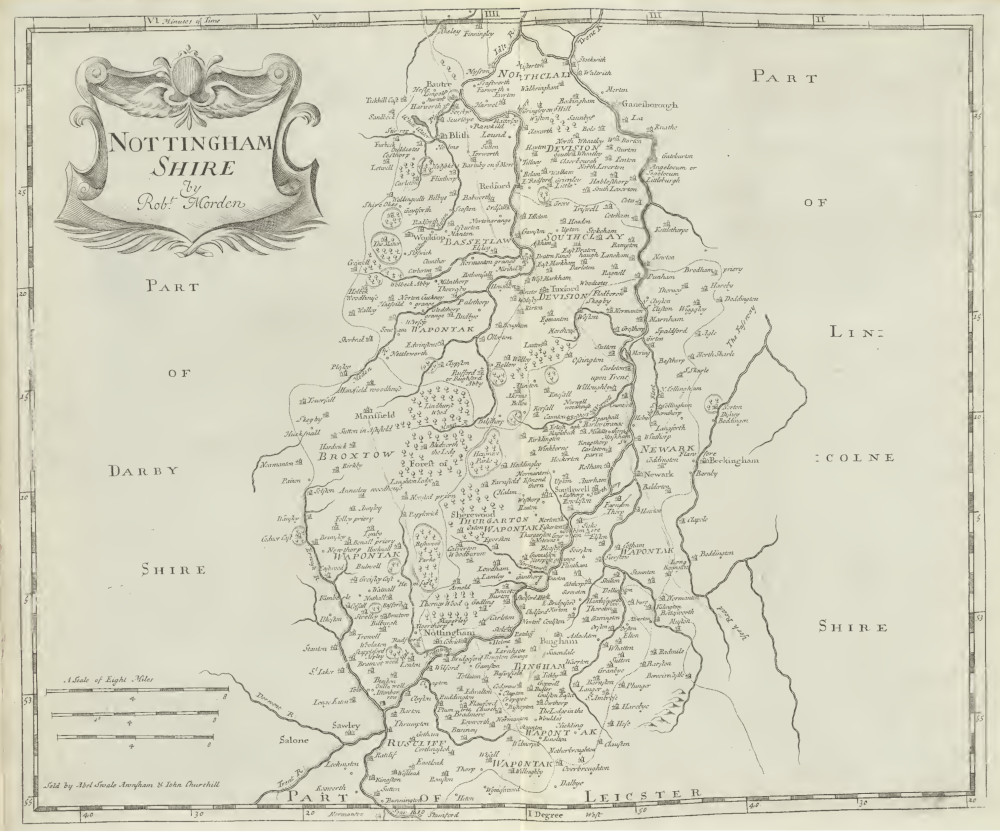
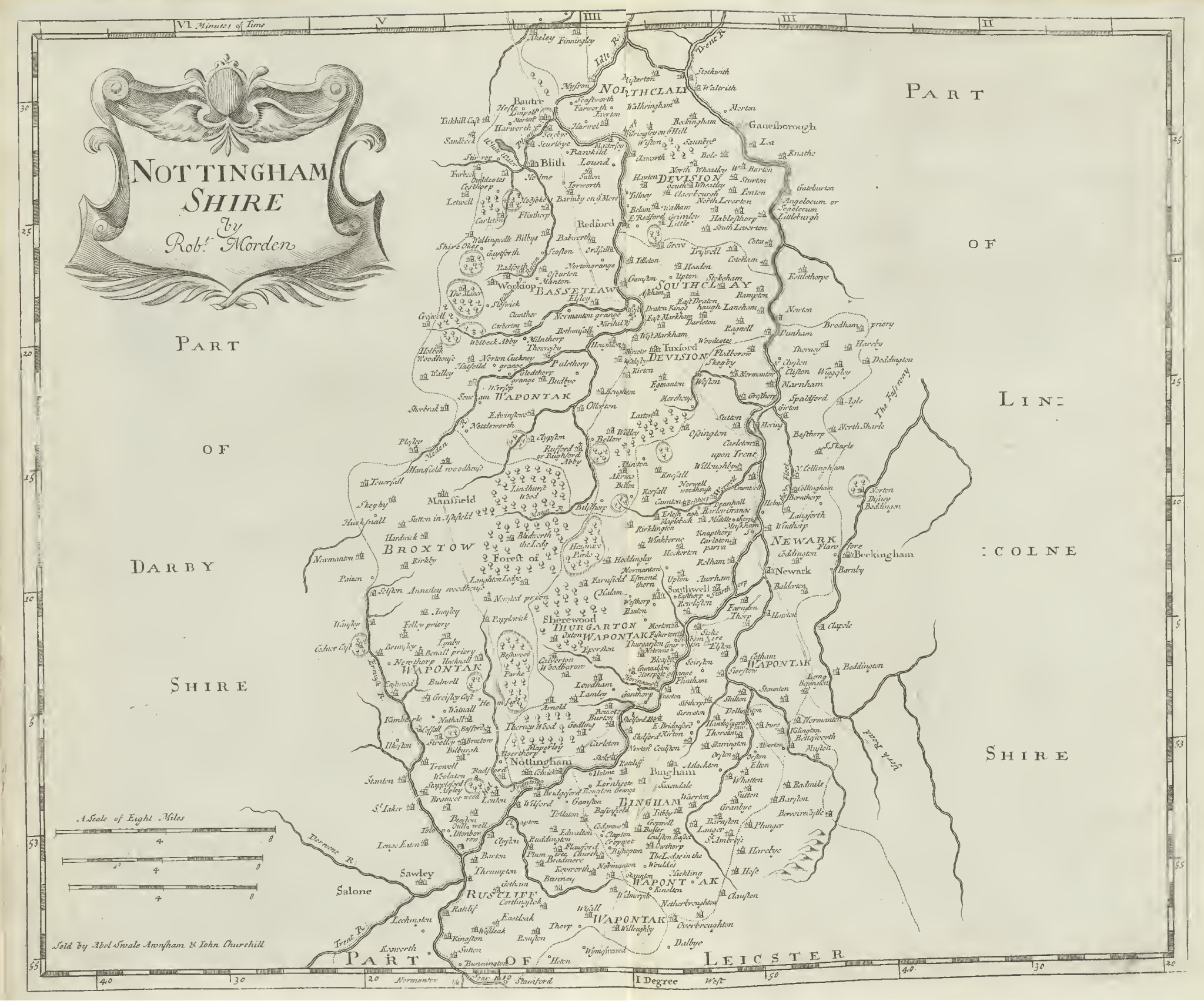
Illustration: Nottinghamshire
(Click here for larger version)
the county of Nottingham borders upon that of Lincoln on the West, but is of much less extent, called by the Saxons Snottengaham-Scyre, by us Nottinghamshire: bounded on the North by Yorkshire, on the West by Derbyshire, and in some parts by Yorkshire; and on the South by the county of Leicester. The South and East parts are enriched by that most noble river the Trent, and the rivulets which run into it. The West part is entirely took up with the forest of Sherwood, which is very large. This part, because it is sandy, the inhabitants call the Sand; the other, because it is clayish, they call the Clay; and thus have they divided their county into these two parts.
the Trent, in Saxon Treonta (which some antiquaries of less note have called in Latin Triginta, from its affinity with that French word which is used to signify this number) after it has run a long way , where it first enters into this county, passes by Steanford, where there are many remains of antiquity yet extant, and many Roman coins found, as I am informed; and then by Clifton, which has given both a seat and name to the ancient family of the Cliftons . Then it receives the little river Leen from the West, which rising near Newstead, i.e. a new place, where formerly King Hen. 2 built a small monastery now the seat of the Byrons, an ancient family, descended from Ralph de Buron, who in the beginning of the Norman times flourished in great state both in this county and Lancashire: it runs near Wollaton, where in this age Sir Francis Willoughby Kt., out of ostentation to show his riches, built at vast charges a very stately house, both for splendid appearance and the curious workmanship of it. After this it washes Lenton, formerly famous for a monastery, built in honour of the Holy Trinity by William Peverell, the natural son of King William the Conqueror; at present, only for the throng fairs there.
On the other side, almost at the confluence of the Leen and Trent, and upon the side of a hill, stands Nottingham, which has given name to this county, and is the chief town in it; the word being nothing but a soft contraction of Snottenga-Ham. For so the Saxons called it from the caves and passages under ground which the ancients for their retreat and habitation mined under these steep rocks in the South part, toward the little River Leen. Hence Asser renders the Saxon word Snottengaham speluncarum domum in Latin, and in British it is tui ogo bauc, which signifies the very same, namely, a house of dens. In respect of situation, the town is very pleasant: there lie on this side toward the river very large meadows; on the other, hills of easy and gentle ascent: it is also plentifully provided with all the necessaries of life. On this side, Sherwood supplies them with great store of wood for fire, (though many burn pit-coal, the smell whereof is offensive,) on the other the Trent serves them with fish very plentifully. Hence this its barbarous verse,
limpida sylva focum, triginta dat mihi piscem.
Sherwood my fuel, Trent my fish supplies.
to wind up all; by its bigness, building, three neat churches, an incomparable fine market-place, and a very strong castle, the town is really beautiful. The castle stands on the West side of the city, upon an exceeding steep rock; in which very spot that tower is believed to have been, which the Danes relying upon, held out against the siege of Aethered and Alfred, till without effecting anything they rose and retired. For when the Danes had got this castle, Burthred King of the Mercians, (as Asser says ) and the Mercians sent messengers to Aethered King of the West Saxons, and to Alfred his brother, humbly entreating that they would aid them; so that they might engage the foresaid army. This request they easily obtained. For the two brothers, having drawn together a great army from all parts, with as much dispatch as they had promised, entered Mercia, and marched as far as Snottenga-Ham, unanimously desiring to fight them. But when the pagans refused to give them battle, securing themselves in the castle, and the Christians were not able to batter down the walls of the castle, a peace was concluded between the Mercians and the pagans, and the two brothers returned home with their forces. Afterwards Edward the Elder built the village Bridgeford over against it, and raised a wall (which is now fallen) quite round the city. The only remains extant of it, are on the West part. A few years after this, namely, in Edward the Confessor's time, (as it is in Domesday) there were reckoned 173 burgesses in it, and from the two mints there was paid forty shillings to the King. Moreover, the water of Trent and the Fosse Dyke, and the way towards York were all looked after, that if anyone hindered ships from passing, he might he amerced four pounds. As for the castle which now stands there, both the founder and the bigness of it make it remarkable. For William the Norman built it to awe the English: by nature and art together it was so strong (as William of Newburgh tells us) that it seemed invincible by anything but famine, provided it had but a sufficient garrison in it. Afterwards, Edward the Fourth rebuilt it at great charge, and adorned it with curious buildings, to which Richard the Third also made some additions. Nor has it ever in any revolution undergone the common fate of great castles; for it was never taken by down-right force. Once only it was besieged (and that in vain) by Henry of Anjou; at which time the garrison burnt down all the buildings about it. It was once also taken by surprise by Robert Count de Ferrariis in the Barons' War, who deprived the citizens of all they had. Those of this castle tell many stories of David King of Scotland, a prisoner here, and of Roger Mortimer Earl of March, taken by means of a passage underground, and afterwards hanged, for betraying his country to the Scots for money, and for other mischiefs, out of an extravagant and vast imagination designed by him. In the first court of this castle we still go down a great many steps with candle-light into a vault underground, and rooms cut and made out of the very stone; in the walls whereof the story of Christ's passion and other things are engraven, by David the Second, King of Scotland, as they say, who was kept prisoner there. In the upper part of the castle which stands very high upon the rock, I likewise went down many stairs into another vault under-ground; which they call Mortimer's Hole, because Roger Mortimer absconded in it, being afraid of himself, out of a consciousness of his own guilt. As for position, this place is 53 degrees in latitude, and 22 degrees 14 minutes in longitude.
from hence the Trent runs gently by Holme, named from the lords Holme Pierrepont, a noble and ancient family, of whom Robert de Petrae Ponte or Pierrepont was summoned to sit among the barons in parliament by Edward the Third. Then to Shelford the seat of the famous family of the Stanhopes, knights, whose state and grandeur in these parts is great, and their name eminent . But it was formerly the barony of Ralph Hanselin, by whose daughters it came to the Bardolphs and Everinghams.
Hence it goes to Stoke, a small village; but remarkable for no small slaughter. Here John de la Pole, Earl of Lincoln, who was designed for the crown by Richard the Third, when he saw himself excluded from the throne by Henry the Seventh, rebelliously fought for a counterfeit prince against his lawful King, and after a stout defence was cut off with his whole party. Not far from hence stands Southwell, a collegiate church of prebendaries dedicated to the Virgin Mary; not very splendid I must confess, but strong, ancient, and famous. Paulinus, the first Archbishop of York, built it (as they write) after he had baptized the people of this country in the River Trent. From that time the Archbishops of York have had a large palace here, and three parks adjoining, well stored with deer. That this is that city which Bede calls Tio-Vul-Fingacester, I the rather believe, because those things which he relates of Paulinus's baptizing in the Trent near Tio-Vul-Fingacester, are always said to have been done here, by the private history of this church.
Hence from the East, the Smite, a small river, runs into the Trent; which is but shallow, and washes Langar, famous for its lords the Tibetots or Tiptofts, who were afterwards Earls of Worcester; and Wiverton, which from Heriz, a famous man in these parts formerly, went by the Bretts and Caltosts to the Chaworths, who take their name from the Cadurci in France, and their pedigree from the lords de Walcherville.
now the Trent divides itself , and runs under Newark, a pretty large town, so called, as if one should say, a new work, from the new castle, very pleasant and curiously built, (as Henry of Huntingdon describes it) by Alexander that munificent Bishop of Lincoln; who (to use the words of an old historian,) being of a very liberal and genteel temper, built this and another castle at vast expense. And because buildings of this nature seemed less agreeable to the character of a bishop, to extinguish the envy of them, and to expiate as it were for that offence, he built an equal number of monasteries, and filled them with religious societies. However, the extravagant profuseness of this military bishop was soon pursued with condign punishment. For King Stephen, who had no better means to establish the sinking state of his kingdom, than by possessing himself of all the fortified places, brought the bishop to that pinch, by imprisonment and famine, that he was forced to deliver up into his hands both this castle, and that other at Sleaford. There is no other memorable accident in this place, but that King John ended the tedious course of an uneasy life here . From hence the river uniting again flows directly to the northward by many villages, but has nothing remarkable before it comes to Littleborough, a small town, and so exactly answerable to the name; where, as there is at this day a ferry much used, so was there formerly that famous station or abode, which Antoninus twice mentions; variously read, in some copies Agelocum, and in others Segelocum. Formerly I sought for this place in vain hereabouts, but now I verily believe I have found it, both because it stands by the military way, and also because the marks of an old wall are still discernable in the neighbouring field, where many coins of the Roman Emperors are daily found by the ploughmen; which are called swines' pennies by the country people, because they are oftenest discovered by the grubbing of the swine there. They also imagine, according to their poor sense of things, that their forefathers enclosed this field with a stone wall, to keep the water from overflowing it in the winter.
in the West part of this county (called the Sand,) where the Erewash, a small river, runs toward the Trent, we see Strelley , heretofore Strellegh, which hath given a name and seat to the Strelleys knights (commonly called Sturly) one of the most ancient and famous families of this county. More inward lies Sherwood, which some interpret a clear wood, others a famous wood; formerly a close shade, with the boughs of trees so entangled in one another, that a single person could hardly walk in the paths of it. At present it is much thinner, yet it still feeds an infinite number of deer and branchy-headed stags; and has some towns in it, whereof Mansfield is the chief, a very plentiful market; the name of which is made use of for an argument by some , who assert the antiquity of the family of Mansfeld in Germany, and that the first Earl of Mansfeld was at the celebration of the round table with our Arthur; and that he was born here. Our kings were formerly wont to retire hither for the sake of hunting, and, that you may have it in the very words of an old inquisition, Henry Fauconberge held the Manor of Cuckney in this county by serjeanty, for shoeing the King's horse when he came to Mansfeld . Many small rivers spring out of this wood, and run towards the Trent; the chief of them is Idle, upon which near Idleton in the year 616, the great success and fortune of Ethered, a most potent King of the Northumbrians, stopped and failed him. For whereas he had formerly always fought with great success, here his fortune varied, and he was cut off, being defeated by Redwald King of the East Angles, who set Edwin (excluded then and deprived of the throne of his ancestors) over Northumberland. The course of this little river lies at no great distance from Markham, a small village; but yet it has given name to the Markhams, a family very famous heretofore both for antiquity and virtue ; the greatest ornament of which was J. Markham, who was Lord Chief Justice of England, and tempered his judgments with so much equity (as you may read in the histories of England) that the glory of him will never perish in after ages . Six miles from hence to the westward stands Worksop, known for its great produce of liquorice, and famous for the Earl of Shrewsbury's house there, built in this age by George Talbot Earl of Shrewsbury, with magnificence becoming the state of so great an Earl, and yet not to contract envy. To the Talbots it came with a great inheritance from the Lovetofts first lords of it in the Norman times, by the Furnivals and Nevilles. Of these Lovetofts, G. Lovetoft in Henry the First's time built a monastery here; the ruins of which are still to be seen among very pleasant meadows, on the East side of the town: but the West part of the church is yet remaining with two towers, very fair and beautiful. A little higher upon the same river I saw Blyth, a noted market town, which was fortified with a castle (as I was informed) by Bulley or Busly, a nobleman of Norman extract; but at this day, hardly the ruins of it are visible; so destructive is age to everything. But the little monastery there was built by Roger Busly and Fulk de Lisieurs, and this is almost the last town of Nottinghamshire to the northward, unless it be Scrooby, a little town belonging to the Archbishop of York, seated in the very edge of it.
William, surnamed the Conqueror, made his natural son William Peverell ruler of this county, not by the title of Earl, but Lord of Nottingham; who had a son that died during the life of his father; and he likewise a son of the same name, deprived of his estate by Henry the Second, for preparing a dose of poison for Ranulph Earl of Chester. About the same time Robert de Ferrariis, who plundered Nottingham, used this title in the gift he made to the church of Tewkesbury, Robert the younger Earl of Nottingham. But afterwards, King Richard the First gave and confirmed to his brother John the county and castle of Nottingham, with the whole honour of Peverell. Long after that, Richard the Second honoured John de Mowbray with this title, who dying young and without issue, his brother Thomas succeeded him; who by Richard the Second was created Earl Marshal and Duke of Norfolk; and being banished immediately after, he begat Thomas Earl Marshal, beheaded by Henry the Fourth, and John Mowbray, who (as also his son and grandson) was Duke of Norfolk and Earl of Nottingham. But the issue male of this family failing, and Richard the infant son of Edward the Fourth, Duke of York, having enjoyed this title among others for a small time; Richard the Third honoured William Marquess of Berkeley, and Henry the Eighth graced Henry Fitz-Roy his natural son , who both died without issue, with this title of Earl of Nottingham. And lately in 1597 Queen Elizabeth solemnly invested Charles Howard, High Admiral of England, (who is descended from the Mowbrays) with this honour, for his service (as the charter of his creation has it) so stoutly and faithfully performed by sea against the Spaniard in the year 1588, and his taking of Cadiz in the year 1596, he then commanding by sea, as the Earl of Essex did by land.
there are 168 parish churches in this county.
additions to Nottinghamshire.
the antiquities of this county were published an. 1677 by Robert Thoroton, doctor of physic, a native of it, with great accuracy and exactness. But keeping close to the descent of families and possessions of estates (in which he has shown a great curiosity) Mr. Camden and he have carried on two very different designs. Had he given himself the liberty of making digressions upon British, Roman, and Saxon antiquities, (as Mr. Burton in his history of Leicestershire has done;) his curiosity must needs have discovered a great many things of that nature, which might have been of considerable use towards the improvement of Camden. Since then he has confined himself to the business of possessions, for those matters I refer the reader thither, where he may have ample satisfaction; and will go along with our author in that part of antiquity which he has principally touched upon.
going out of Leicestershire, the Fosse Way (which is the best, if not the only direction for what we principally look after) leads us into the South part of this county, and carries us along the East of it into Lincolnshire. And because Mr. Camden has taken no notice of it, the best service that probably can be done here, will be to set down such remains of antiquity as have been discovered; and so fill up that breach in the road which is between Leicester and Lincoln.
and first Willoughby on the Wolds, in the hundred of Ruscliffe, just upon the South edge of this county, may pretend to something of antiquity. For it lies near the Fosse, and in a field belonging to it are the ruins (as the inhabitants say) of a town called Long Billington, which has been long since demolished. Hereabouts the ploughmen and shepherds commonly gather up coins of the Romans, in great numbers. And its distance from Caer-Lerion, i.e. Leicester, and from Vernometum or Borough Hill, (being 9 miles from each) adds to the confirmation of it. All which put together, would tempt us to believe that this had been a Roman station.
from hence the Fosse passes North-east through the vale of Belvoir, and therein through the field of East Bridgford, or Bridgford on the Hill, in which are still the remains of a Roman station near a spring called the Old Wark Spring; and the field in Bridgford, in which part of this camp lies, is called to this day Boroughfield. Mr. Foxcroft also, rector of Wyfordby in Leicestershire (to whose diligence the discovery of those places is in a great measure owing) assures me that he has seen a fair silver coin of Vespasian which was found there, and that others are sometimes ploughed up by the inhabitants of that town. What further confirms the conjecture of a station here, is its distance from Willoughby of about 8 miles, and near the same space from Long Collingham, about 3 miles beyond Newark; near which in a large field there is some reason to fix another station. The Fosse road indeed lies above a mile from it, but it receives authority enough from several of Constantine's coins which have been found there, as well as its distance from Lincoln (viz. 9 miles) where was another station.
by this means (if these conjectures may be allowed any colour of truth, as I see no great objection lies against them) that vast breach between Leicester and Lincoln, along the Fosse, is pretty well pieced up. From Leicester to Willoughby, 9 miles; from Willoughby to East Bridgford, about 8 miles; from thence to Long Collingham 9 miles; and from hence to Lincoln, 9 more.
having followed the Fosse thus far toward the North, for the more convenient clearing of this point; we are drawn a little out of our road, and must return to the South part, from whence now the Trent especially must direct our course.
and first we meet with Steanford, or Stanford, which, whatever it had in our author's time, at present shows nothing of antiquity. Its greatest ornament is a church lately repaired and beautified at the expense of Thomas Lewes esquire, the present patron thereof. Its neighbour Clifton has been the inheritance of a family of that name for above 600 years, as is evident from an inscription upon a monument in the chancel.
next is Nottingham. Mr. Camden expressly says, that William the Conqueror built the castle there, to keep in order the English: but Dr. Thoroton, who was no doubt a better judge in that matter, is altogether positive that it was built by Peverell; he was base son to William the Conqueror; and it appears that he had licence from the King to include 10 acres (ad faciendum pomerium<301>) thereabouts, which after the forest measure contains above 50 statute acres; and that, it seems, is near the proportion of the old park of Nottingham. Besides, there is no mention of it in Domesday, which was made the year before the Conqueror's death; and therefore 'tis probable his son built it by a commission from him. While it was in the hands of the Earl of Rutland, many of the good buildings were pulled down, and the iron and other materials sold; yet in the beginning of the civil wars K. Charles 1 made choice of it as the fittest place for setting up his royal standard, about Aug. 2, A.D. 1642. Shortly after, it became a garrison for the Parliament, and in the end of the war, orders were given to pull it down; but it was not quite demolished. Since King Charles 2's return, the Duke of Buckingham (whose mother was only daughter and heir of Francis Earl of Rutland) sold it to the Marquess of Newcastle, afterwards Duke, who in 1674, began to clear the foundations of the old tower, and hath erected a most stately fabric in the place of part of it. So much for the castle. What the present condition of the town may be, is beside my business to enquire; only I cannot omit the mention of an almshouse there for 12 poor people, which was built and endowed with 100l. per ann. By Henry Hanley Esq.
not far from Nottingham lies Lenton, which Mr. Talbot for some reasons was inclined to believe the ancient Lindum of Antoninus. I take it for granted, it was the affinity of the two names which first led him to this conjecture, and that drew him to other fancies which might seem in any wise to confirm his opinion. As, that the river which runs through Nottingham into Trent, is at this day called Leen or rather Lind; but then Lenton lying at a pretty distance from it, he is forced to back it with this groundless imagination, that Lenton might be sometimes part of Nottingham; though they be a mile asunder one from the other. What he says in defence of Lenton, why the old town might possibly be there, is very true; that it is a thing frequently observed, that famous towns have degenerated into little villages, and that therefore its present meanness is no objection against it: but then it can derive no authority from the River Leen or Lind. Besides, the obscurity of a place is really a prejudice to its antiquity, unless the discovery of camps, coins, bricks, or some such remains, demonstrate its former eminence. Nothing that he has said in favour of this opinion, taken from distances and such like, is of force enough to draw it from Lincoln.
at a little distance from hence, there stands in a large field a church with a spire-steeple, called Flawford church, the burying-place of Ruddington, a great country town above half a mile West from it. But this having a large chapel of its own, the church is the more neglected, and has much rubbish in it. Among it there have been many ancient monuments, no doubt of great note formerly. Some considerable ones are yet remaining both in the chancel and South aisle; part whereof seem to imply that the persons to whom they belong have been engaged in the holy war. North-east from whence is Aslockton, famous for the birth of Thomas Cranmer, Archbishop of Canterbury.
a little more northward stands Shelford, mentioned by Mr. Camden as the seat of the Stanhopes. In the civil wars it was a garrison for the King, and commanded by Colonel Philip Stanhope, a younger son to Philip the first Earl of Chesterfield; which being taken by storm, he and many of his soldiers were therein slain, and the house afterwards burnt.
directly towards the North, upon the westside of the river, is Southwell, where I cannot but take notice of an inscription upon a pillar in that church, both because I do not observe it set down by Dr. Thoroton, and also because it contains a sort of historical account of that place.
reges & reginae erunt nutrices tuae.
hanc
collegiatam & parochialem ecclesiam
religiosa antiquitas
fundavit.
rex Henricus 8. illustrissimus restauravit 1543, Edwardo Lee Archiepiscopo Ebor. piissimo petente:
regina Elizabetha religiosissima sancivit 1584, Edwino Sandys Archiepiscopo Ebor. dignissimo intercedente:
monarcha Jacobus praepotentissimus stabilivit 1604, Henrico Howard, comite Northamptoniensi praenobilissimo mediante.
a domino factum est istud:
da gloriam deo
honorem regi.
sint sicut Oreb & Zeb, & Zebe & Salmana
qui dicunt possideamus sanctuarium Dei.
psal. 83.11.
det deus hoc sanctum sanctis; sit semper asylum
exulis, idolatras sacrilegosque ruat.
gervas. Lee
in piam gratamque maecenatum memoriam
posuit
1608.
Kings and queens shall be thy nursing parents.
This
Collegiate and Parochial Church
Religious antiquity
Founded.
The illustrious Prince, Henry 8 repaired it 1543, C Edward Lee, the most pious Archbishop requesting.
The most religious Queen Elizabeth confirmed it 1584, Edwin Sandys, the most worthy Archbishop of York interceding.
The most potent Monarch, James established it 1604, Henry Howard, the most noble Earl of Northampton mediating.
This is the Lord's doing:
Give Glory to God:
Honour to the King.
Let them be as Oreb and Zeb, and like as Zebe and Salmana
Who say, let us take to ourselves the Houses of God in possession.
Psal. 83. 11.
This holy place let holy men enjoy,
A refuge to the banished and distressed.
But ruin to idolatry, and sacrilege.
Gervase Lee
To the pious and grateful memory of his patrons
Placed this,
1608.
from this town the family of the Southwells took their name, and were anciently seated here. For mention is made in the Records, of Sir Simon Southwell under Hen. 3, of Sir John under Edw. 1, and of several others, down to Hen. 6: when they spread themselves into Norfolk and Suffolk. In the reign of Charles 2 Sir Robert of that name went into Gloucestershire, where he is now seated at King's Weston.
the next place is Langar, which Camden mentions, as eminent for the lords of it, the Tibetots; where we are to observe, that this name has had no relation to that place since the time of Edw. 3, for in the 46th year of his reign, Robert, the last of the Tibetots, dying without heir male; the custody of all his lands, and the care of his three daughters, were committed to Richard le Scrope; and he marrying Margaret, the eldest, to his son Roger, brought that seat into the name of the Lords Scropes, wherein it continued down to Emmanuel, who was created Earl of Sunderland, 3 Car. 1. But he having no issue by his wife Elizabeth, that and the rest of his estate was settled upon his natural issue (three daughters;) and Annabella, the third of them (to whose share this manor fell in the division) marrying John Howe, second son of Sir John Howe of Compton in Gloucestershire, brought it into that name.
on the West side of Trent, not far from the river Idle, stands Tuxford, where Charles Read esquire built a curious free-school, and endowed it with 50l. per ann. The like he did at Corby in Lincolnshire, and Drax in Yorkshire; to which last he added a hospital, and endowed that also with 50l. per ann.
returning to the course of the river, we are led to Littleborough, which Camden tells us, upon second thoughts, he's fully satisfied is Antoninus's Agelocum, or Segelocum. The place at which he says he formerly sought it, appears from his edition of 1594 to have been Idleton, seated upon the bank of the River Idle; to which he was induced partly by its distance from Lindum, and partly because he imagined it might be an easy slip of the librarian to write Agelocum for Adelocum, which latter is not unlike the present name of it. Talbot is for Ollerton in Sherwood, and Fulk (contrary to Antoninus, who makes it distant from Lindum 14 miles at least) for Agle, almost six miles from that place. Dr. Thoroton seems inclined to reduce it to the bank of the River Idle, where Eaton standing, upon that account may as well be called Idleton; and id or yd in the British signifying corn, as ydlan denotes a granary, there may seem to be some affinity between that and Segelocum, as if it were a place of corn. But then it is scarce fair to bring it to Idleton upon the likeness in sound with Adelocum; and afterwards to settle it there upon a nearness in signification to Segelocum; one of which readings must be false, and by consequence not both to be made use of as true, to confirm the same thing. Upon the whole, Mr. Burton approves of our author's conjecture; and to reconcile Agelocum and Segelocum, has ingeniously ranked these two amongst the words, to which the Romans sometimes prefixed an s or sibilus, and sometimes omitted it. So (says he) they called the Alps, which in Lycophron's Cassandra we find written Salpies: and they who are called Ameizon Insulae by Dionysius in his Periegesis, the same in Strabo are Sameizon; lying in the British sea. Salamantica of Spain is called by Polybius Amantiche, and Caesar's Suessiones, in Ptolemy are Omessones. To add one common noun out of Dioscorides, what in Virgil's eclogues is Saliunca, in him is Aliegia: or rather take the whole place out of him.
On the North-west side of this county, about a mile and a half from Worksop, is Welbeck Abbey, now a very noble building, seated in the lowest part of a fine park surrounded with trees of excellent timber; and was the seat of William and Henry late Dukes of Newcastle.
and about 6 miles East from hence, stood the abbey of Rugford, now the noble and pleasant seat of George Marquess of Halifax.
continuation of the Earls.
Charles Howard (mentioned by our author) dying an. 1624 was succeeded by his second son Charles; William the elder dying before him without issue male. This Charles was succeeded by a son of his own name, who was likewise second son, James the elder dying unmarried. At present the title is enjoyed by the right honourable Daniel Finch, late Secretary of State.
more rare plants growing wild in Nottinghamshire.
<131>
caryophyllus minor repens nostras. An Betonica coronaria, sive Caryophyllata repens rubra J.B? Purple Creeping Mountain Pink. By the roadside on the sandy hill you ascend going from Lenton to Nottingham, plentifully; and in other sandy grounds in this county.
gramen tremulum medium elatius, albis glumis non descriptum. Said to grow in a hollow lane between Pleasely and Mansfield by P. B. I have not seen this sort of grass myself, nor do I much rely on the authority of this book: only I propose it to be searched out by the curious.
glycyrrhiza vulgaris Ger. Emac. Common English Liquorice. It is planted and cultivated for sale at Worksop in this county: which Camden also takes notice of.
lychnis sylvestris alba nona clusii Ger. Emac. Montana viscosa alba latifolia C.B. Sylv. alba sive Ocimoides minus album Park. Polemonium petraeum gesneri J.B. White Wild Catchfly. On the walls of Nottingham castle, and on the grounds thereabout.
verbascum pulverulentum flore luteo parvo J.B. Hoary Mullein with Small Flowers. About Wollaton Hall, the seat of my honoured friend Sir Thomas Willoughby baronet.