Camden's Britannia

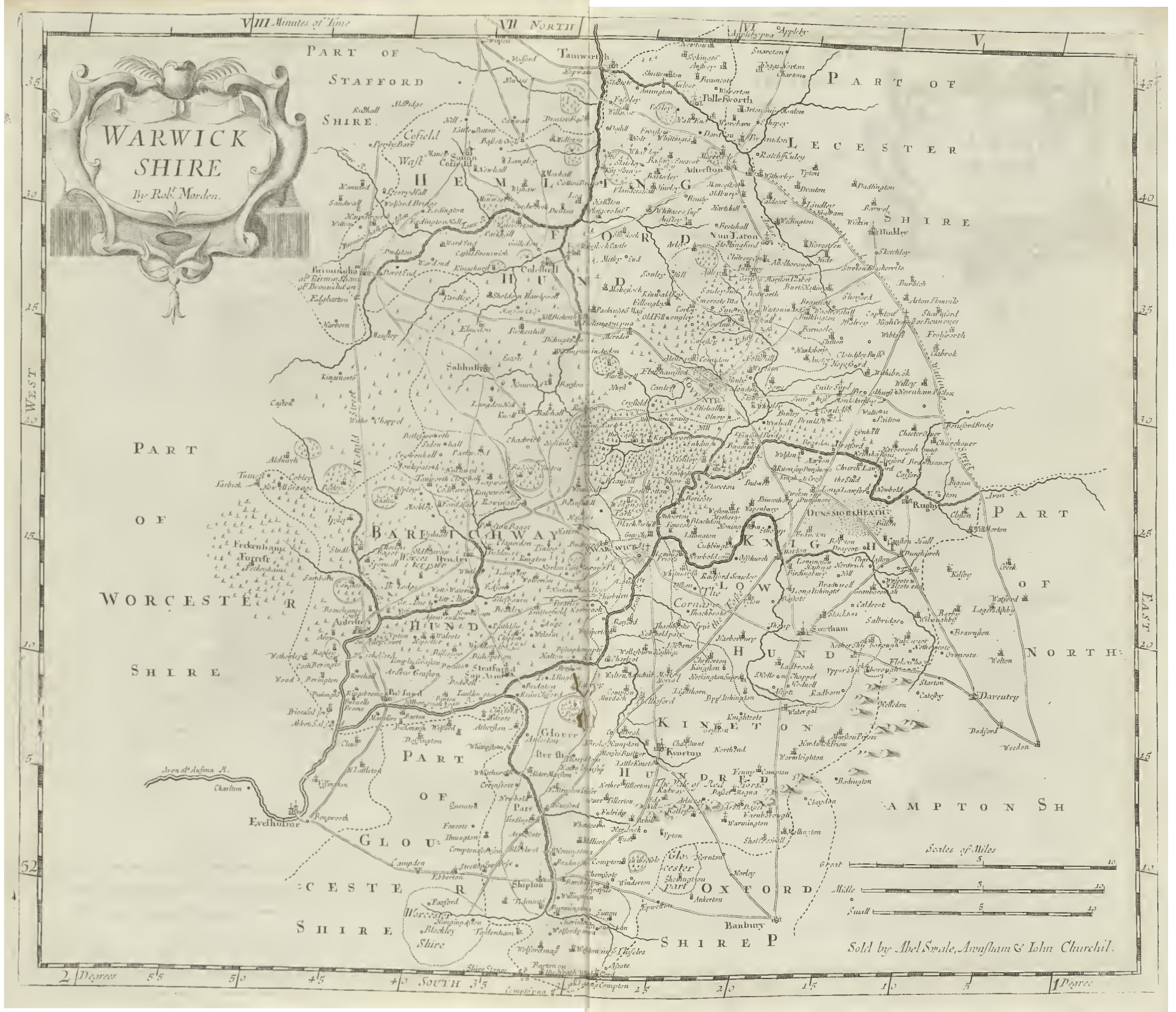
Illustration: Warwickshire
(Click here for larger version)
the county of Warwick, called by the Saxons, as at present, Warwickshire, is bounded on the East with Northamptonshire, Leicestershire, and the military way mentioned before; on the South side with Oxfordshire and Gloucestershire; on the West, for the greatest part with Worcestershire; and on the North with Staffordshire. It is divided into two parts, the Feldon and the Woodland, i.e. a champaign<146>, and a woody country, severed by the river Avon, running obliquely from North-east to South-west, through the middle of this county.
on the South side of the Avon lies Feldon, a champaign country, whose fertile fields of corn, and verdant pastures yield a most delightful prospect to those who view them from the top of Edgehill. Where this track of hills terminates near Warmington, I saw a large round military entrenchment, which I suppose (as others of the like nature) was cast up and made for present defence against the sudden inroads of some enemy. From the red soil hereabouts, a village at the foot of Edgehill is called Rodway, or Ratley, and a great part of the vale, the Vale of the Red Horse, bearing that name from the figure of a great horse, cut by the country people in the side of the hill near Pillerton, out of red coloured earth. In this part of the country the places worthy of note are Shipston and Kineton, the former an ancient market for sheep, the latter for kine or beasts; from whence they both derived their name. Compton in the Hole, so called from its being situated in a bottom almost surrounded with hills; yet it is not without its pleasures. From this place a noble family borrowed their name; a descendant of which Henry Compton in the year 1572 was by the most illustrious princess Queen Elizabeth raised to the dignity of a Baron of this kingdom . Wormleighton, well-known for the richness of its sheep-pastures; but much more remarkable since K. James created that excellent person, Robert Spencer, (of whom I have already spoken) Baron Spencer of Wormleighton. Shugborough, where the star-stones (astroites) are often turned up in ploughing the fields; which the lords of that manor, the Shugburys, have long since taken into their coat-armour. Southam, a market town of some note, and well frequented. Leamington, (so called from the little river Leam which runs through the precinct thereof) where there rises a salt spring. Vehindon, now Long Ichington, and Harbury. These two places are memorable on no other account, than the death of Fremundus, son of Offa King of the Mercians, who was basely and treacherously slain betwixt them. A person of great eminence in his time, and of singular piety; whom nothing so much made the mark and object of envy, as that in an unhappy juncture, he triumphed over the insolent enemy. But this undeserved fate of his turned to his greatest glory; for being buried at the palace of his father Offa (now called Offchurch) his memory was continued to posterity, and canonized, he had divine honours paid him by the people, and his life writ by an ancient author in no ill verse. Some of which (describing the villain, who spurred on with the ambition of a crown, thus impiously assassinated him) it may not be unacceptable to present you withal.
non sperans, vivo Fremundo, regis honore
optato se posse frui, molitur in ejus
immeritam tacito mortem, gladioque profanus
irruit exerto servus, Dominique jacentis
tale nihil veritum saevo caput amputat ictu.
talis apud wydford Fremundum palma coronat,
dum simul & sontes occidit, & occidit insons.
despairing e'er to reach his proud desires
while Fremund lived, he wickedly conspires
against his life, and with his treacherous sword
beheads his sleeping and unthinking Lord.
at Wydford thus blessed Fremund gained a crown,
while guilty blood he shed, and guiltless spent his own.
but I must not omit to acquaint you that the Fosse Way (that old Roman-way) crosseth this Feldon or champaign<146> part; some remains of whose causeway, in pastures now trackless and unfrequented, are to be seen near Chesterton, the seat of the very ancient family of the Peytos; of which was that William Peyto, the Franciscan friar, whom Paul the Fourth then Pope, to mortify Cardinal Pole, (thus divine minds you see are subject to mortal passions!) created in vain Cardinal and legate of England; having cited Pole, as guilty of some heretical opinions, to answer the same at Rome. For Mary Queen of England, although entirely devoted to the see of Rome, so interposed in it, or rather opposed the same, that Peyto was inhibited from entering England, and Pole preserved his legatine authority. Perhaps it may not be impertinent to mention what some writers under the reign of Edward the Fourth [parabolically representing the great depopulation caused by enclosing of common-fields] have complained of, viz. that Covetousness coming down at the head of a numerous army of sheep, fell with great fury on the populous villages of this tract, drove out their ancient inhabitants with a mighty slaughter, and placed her new followers in their stead. Which great destruction made a man of learning in that age exclaim with the poet;
quid facerent hostes capta crudelius urbe?
could plund'ring foes more cruelty have shown?
on the bank of Avon, where with a slender stream it enters this county, Rugby first offers itself to your view, a market town abounding with butchers; then Newnham Regis on the opposite side of the river, where three springs arise, percolated, as 'tis probable, through an alum mineral, whose waters of a milky colour and taste, have the reputation of being very medicinal in the stone. They certainly are exceeding diuretic, close and heal green wounds, and being drank with salt are laxative, with sugar restringent. Then Baginton, which had its castle, and heretofore belonged to the Bagotts, a very honourable family. From which at a little distance lies Stoneleigh, where King Henry the Second founded a small Abbey. Opposite to this on the bank of the Avon, stood a little castle called Stoneleigh-Holme, built in Holme-Hull, which was destroyed at the time when England was miserably harrassed and over-run by the barbarous Danes under their leader Canute.
the next place on the banks of Avon, is the principal town of this county, which we call Warwick, the Saxons Warring-Wic, Nennius and the Britons Caer Guaruic and Caerleon. All these names, (since they seem to be derived either from the British word guarth, which signifies praesidium or a fortress; or from legions posted in such places for their security;) in a great measure inclined me to think (although I am more of the sceptic than critic in matters of etymology.) That this was that very town which in Britain by the Romans was called Praesidium: where (as it is in the Notitia<49> ) the Prefect of the Dalmatian horse by the appointment of the governor of Britain was posted. These troops were levied in Dalmatia:<305> and here we may observe the political prudence of the Romans, who in their provinces disposed and quartered their foreign troops in garrisons; with whom and the natives (by reason of the great diversity of language and humours) there could not likely be any secret combinations formed against their government. For, as Florus writes, Nations not habituated to the yoke of slavery, would otherwise be always attempting to shake it off. Whereupon it was, that from Africa the Moors, from Spain the Asturians and Vettones, from Germany the Batavians, the Nervii, Tungri, and Turnacenses; from Gaul, the Lingones and Morini, and from other parts the Dalmatians, Thracians, Alains, &c. Were brought over to serve in Britain; as in their proper places we shall observe. But to return to our business: no one ought to think the Britons derived the word guarth from the Franks; for if we believe Lazius, 'tis of Hebrew extraction, in which original most countries agree. But that this was the Praesidium , the authority of our annals may convince us, assuring us, that the Roman legions had here a station: and also its situation almost in the centre of the province, intimates no less. For it lies at an equal distance from the coast of Norfolk on the East, and of Wales on the West; just such a situation as was that of Praesidium, a town of Corsica in the heart of that island. Nor will it seem strange that the Romans should here have a fortress and military station, if we consider its situation on a steep and rocky eminence over the river Avon, and the way on every side leading up to it, cut through the rock. That it hath been fortified with walls and a ditch, is very manifest. The castle is very strong both by nature and art: the seat heretofore of the Earls of Warwick, extending itself South-west. The town itself is adorned with fair buildings, and owes very much of its beauty to Ethelfleda, lady of the Mercians, who in the year 911 raised it out of its ruins. At the Norman invasion it was in a flourishing state, and had many burgesses, as they call them; of whom 12 were by tenure to accompany the King in his wars, as may be seen in Domesday Book. He who upon warning given did not go, was fined 100 shillings to the King. But if the King crossed the seas against an enemy, then they were either to send him four boatswains, or in lieu of them four pound in deniers. In this barony the King hath in demesne 113 burgesses; and the barons of the King 112.
Roger, second Earl of Warwick of the Norman race, built here in the middle of the town the beautiful church of St. Mary; which the Beauchamps, succeeding Earls, adorned with their monuments; but his monument in Worcester cathedral, where he lies buried, tells us his name was Thomas Littleton. More especially the last of the Beauchamps, Richard Earl of Warwick and governor of Normandy, who dying at Rouen in the year 1439 was with great magnificence and funeral pomp brought over and interred here.
near Warwick to the North is Blacklow Hill, on which Peter de Gaveston, whom Edward the Second from a mean condition had raised to the honour of the earldom of Cornwall, was beheaded by the barons. For this man, puffed up with the favour of his prince, and the flattery of fortune, had assumed an excessive liberty, debauched the King, vilified all good men, preyed upon the estates of all, and like a crafty old courtier, promoted quarrels betwixt the King and the nobility.
hard by upon the Avon stands Guy's Cliffe, called by others Gibcliff, the present seat of Thomas de Bellofago or Beaufoe, of the old Norman race. This place is the seat of pleasure itself: there is a shady grove, crystal springs, mossy caves, meadows ever green, a soft and murmuring fall of waters under the rocks; and to crown all, solitude and quiet, the greatest darling of the muses. Here, fame tells us that Guy of Warwick, that celebrated hero, after he had finished his martial achievements, built a chapel, led a hermit's life, and was at last buried. But the wiser sort think that this place took its name from Guy de Beauchamp who lived much later. And certain it is, that Richard de Beauchamp Earl of Warwick, built and dedicated here a chapel to St. Margaret, and set up the giant-like statue of the famous Guy, still remaining.
from Warwick the Avon with a fuller body passes by Charlecote, the seat of the noble and knightly family of the Lucys; which long since hereditarily passed to them from the Charlecotes, who out of a pious intent built a religious house (for the support and entertainment of poor people and strangers) at Thelsford. For the brook was called Thelley; which running by Compton Murdack (heretofore belonging to the Murdacks, now to the family of the Verneys knights) and thence by this Thelsford, falls into Avon. Which river within a little way salutes Stratford, a pretty handsome market town, that owes its ornaments and beauty chiefly to its two natives, John de Stratford archbishop of Canterbury, who founded the church here; and Hugh Clopton sometime Lord Mayor of London, who at extraordinary expense built the stone bridge here over the Avon, consisting of 14 arches. He was younger brother of an ancient family, which took their name from the adjacent manor of Clopton, from the time that Walter Cocksfield, styled Knight-Marshal, fixed his seat here at Clopton for himself and posterity. Their inheritance in our time descended to two sisters coheirs, one of them married to Sir George Carew a famous Kt. (Vice-Chamberlain to her most serene majesty Queen Anne) whom K. James created Baron Carew of Clopton, Baron Carew of Clopton. And whom, if for no other reason, I cannot omit for the great respect he paid to venerable antiquity. Avon sees nothing more on its banks, besides Bidford a small market town, and some little country villages, before it makes its entry into Worcestershire.
now let us take a view of the Woodland, which lying on the northern side of Avon, extends itself into a much greater compass than the Feldon; for the most part clothed with woods, yet not wanting pastures or corn-fields; and hath several veins of iron. As it is now called the Woodland, so by a more ancient name it was called Arden: which in my opinion are words importing the same thing. For Arden with the ancient Britons and Gauls did denote a wood. And we know, in France, a vast wood bears the name of Arden; and a town in Flanders situated near another wood, is called Ardenburg; and that celebrated forest of England, paring off the first syllable, retains the name of Den. Not to mention that Diana, which in the old Gallic inscription was called Ardwena and Ardoina, i.e. (if I am not much mistaken) sylvestris, or, of the woods, and was the same that in the italic inscriptions is called Nemorensis, or Diana of the groves. From this part, Turkil de Arden who resided here, and was in great favour with King Henry 1 assumed that surname; and his descendants the Ardens, famous in succeeding ages, were branched out into all parts of England.
on the western side of the woodland, the River Arrow makes haste by Studley (some ages since a castle belonging to John son of Corbutio) to join the river Avon. But whether it be so called (as Tigris a river of Mesopotamia, which in the Persian language signifies an arrow) from the swiftness of its current, or from its slow course (for that the word ara among the old Britons and Gauls imports;) I leave to the search of others . On the banks of Arrow lies Coughton, the chief seat of the family of the Throckmortons, Knights, who since they married with the heiress of Spiney, grew very numerous, famous, and fruitful of good wits. Not far from hence lies Ousley, memorable for the ancient lords thereof, the Butlers, barons of Wem, from whom it hereditarily descended to the Ferrars of Ousley whose inheritance in a short time was divided betwixt John Lord of Greystoke, and Ralph Neville. A little lower upon Arrow is seated Beauchamp Court, so called from Baron Beauchamp of Powick; from whom, by the only daughter of Edward Willoughby son of Robert Willoughby Lord Broke, it came to Sir Fulk Greville Kt., a person no less esteemed for the sweetness of his temper, than dignity of his station. Whose only son, of the same name, so entirely devoted himself to the study of real virtue and honour, that the nobleness of his mind far exceeded that of his birth: for whose extraordinary favours, though I must despair of making suitable returns, yet whether speaking or silent, I must ever preserve a grateful memory.
below Beauchamp Court the river Alne or Alenus falls into Arrow, which in its course through a woody country, passes by Henley, a little market town, near which the Montforts, a noble family of great name, had a castle, that from its delightful situation on a hill amidst the woods, was called by a French name Belle Desert. But the castle hath long since been buried in its own ruins. They derived their pedigree not from the Almarian family of the Montforts, but from Turstan de Bastanberg a Norman. Their inheritance at length passed away by daughters to the barons of Sudeley and the Frevilles. Just at the confluence of the two rivers Arrow and Alne, I saw Alcester, by Matthew Paris called Allencester; and that more properly. The inhabitants, because it hath been a place of great note and antiquity, will needs have the true name to be Ouldcester. This was (as we read in an old inquisition) a free borough of our Lord Henry 1, which the same King gave to Robert Corbet for his service: and when the same Robert died, it descended to William de Botereux, and to Peter the son of Herbert. And when William de Botereux died, his moiety descended to Reginald de Botereux as heir, who now holds it: And when Peter the son of Herbert died, his moiety descended to Herbert the son of Peter, which Herbert gave it to Robert de Chaundois. But from a very great town, 'tis reduced to a small market, though very noted for all sorts of grain.
Higher [North-east] where the country is not so thick clothed with woods, stands Wroxall; where Hugo de Hatton built a little monastery or priory. And Baddesley, formerly the possession of the Clintons, now of the Ferrars. And Balsall, heretofore a preceptory of the Templars which Roger de Mowbray gave them, whose munificence to the order of the Knights-Templars was so extraordinary, that by unanimous consent of their chapter they decreed, that he should have the power of pardoning any brother who had transgressed the rules of the order, provided he came and acknowledged his crime before this their benefactor. And the knights of the order of St. John of Jerusalem, to whom all the possessions of the Templars in England were assigned, (for to give to profane uses things once consecrated to God, our ancestors thought a crime not to be atoned for,) in testimony of their gratitude granted to John Mowbray de Axholme, successor of the said Roger, that he and his successors, at every of the assemblies of their order, should be received in the next degree of honour to sovereign princes.
more to the North-east, in the midst of a chase and park, a confluence of little streams form a lake; which being presently confined within banks, make a channel or kennel. Upon this stands Kenilworth, heretofore vulgarly called Kenelworda, and corruptly Killingworth. From this town a most noble, beautiful, and strong castle, encompassed with a chase and parks, takes its name. It was built neither by Kenulphus, nor Kenelmus, nor Kineglisus, as some historians have dreamt; but by Geoffrey de Clinton Lord Chamberlain to King Henry 1, and his son, (as may be seen in authentic evidences,) after he had founded there a monastery for Canons Regular. But Henry his great-grandchild wanting issue, sold it to King Hen. 3, who granted it to Simon de Montfort Earl of Leicester with Eleanor his sister, for her portion. But presently after, this bond of amity and friendship being broken, and Earl Simon, after dismal commotions, being slain in the Barons' Wars , the castle endured a siege of six months, and at last was surrendered to King Hen. 3, who made it part of the inheritance of the Lancastrian family. At which time was made and published the edict which our lawyers style dictum de Kenilworth; whereby it was enacted, that all who had taken up arms against the King, should pay five years value of all their lands, &c. a very wholesome piece of severity, without effusion of blood, to check those seditious spirits, so pernicious to the government; whose only hopes were placed in the distractions of the state at that time. But now of late, by the royal munificence of Queen Elizabeth, it became the seat of Robert Dudley Earl of Leicester; who in rebuilding and adorning it, spared no cost. So that if you regard the magnificence of buildings, and nobleness of the chase and parks lying round and belonging to it; it may claim a second place among the stateliest castles of England.
from hence (that I may pursue the same course I did in my journey) I saw Solihull, in which was nothing worth seeing beside the church. Next, Birmingham, swarming with inhabitants, and echoing with the noise of anvils, (for here are great numbers of smiths.) The lower part is very watery. The upper rises with abundance of handsome buildings: and 'tis none of the least honours of the place, that from hence the noble and warlike family of the Berminghams in Ireland had both their original and name. From thence in the extreme point of this county northward, lies Sutton Coldfield, in a foresty, unkind, and barren soil; boasting of its native John Vesey Bishop of Exeter, who in the reign of Henry 3 raised up this little town, then ruinous and decayed, and adorned it with fair buildings, great privileges, and a grammar-school. From hence going southward, I came to Coleshill, belonging heretofore to the Clintons; and neighbour to this is Maxstoke Castle, which in a continued succession had for its lords the Lindseys, who were lords of Wolverley; the Odingsells, having their original from Flanders; and the Clintons, who have been very eminent in this county. Lower in the middle of this woody country is seated Coventry, so called (as I conjecture) from a convent; for such a convent in our tongue we call a covent, or covenn; and frequently in our histories, and in the pontifical decrees, this is called Conventria; as particularly in that, either the Bishop of Conventry is not in his right wits, or he seems wilfully to have quitted common sense.<306> Yet some there are, who will have the name taken from a rivulet running through it, at this day called Sherbourne, and in an old charter of the priory, Cuentford. Whencesoever the name be taken, this city some ages since being enriched with the manufacture of clothing and caps, was the only mart-town of this country, and of greater resort than could be expected from its midland situation. 'Tis commodiously seated, large and neat; fortified with very strong walls, and adorned with beautiful buildings: amongst which, two churches of excellent architecture stand near together, as it were rivalling each other; the one dedicated to the Holy Trinity, the other to St. Michael. There is nothing in it of very great antiquity. That which seems to be the greatest monument, is the religious house or priory, whose ruins I saw near these two churches. This, King Canute founded for nuns; who being expelled within a little time, in the year 1040, Leofric Earl of Mercia enlarged it, and in a manner built it anew, with so great a show of gold and silver (to use Malmesbury's words) that the walls of the church seemed too strait to contain the treasures of it. It was very prodigious to behold; for from one beam were scraped 50 marks of silver. And he endowed it with so great revenues, that Robert de Limesey, Bishop of Lichfield and Chester, removed his see hither, as to the golden sands of Lydia; that (as the same Malmesbury hath it) he might steal from the treasures of the church wherewithal to fill the King's coffers, to cheat the Pope of his provisions, and gratify the Roman avarice. However, this see, after a few years, returned back to Lichfield; but upon these terms, that one and the same bishop should be styled Bishop of Coventry and Lichfield. The first Lord of this city that I know of, was Leofric; who being incensed against the citizens, laid upon them very heavy taxes: these he would by no means remit (notwithstanding the great intercession of his Lady Godiva) unless she would consent to ride naked through the most frequented parts of the city; Which (if credit may be given to tradition) she performed, having covered her body with her long dangling hair, without being seen by anyone: and so freed her citizens from many heavy impositions. From Leofric, this city by Lucia his son Algar's daughter, came into the possession of the Earls of Chester; for she had married Ranulph (the first Earl of that name, and the third of the family) who granted the same liberties to Coventry that Lincoln enjoyed; and gave a great part of the city to the monks: the residue of it, and Cheylesmore their manor-house near the city, he reserved to him and his heirs; who dying, and the inheritance for want of issue male coming to be divided amongst the sisters, Coventry, by the death of the Earls of Arundel, fell to Roger de Monte Alto or Monthault; whose grandson Robert, granted all his right, for want of issue male, to Queen Isabel, mother of King Edw. 3, to hold during her life: after her decease, the remainder to John de Eltham brother of the King, and to the heirs of his body begotten. In default of such, the remainder to Edward King of England and his heirs for ever. For so you have it in a fine, the second year of Edward 3. But John of Eltham was afterwards created Earl of Cornwall, and this place became annexed to the earldom of Cornwall: from which time it hath flourished very much. Several kings gave it divers immunities and privileges, especially Edward 3, who granted them the electing of a mayor and two bailiffs ; and Henry 6, who having laid to it some of the neighbouring villages, granted by his charter (for so are the very words of it,) that it should be an entire county, incorporate by itself in deed and name, distinct from the county of Warwick. At which time, in lieu of two bailiffs he constituted two sheriffs; and the citizens began to enclose it with very strong walls. In these, are very noble and beautiful gates: at that which goes by the name of Gosford, is to be seen a vast shield-bone of a boar; which you may believe that Guy of Warwick, or Diana of the Groves (which you please) killed in hunting, after he had with his shout turned up the pit or pond that is now called Swanswell Pool, but in ancient charters Swineswell. As to the longitude of this city, it lies in 25 degrees, and 52 scruples; the latitude in 52 degrees, and 25 scruples. Thus much of Coventry; which yet (that I may ingenuously acknowledge the person who furnished me with it) you must know you have not from me, but from Henry Ferrars of Baddesley, a person to be respected as for his birth, so for his great knowledge in antiquity, and my very good friend; who in this and other places courteously directed me, and (as it were) gave me leave to light my candle at his.
near Coventry, to the North, are situated Astley, a castle heretofore of the Hastings Lords of Abergavenny; and Brandon, of old a seat of the Verdons. To the East is placed Cloughton, vulgarly called Caledon, an ancient seat of the Barons Segrave, from whom it descended to the Barons de Berkeley, by one of the daughters of Thomas Mowbray Duke of Norfolk. These Segraves (from the time that Stephen de Segrave was Lord Chief Justice of England) were barons of this realm, and enjoyed the inheritance of the Chaucombes, whose arms from that time they assumed, viz. A lion rampant, argent, crowned or, in a shield, sable. John the last of this family, married Margaret Duchess of Norfolk, daughter of Thomas de Brotherton; and had issue Elizabeth, who carried the honour of Marshal of England, and title of Duke of Norfolk, into the family of the Mowbrays.
not far from hence is Brinklow, where was an ancient castle of the Mowbrays; to which belonged many fair possessions lying round it: but time hath swept away the very ruins of it; as also of the monastery of Coombe, which the Camvilles and the Mowbrays endowed; out of whose ashes the fair structure of the Harringtons arose in this place. As you go eastward, Cesterover presents itself, the possession of the Grevilles; of whom I have before made mention. Near which, Watling Street, a military way of the Romans, dividing this county to the North from Leicestershire, passes by High Cross, of which we have already spoken: near Nuneaton, which of old was called Eton; but Amicia the wife of Robert Bossu Earl of Leicester (as Henry Knighton writes) having founded a monastery of nuns here, in which she herself was professed of that number; from those nuns it got the name of Nuneaton. And formerly it was of great fame for the piety of its holy virgins, who being constant in their devotions, gave a good example of holy living to all about them. Near this stood heretofore Astley Castle the chief seat of the family of the Astleys ; the heiress of which was the second wife of Reginald Grey Lord of Ruthin. From him sprang the Greys Marquesses of Dorset, some of whom lie interred in the neat college here.
a little higher upon Watling Street (for so this military way of the Romans is vulgarly called) where there is a bridge of stone over the river Anker, Manduessedum is seated; a town of very great antiquity, mentioned by Antoninus: which having not yet altogether lost its name, is called Manchester, and in Nennius's catalogue, Caer Mancegued. Which name (since a quarry of free-stone lies near it) 'tis probable was given it from the stone there digged and hewed. For in the glossaries of the British tongue, we learn that main signifies a stone, and fosswad in the provincial language, digging; which being joined together, seem aptly enough to express the name Manduessedum. But how great, or of what note soever it was in those times, 'tis now a poor little village, containing not above fourteen small houses; and hath no other monument of antiquity to show, but an old fort, which they call Oldbury, i.e. an old borough. Atherston on the one side, a well-frequented market, (where the church of the friars was converted into a chapel, which nevertheless acknowledges that of Manchester to be the mother church;) and Nuneaton on the other side, have by their nearness reduced Manchester to what you see it. Neighbour to Atherstone is Merevale, i.e. merry-vale, where Robert de Ferrers built and dedicated a monastery to God and the Blessed Virgin; in which his body, wrapped up in an ox-hide, lies interred.
beyond these, northward, lies Polesworth, where Modwena an Irish virgin, famed for her wonderful piety, built a nunnery, which Robert Marmion, a nobleman (who had his castle in the neighbourhood at Stippershull) repaired. Hard by also in the Saxon times flourished a town (of which there appear now but very small remains) called Secandunum, at this time Seckington; where Ethelbald, King of the Mercians, in a civil war was assassinated by Beared in the year 749, but in a little time he was cut off by King Offa; by the same means falling from the throne by which he had impiously got it.
to close the whole, I must now give you a catalogue of the Earls of Warwick. And to pass over Guar, Morindus, Guy that Echo of England, and many more of that stamp, which the fruitful wits of those times brought forth at one birth: Henry son of Roger de Bellomonte, brother of Robert Earl of Mellent, was the first Earl of the Norman race, who married Margaret daughter of Aernulph de Hesdin, Earl of Perch, a person of mighty power and authority. Of this family there were, who bore that honour, Roger son of Henry, William son of Roger (who died in the 30th of King Henry the Second,) Walleran his brother, Henry son of Walleran, Thomas his son (who died without issue in the 26th of Henry the Third,) and his sister Margery surviving, was Countess of Warwick, and died childless. Her two husbands nevertheless, first John Mareschal, then John de Plessets, in right of their wife, and by the favour of their prince, were raised to the honour of Earls of Warwick. But these dying without any issue by Margery, Walleran, Margery's uncle by the father, succeeded in the honour; and he dying without issue, Alice his sister came to the inheritance. Afterwards, William her son (called Maledoctus, Malduit, and Manduit de Hanslap,) who died also without issue. But Isabel his sister being married to William de Bello Campo, or Beauchamp, Baron of Elmley, carried the earldom into the family of the Beauchamps. Who, if I am not mistaken, because they were descended from a daughter of Ursus de Abtot, gave the bear for their cognisance, and left it to their posterity. Of this family there were six earls and one Duke, William the son of Isabel, John, Guy, Thomas, Thomas the younger, Richard, and lastly Henry, to whom King Henry the Sixth made a grant without precedent, that he should be Premier Earl of all England, and use this title, Henry Premier Earl of all England, and Earl of Warwick. He made him also King of the Isle of Wight, afterwards created him Duke of Warwick, and by the express words of his patent, granted that he should have place in parliament, and elsewhere, next to the Duke of Norfolk, and before the Duke of Buckingham. He had but one daughter, Anne, who in the inquisitions was styled Countess of Warwick, and died in her infancy. She was succeeded by Richard Neville, who had married the daughter of the said Duke of Warwick; a person of an invincible spirit, but changeable and fickle in his allegiance, the very sport and tennis-ball of fortune. Who, although no King himself, was yet superior to kings; as being the person who deposed Henry the Sixth (a most bountiful prince to him) and set up Edward the Fourth in his place. Afterwards he un-kinged him again, re-established Henry the Sixth in the throne, and involved the kingdom in the flames of a civil war, which were not extinguished but with his own blood . Edward, son of one of his daughters by George Duke of Clarence, succeeded; whom Henry the Seventh (for neither youth nor innocence could protect him) to secure himself and the line, put to death. The title of this earldom (which was become formidable to Henry the Eighth by the great troubles Richard Neville, that scourge of kings, had created) lay dormant, till Edward the Sixth gave it to John Dudley; deriving a title from the Beauchamps. He (as the before mentioned Richard) endeavouring to subvert the government under Queen Mary, had his boundless ambition punished with the loss of his head. But his sons, first John, whilst his father was living and Duke of Northumberland, by the courtesy of England made use of this title for some time: and afterwards Ambrose, a person most accomplished in all heroic qualities, and of a sweet disposition, by the royal favour of Queen Elizabeth, had in my time the title restored him , maintained the honour with great applause, and at last died without issue .
in this county are 158 parish churches.
additions to Warwickshire.
this county at first sight should promise a considerable stock of antiquities, being almost encompassed with old Roman ways, which generally afford us the largest treasure. Watling Street runs along the East part, Icknield Street upon the West, and both are cut by the Fosse, crossing it from South-west to North-east. And had but Sir William Dugdale took the liberty of making larger digressions of that kind, either in the body of his work, as such places lay in his way, or in the method which Dr. Plott has since used, making such antiquities an appendix to his elaborate work; we should probably have found the discoveries answerable to the appearance, and that those ways would have contributed the same assistance to that search, as they do in other counties. I dare not call it an omission, because it did not so directly fall under his design; but if it were, those many excellent digressions he has given us concerning the nature and difference of monastic orders, consecrations of churches, and such like, would make ample satisfaction. However, since we cannot compass the whole, let us be content with what we have; and accompany Mr. Camden to the several parts of this county.
only, we must premise something of the condition of its two general branches, Feldon, and Woodland. That the first was once exceeding populous, may certainly be inferred from the numbers of villages entered in Domesday, the situation whereof are now known only by their ruins, or at most by a cottage or two of a shepherd's, who ranges over and manages as much ground as would have employed a dozen teams, and maintained forty or fifty families. The reason of converting so much tillage into pasture in this part, seems to be the great progress the Woodlanders have made in agriculture, by which means the county began to want pasture. For the iron-works in the counties round, destroyed such prodigious quantities of wood, that they quickly laid the country a little open, and by degrees made room for the plough. Whereupon the inhabitants, partly by their own industry, and partly by the assistance of marl, and of other useful contrivances, have turned so much of wood and heathland into tillage and pasture, that they produce corn, cattle, cheese, and butter enough, not only for their own use, but also to furnish other counties; whereas, within the memory of man, they were supplied with corn, &c. from the Feldon.
Feldon is recommended for the delicate prospect it affords from Edgehill; but Edgehill itself is since become much more considerable for that signal battle fought there between the King and parliament, Sept. 9. 1642. The generality of our historians compute the number of the slain to have been five or six thousand, but by the survey taken by Mr. Fisher, vicar of kineton (who was appointed by the Earl of Essex for that purpose) the list of the slain amounted only to thirteen hundred and odd.
on the North-East corner of Edgehill stands Ratley, called falsely by our author Rodley, it never appearing under that name: only in Domesday Book it is indeed called Rotelei. The fortification he mentions, is not round, but quadrangular, and contains about 12 acres. Near which within our memory, were found a sword of brass, and a battle-axe: something of this kind our author observes to have been discovered at the foot of St. Michael's Mount in Cornwall.
the shape of the horse mentioned by our author is on the side of Edgehill; and the trenches that form it are cleansed and kept open by a neighbouring freeholder, who holds lands by that service.
kineton cannot be (as Mr. Camden would have it) derived from its market of kine, because Henry 1 gave this church under the name of Chinton to the canons of Kenilworth, whereas the market was not granted till 4 Henr. 3. But 'tis probable it had that name from being the possession of the kings, particularly, of Edward the Confessor or William the Conqueror. And to the North-west of the town, at the point of a hill, still called Castle Hill, there has been a castle (as appears by a little mount cast up, and a broad and deep ditch round it,) where tradition says King John kept his court: a spring also at the foot of the hill goes at this day by the name of King John's Well.
North-East from Kineton is Chadshunt, one of the 24 towns given by Leofric Earl of Mercia to the monastery of Coventry; in his charter called Chaddesleyhunt, and in Domesday Cedesleshunte. 'Tis probable it had that name from St. Chad, called also Cedde, and Ceadde. For in the chapel yard was an ancient oratory, and in it (as the inhabitants report) the image of St. Chad; by reason of the resort of pilgrims worth 16l. per ann. to the priest. Here is also a well or spring, that still retains the name of Chad's Well.
not far from hence is Nether Ealendon, which manor was held of Henry de Ferrers at the time of the Conquest, and continues at this day in the hands of his posterity of the male line; such an uninterrupted succession of owners for so many ages, as we seldom meet with. Till Henry the Third's time it was their principal seat: then removing into Derbyshire, they took the name of Shirley, and the present Lord of this place is Sir Robert Shirley, baronet.
more eastward stands Wormleighton, of which place Mr. Camden tells us Robert Spenser was created Baron by K. James 1. Dugdale also says that Sir Robert Spenser, son to Sir John, (and not Sir John, as it is in some editions of our author) was he upon whom K. James 1 on the 21th of July, and first year of his reign, conferred the dignity of a Baron under the title of Lord Spenser of Wormleighton: whose grandson Henry Lord Spenser being advanced by K. Charles the First to the title of Earl of Sunderland, and in arms for that prince in the late civil wars, lost his life in the first battle of Newbury.
next we go forward to Long Itchington, so called from the river Itchen on which it stands; and memorable for the birth of St. Wolstan the famous Bishop of Worcester; who being educated in the abbey of Peterborough, was shorn a monk in the monastery at Worcester, and afterwards became Bishop of the place an. 1060, upon the removal of Aldred to the see of York. This town was anciently one of the chief of this county, as appears by the large number of hides<78> it contained in the Conqueror's survey, and by its being ranked in the number of those few, which in 15 Hen. 2 were put under the title de auxilio villarum & burgorum ad maritandam filiam regis,<307> whereunto the inhabitants hereof paid C. shillings.
from hence to the South-west lies Chesterton, which shows a threefold evidence of its antiquity; the first it carries in the name; for the Saxon ceaster, and so our Chester, comes plainly from the Roman castrum, and is not originally a German word, but used by them here in England after the Romans had left it. And this is plain from Mr. Burton's observation, that he never found the termination added to any places, but such only where the Romans had built their castra. The second mark, is its nearness to the Roman Fosse, upon which 'tis evident that at convenient distances, places of entertainment were built for the reception of the armies in their march. The third token is, that in the compass within which the Roman building is supposed to have stood, several old coins have been digged up. And these three arguments amount to little less than a demonstration of its Roman antiquity.
let us now return to the East part, and follow the course of the river Avon; upon which we first meet with Rugby, in Domesday Book written Rochebery, which name Sir William Dugdale derives from a roche, a rock or quarry of stone, for such (says he) there is westward from this town about half a mile; and 'tis very like that the ground whereon the town stands being high, is of the same condition. There was formerly at it a little castle, which stood about a furlong from the church northwards, as is to be seen by the banks of earth, and part of the moat yet remaining. The fore-cited author is of opinion that it was built in the time of King Stephen, who fearing an invasion from the Empress, granted leave to the nobility to build every man his castle within his own grounds.
not far from Rugby is Brownsover, upon the East-bank of the River Swift; in the original whereof (as also of many other names of the same termination) I must crave leave to dissent from Sir William Dugdale, who tells us that over used upon those occasions, signifies always supra, above, over, or higher. And where it has nether answering it in the name of a place at some little distance, the case is plain; but whenever such a place stands upon a river, I think it is more natural to fetch it from the Saxon ofre, ripa, a bank, which as it is suited to the condition of the place, so does it prevent the absurdity of laying down a relative name without a correlative to answer it. This conjecture will, I am confident, approve itself by instances in most counties in England, as it does particularly in Warwickshire.
more towards the West we find Stretton, so named from its situation upon that stratum or street of the Romans called the Fosse. There is another place of this name not far from Stow in Lincolnshire, which likewise stands upon a Roman causeway; and that name, wheresoever it occurs throughout this kingdom, seems to have the same original: which observation may perhaps now and then be of use to persons of curiosity, whose inclinations lead them to the tracing out of such ways.
going along with the Fosse towards Leicestershire, at a little distance from it, is Monks Kirkby, where are certain tokens of a Roman station. For by digging the ground near the church, there have been discovered the foundations of old walls and Roman bricks. There are also three or four heaps of earth in an adjoining pasture, apparently the monuments or sepulture of some military persons in those days: which badges are sufficient to prove, that it hath been a place of note many hundreds of years since. But what my author adds; And it may very well be, that those materials for building, by reason of the ruins before mentioned, so ready at hand, became a special motive to that renowned Lady Ethelfleda (so much taken notice of by our old historians, and styled Merciorum Domina<305>) to begin the structure of this place. This (I say) I cannot agree to for two reasons; the first, because that place is called in Saxon Cyricbyrig, and I have never observed that their byrig passes into our modern by or bie; nor is this termination the same with byrig (as Sir William Dugdale intimates) which comes from beorg, collis, and includes in its signification a rising ground, such as their forts were generally built upon; whereas the other implies no more than a bare dwelling place, without any respect to the situation, and is (if I mistake not) of Danish original, by meaning the very same thing in the old Icelandic. My second reason is, that another place offers itself with a greater colour of probability. It is Chirbury on the West part of Shropshire, which as it retains the old name, so lying upon the frontiers of the kingdom of Mercia, and not far from the Severn, it seems to me a much more proper place than the other.
next is Warwick, in the description whereof our author has been very particular, as to matters of antiquity; but has left us little concerning its situation, though that be pretty singular. It stands on a hill, which is one entire rock of free-stone; out of whose bowels were wrought all the public buildings that adorn it. Each of the four ways to it (answering the four points) lead you by a religious house, through a rock, and through streets which all meet in the centre of the town. The wells and cellars are made in the rock; and the descent every way keeps it clean. Under it, on the South, is a fruitful champaign<146> country; on the North are groves, woods, and parks.
The castle is now made a most noble and delightful seat: the height of the solid rock from the river on which it stands, is 40 foot, but on the North side it stands even with the town, which particularly is adorned with two public buildings, a County Hall and a market-house; and is now supplied with water brought in pipes from springs at half a mile's distance.
besides the monuments of the Beauchamps, the church of St. Mary is honoured with those of Robert and Ambrose Dudley, Earls of Leicester. On the North side also of the choir, in an octangular room (formerly the chapter-house) is a stately monument (black and white marble) of Fulk Lord Brooke, erected by himself in his life-time, and circumscribed with this epitaph: Fulk Greville, servant to Queen Elizabeth, counsellor to King James, and friend to Sir Philip Sidney. Trophaeum peccati.<309> In the church itself lies John Rous, a native of this place, and chantry-priest of Guy's Cliff. Sir William Dugdale calls him a famous antiquary; and Leland and Bale give him a character as ample, when they tell us, he had devoted himself wholly to the study and search of antiquities, particularly of this his native place; and to that end had viewed and examined most libraries in England. Here lies also John Cartwright (first master of the Earl of Leicester's hospital) whom Mr. Camden in his Elizabeth styles inter puritanos antesignanus.<310>
the story of the famous Guy of this place is so much obscured by fables and romances, that 'tis difficult to determine how far it ought to be credited. 'Tis certain however, that some centuries since, the greatest of the Earls of Warwick have paid a mighty veneration to his memory. William Beauchamp called his eldest son after him, Guy; Thomas, by his last will, bequeathed the sword and coat of mail of this Guy, to his son; another christened a younger son by the name of his successor, and dedicated to him a noble tower, the walls whereof are 10 foot thick; the circumference 126, the height from the bottom of the ditch upward, 113 foot. Another left a suit of arras,<311> wherein were wrought the heroic acts of Guy, as an heirloom to his family. Lastly, his sword and other accoutrements, now to be seen in the castle, were by patent 1 Hen. 8 granted to William Hoggeson, Yeoman of the Buttery, with the fee of two pence per diem for that service. Whether it was the example of this hero that put a spirit in his successors, I know not; but we find by our histories, that from the Conquest to the death of Ambrose Dudley, there was scarce anyone considerable scene of action, wherein the Earls of Warwick made not a great figure.
two miles below Warwick is Barford, where there is still living one Samuel Fairfax, born in the year 1647, who when he was 12 years of age, dwelt under the same roof and eat at the same table with his father and mother, grandfather and grandmother, great grandfather and great grandmother; who all lived very happily together: and none of the three generations of either sex had been twice married.
then the Avon runs to Stratford, given by Ethelardus a viceroy of Worcestershire, to the bishopric of Worcester, 300 years before the Conquest. The church was collegiate, and the college is still standing: in the chancel lies William Shakespeare, a native of this place, who has given proof of his genius and great abilities, in the 48 (sic) plays he has left behind him. The stone that covers him has this inscription:
good friend, for Jesus sake, forbear
To dig the dust enclosed here.
blessed be the man who spares these stones,
and curst be he that moves my bones.
from hence we are carried by the same river to the Arrow, which runs into this a little below Bidford. I was once of opinion that it was this river the Danes sailed up when they had a design upon the kingdom of Mercia; being induced to it by the common conjecture, and the similitude of Arwan, the ancient name, and Arrow the present. What made it yet more plausible, was, the reading of Florence of Worcester and Howden, wherein I find the same river called Arewe. But upon weighing the circumstances of that action, I found a necessity of quitting my opinion, though without the good fortune of meeting with any other place where I could safely settle it. For first, Arrow rises in Worcestershire, and does not run long before it joins itself to the Avon, being no way so considerable as to be capable of carrying vessels, though very small. Then the history tells us, they went out of the Thames, and after they had compassed their design, brought the spoil into the river Medway in Kent; which makes it very probable, that this place was not at so great a distance as Warwickshire. What if we should say that Orwell, a good large river which parts Essex and Suffolk, was the place. 'Tis more than probable, that this initial or was formerly ar, because that change has been very usual, and at the side of this river is a place called Erwarton; and why may not Harwich have been formerly called Arwic, and not Herewic, as Camden imagines, who very often sets down Saxon names without the authority of records, unless he had some which I could never yet see. If this conjecture seem a little too much strained, why may not the reading of the Saxon annals, into Arwan, be false for to Arwan, and so that name rather denote the place whither they went, than the river? Nothing is more common in ancient copies than such errors; and if Arwan may be changed into Waran, the river may be Lee, and and the place Ware. But these are bare conjectures, to which I cannot reasonably challenge any man's positive assent.
leaving the Avon, and following the River Arrow, we first meet with Alcester; the termination whereof tempts us to expect something of antiquity. Its situation likewise upon the Roman way Icknield Street, raises our expectation yet higher; and upon the authority of Sir William Dugdale (who tells us that old foundations of buildings, Roman bricks, and coins both of gold, silver, and brass, have been frequently found there) we need not scruple to affirm that this was formerly a Roman station. About fifty years ago, in an old foundation where they were digging a cellar, there was an urn taken up, with 600 and odd pieces of Roman coin in it; eight of them gold, and the rest silver. Most of them are of Roman Emperors, and the reverses generally different. They fell to the right honourable the Lord Brooke, as Lord of the manor; and are now in the hands of his lady.
to follow Mr. Camden, let us next go to Kenilworth, or Killingworth, which passed from Robert Dudley Earl of Leicester to Sir Robert Dudley his natural son, who sold it to Prince Henry; and he dying without issue, it came into the hands of Prince Charles, who committed the custody of it to Robert Earl of Monmouth, Henry Lord Carey his eldest son, and Tho. Carey esquire; the inheritance whereof is granted to Lawrence Viscount Hyde of this place, and Earl of Rochester. King Edw. 2. was for some time detained prisoner here. They still find balls of stones 16 inches diameter, supposed to have been thrown in slings in the times of the Barons' Wars. Robert Earl of Leicester is said to have laid out 60000 pound in repairing, building, and adorning it. He entertained Queen Elizabeth and the court 17 days, with all the varieties and magnificence both of feasting and shows. In which time he spent 320 hogsheads of ordinary beer, as appears by the accounts of his steward. The castle, in the late civil wars, was demolished by those that had purchased it of the parliament with design to make money of the materials.
in the utmost northern bound is Sutton Coldfield, where the Earls of Warwick had a chase of great extent. The market is now almost wholly disused; and the Bishop of Exeter mentioned by our author, lived and died here in the 103rd year of his age.
next is Coleshill, where in an old foundation, was lately, dug up a Roman copper coin of Trajan's: and not far from it, Blyth, memorable for nothing but that it was purchased by Sir William Dugdale, and was his place of residence when he compiled that accurate and elaborate work, his Antiquities of this county.
we come next to Coventry, the walls and towers whereof were demolished at the restoration, by command of King Charles 2, the gates only left standing; by which one may guess at the strength and beauty of the former. Edward 4 for their disloyalty took the sword from the mayor, and seized their liberties and franchises; which they redeemed for 500 marks. In memory of Leofric (who died 13th of Edward the Confessor) and Godiva his Countess, their pictures were set up in the windows of Trinity Church, with this inscription;
I Luric for the love of thee
do set Coventry toll-free.
and a procession or cavalcade is still yearly made in memory of Godiva, with a naked figure, representing her riding on horse-back through the city. They have a stately cross built (33 Hen. 8) by Sir William Holles, sometime Lord Mayor of London, for workmanship and beauty inferior to few in England. The city, among other things, is famous for the two parliaments held in it; the former in the 6 Hen. 4, called from the exclusion of the lawyers Parliamentum Indoctorum; the latter in the 38 Hen. 6, from the attainder of Richard Duke of York, the Earls of Salisbury, Warwick, and March, called by some Parliamentum Diabolicum. Since our author's time, it hath afforded the title of Earl to George Villiers, created Earl of Coventry and Duke of Buckingham, 18. May 21 Jac. 1, in which honours he was succeeded by his son of the same name.
from Coventry let us pass to Brinklow, famous for an ancient castle. It is, in all probability, older than the Norman Conquest, otherwise our public records, or some other authorities, would certainly have taken notice of it. If we should carry it back to the times of the Romans, there are several circumstances which seem to justify such a conjecture. As, the Saxons very often applying their hleaw (from whence our low comes) to such places as were remarkable for the Roman tumuli; that there is an eminent tumulus, upon which the keep or watch-tower of the castle did stand; that it lies upon the Roman Fosse; and is at a convenient distance from the Bennones.
passing hence northward to the river Anker, on the western bank thereof we find Manchester, confirmed to be the ancient Manduessedum, by divers coins of silver and brass, which have been by digging and ploughing frequently brought to light.
in the same Parish is Oldbury, a place of great antiquity, as appears by a quadrangular fort containing seven acres of ground. In the North part of it, there have been found several flint-stones about four inches in length, curiously wrought by grinding or some such way. The one end is shaped like the edge of a pole-ax; and by Sir William Dugdale they are thought to have been weapons used by the Britons, before the art of making arms of brass and iron. They must have been brought hither for some extraordinary use, because there are no flints to be found within 40 miles of the place. One of them is now to be seen in Ashmole's museum at Oxford.
on the other side of the river, northward, lies Polesworth, where Sir Francis Nethersole, a Kentish gentleman, and sometime public orator to the university of Cambridge, at the instance of his lady, built a free-school; on the front whereof is this inscription:
soli deo gloria.
schola pauperum
puerorum, Puellarum.<312>
he enfeoffed<313> six gentlemen and seven divines in as much as amounted to 140l per annum at the least, for a liberal maintenance of a school-master and school-mistress to teach the children of the parish. And what remained, was to be employed in charitable uses, such as he in his lifetime should think fit, and in default of his own actually disposing of it, left it to the discretion of his trustees. He likewise he built a fair house for the vicar of Polesworth.
further North is Seckington, which as it is memorable for the battle between Ethelbald and Beornred, so I may further add that it took its name from that engagement; secce in Saxon signifying battle, and dun (which afterwards was changed into ton) a hill. Scarce a furlong North of the church, is a notable fort, and near it an artificial hill of 43 foot high.
continuation of the Earls.
Ambrose Dudley the last Earl, dying in the year 1589. Robert Lord Rich of Leez was created Earl of Warwick 16 Jac. 1, and soon after dying, was succeeded by his son, and grandson, both Roberts. Charles, brother to the latter, was next Earl, who dying 24 Aug. 1673 left the honour to Robert Rich, Earl of Holland, his cousin-german. Which Robert was succeeded in both the honours by Edward his son and heir.