Camden's Britannia

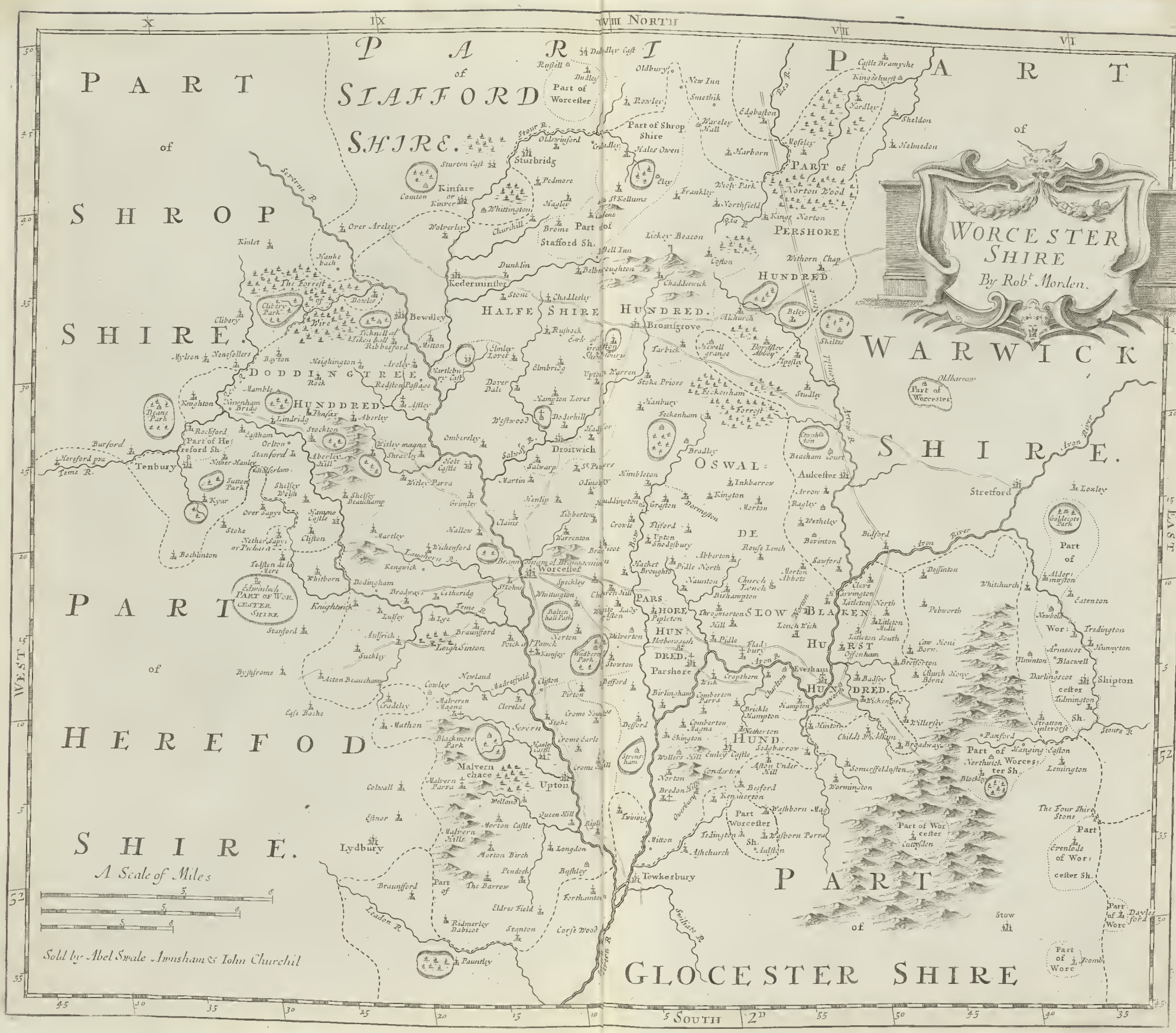
Illustration: Worcestershire
(Click here for larger version)
the second province of the Cornavii having now changed its name, is from the principal town called in Latin Wigorniensis Comitatus, in Saxon Wireceaster-Scyre, and in the present English, Worcestershire. The inhabitants hereof with their neighbours, in the time of Bede, before England was divided into counties, were called Wiccii, which name, if not given them from the winding course of the river on which they dwell (for as I have before observed, the Saxons styled the winding reach of a river, wic,) may seem to be derived from the salt-pits, which the ancient English in their language named witches. For in this country there are noble brine-pits; and many salt-springs are ever and anon discovered, but are presently stopped up, because, as I learn from ancient writings, they are obliged, for the preservation of wood, to make salt only in one place. Nor let it be thought improbable that places should take their names from salt-pits, seeing there are many instances hereof in all countries; and our ancestors the Germans (as Tacitus reports) firmly believed such places to be nearest heaven; and that men's prayers are nowhere sooner heard by the gods.
this county lies bounded by Warwickshire on the East, by Gloucestershire on the South; by the counties of Hereford and Salop<314> on the West, and on the North by Staffordshire. To say all in one word; the air and soil are both so propitious, that it's inferior to none of its neighbours, either for health or plenty . It produceth especially pears in great abundance, which though not grateful to nice palates, nor do they keep well; yet they afford a vinous juice of which is made a sort of counterfeit wine called perry, which is very much drunk; though it be, like other liquors of that kind, both cold and flatulent.
neither is it less happily accommodated with water, for it hath in all parts very fine rivers, which furnish it plentifully with fish of the most delicious kinds. Not to mention those which are less remarkable, the most noble river of Severn directs the course of its rich stream from North to South through the very middle of the county, and Avon waters the South part thereof in its way out of Warwickshire into Severn.
Severn at its very first entrance into this county runs between Kidderminster and Bewdley; the latter justly taking that name from its most pleasant situation, upon the declivity of a hill over the western bank of the river: it was lately remarkable for the wonderful height of the trees in the adjacent forest of Wyre, which are now in a manner all gone; whence our poet and antiquary Leland saith of it,
delicium rerum bellus locus undique floret
fronde coronatus Virianae tempora sylvae.
fair seated Bewdley a delightful town,
which Wyre's tall oaks with shady branches crown.
but now this little town is celebrated only for its delicate situation and beauty; together with the palace of Tickenhall, which King Henry the Seventh built to be a place of retirement for prince Arthur at which time he granted some privileges to Bewdley. [The name probably is Ticcen Hill, i.e. Goats' Hill, not Ticken Hall; and so has been the name of the place before the house was built, which with the adjoining park was destroyed in the late times of usurpation.Upon the strictest enquiry I cannot find any ground for what Mr. Holland saith. The town seems to have been first incorporated by King Edw. 4, whose charter grants them great privileges both by land and sea; which showeth them, in those days, to have improved the advantage of the river for traffic. These immunities were twice confirmed by King Henry 8; and by Act of Parliament 34 and 35 of his reign, Bewdley was annexed to the county of Worcester. King James 1 granted them a charter by the name of the bailiffs and burgesses of Bewdley, gave them one burgess to represent them in parliament.]
the former, Kidderminster, which is also called Kiddelminster, lies over against it on the East side, but at a greater distance from the river; which is a neat town, and a market well furnished with all commodities, divided by the little river Stour which runs through it. The greatest ornaments it hath at present, are, a very fair church, in which some of the eminent family of the Cokeseys lie interred; and a fine house of the Blounts, a good family, honoured with knighthood, and descended from those of Kinlet. But anciently this place was of note for its lords the Bissets, who were in their time very great men; whose rich patrimony at length coming to a division among sisters, part went to the barons of Abergavenny, and part to an hospital of leprous women in Wiltshire; which house, one of these sisters, being herself a leper, built and endowed with her share of the estate. Afterward it gave the title of Baron to John Beauchamp, steward of the household to Richard the Second, who by his letters patents created him Baron Beauchamp of Kidderminster. Soon after this, he, with many other eminent persons, in defiance of that King, was condemned and beheaded by the barons, who making an insurrection with the Commons, in contempt of the King's authority, called all his prime favourites to account for maladministration.
hence Severn taking somewhat an oblique course, salutes Hartlebury, a castle of the bishops of Worcester, not far distant; and so goes on to Holt, which hath that name from the thick woods, a castle anciently belonging to the Abtots, and since to the Beauchamps, who springing from William Beauchamp, surnamed the blind Baron, grew up into a very honourable family, whose estate after some time by heirs-female came to the Guises and Penistones. In its passage downward, Severn feeds such a number of river lampreys, that nature seems to have made a pond for them in this place, such as the Romans anciently invented in the height of their luxury. Lampreys have their name from the Latin lampetra, from licking the rocks; they are like eels, slippery and of a dark colour, only somewhat bluish on the belly: on each side the throat they have seven holes, at which they receive water, having no gills at all. They are best in season in the spring, as being then of a most delicious taste, whereas in the summer the string within them, which doth the office of a backbone, groweth hard. The Italians do much improve the delicacy of their taste, by a particular way of dressing them. First they kill the fish in Malvesey,<315> and stop the mouth with a nutmeg, and each hole with a clove; then rolling them up round, they add the kernels of filberts stamped, crumbs of bread, oil, Malvesey and spices, stewing them all together carefully in a pan over a moderate fire for some little time. But to instruct cooks and epicures is no business of mine.
below Holt, Severn opens its eastern bank to receive the river Salwarpe. This hath its first veins out of the Lickey Hill, most eminent in the North part of this shire; near unto which at Frankley the family of the Littletons were planted by John Littleton alias Westcote, the famous lawyer, justice in the King's Bench in the time of King Edw. 4. To whose treatise Of Tenures the students of our common law are no less beholden, than the civilians<229> to Justinian's Institutes. The Salwarpe rising in the North part of the county runs by Bromsgrove, a very considerable market town, not far from Grafton, A seat of the renowned family of the Talbots, which King Henry the Seventh gave to Gilbert Talbot a younger son of John the second Earl of Shrewsbury, whom for his bravery in war, and his extraordinary wisdom, he also made Knight of the Garter, and governor of Calais in France.
from Bromsgrove, Salwarpe proceeds to Droitwich (Durtwich some call it) from the brine-pits and its wet situation, as Hyetus in Boetia from its dirty soil. Here rise three springs, by nature's particular bounty yielding plenty of brine, they are separated by a brook of fresh water which runs between them and out of them is made the purest and whitest kind of salt, for six months in the year, that is, from the summer to the winter solstice. It is prepared in little boiling houses built about the pits. What a prodigious quantity of wood these salt-works consume, though men be silent, yet Feckenham forest, once very thick with trees, and the neighbouring woods, will by their thinness declare daily more and more. If I should say that Richard de la Wych, Bishop of Chichester, who was born here, did by his prayers obtain these salt-springs, I am afraid some would censure me as very injurious to the divine providence, and over-credulous of old wives' fables. Nevertheless, so great was the pious credulity of our ancestors, that they did not only believe it firmly themselves, and transmit it in writing to us, but also upon that account paid him honours in a manner divine; when for his skill in the canon law, and sanctity of life, he was solemnly canonized for a saint by Urban the Fourth. Yet before this Richard was born, Gervase of Tilbury wrote the following account of these springs, though not exactly true: In the diocese of Worcester there is a village not far from that city named Wych, where at the foot of a little hill, there runs a stream of very sweet water. On the bank hereof are certain pits, few in number, and of no great depth, whose water is extremely salt, which boiled in pans condenseth into very white salt. All the country report, that from Christmas to midsummer there comes up very strong brine, but all the rest of the year the water is somewhat fresh and unfit to make salt. And which I think more wonderful, when the water not strong enough for making salt, riseth, it scarce ever runs over the pit; at the season of its saltness, the brine is not in the least weakened by the vicinity of the fresh river; and yet it is not at all near the sea. Moreover in the King's survey, which we call Domesday Book, in Wych there be eight vats of salt belonging to the King and to the Earl, which every week of welling yield on the Friday 16 bullions. Salwarpe having now entertained a small brook descending from Chaddesley, where anciently the family of Foliot flourished, as after at Longdon, makes haste to Severn.
not four miles lower, Severn with a slow course, and as it were admiring, passeth by Worcester, the chief town of this shire, seated on its bank: and really it deserveth admiration both for its antiquity and beauty. For Antoninus mentions it by the name of Branonium, and Ptolemy (in whom by the transcriber's negligence it is misplaced) by the name of Branogenium, whence the Britons or Welsh call it at this day Cair Vrangon, and in the catalogue of Nennius it is Caer Guorangon and Caer Guorcon. Afterwards the Saxons called it Weogare-Ceaster, Wegeorna-Ceaster, and Wire-Ceaster, perhaps from wire a woody forest adjoining. In Latin it is Wigornia. One of the first who mentions it by that name, if I mistake not, is Joseph of Exeter (the most elegant poet of that age, whose book passeth under the name of Cornelius Nepos) in these verses to Baldwin Archbishop of Canterbury:
in numerum jam crescit honor, te tertia poscit
infula, jam meminit Wigornia, Cantia discit,
romanus meditatur apex, & naufraga Petri
ductorem in mediis expectat cymba procellis.
now thy vast honours with thy virtues grow,
now a third mitre waits thy sacred brow.
deserted Wigorn mourns that thou art gone,
and Kent's glad sons thy happy conduct own.
now Rome desires thee, Peter wants thy hand
to guide his leaky vessel safe to land.
this city was, in all probability, built by the Romans, when to curb the Britons who dwelt beyond Severn, they planted cities at convenient distances all along upon its East bank, just as they did in Germany on the South side of the Rhine. It is seated upon an easy ascent from the river, over which lieth a bridge with a tower upon it. It was anciently fenced with lofty Roman walls, as an old parchment-roll informs us; and hath to this day a good firm wall. But its glory consists in its inhabitants; who are numerous, courteous, and wealthy, by means of the clothing trade; in the neatness of its buildings, the number of churches, and most of all, in the episcopal see, which Sexwulfus Bishop of the Mercians placed here A.D. 680, building a cathedral church in the South part of the city, which hath often been repaired, and by the bishops and monks hath been lengthened westward, a little at a time, almost to Severn side. It is really a fair and magnificent structure, ennobled with the monuments of King John, Arthur Prince of Wales, and some of the Beauchamps. A college also of learned men called prebendaries, no less famous than were formerly the priory of monks, or college of secular priests, here. For in this church, presently upon its first foundation (as in the other abbeys of England) were placed married presbyters, who governed those churches a long time with great reputation for sanctity; till Dunstan, Archbishop of Canterbury, in a synod decreed, A.D. 964, That for the future all religious men in England should lead a single life. For then Oswald, Bishop of this see, who was a most zealous promoter of monkery, removed the priests, and placed monks in their room; which King Edgar attests in these words: The convents both of monks and virgins were destroyed and neglected all England over, which I have determined to repair to the praise of God for the benefit of my own soul, and to increase the number of the servants of God of both sexes; and accordingly I have already settled monks and nuns in seven and forty houses, and resolve (if Christ spare me life to do it) that I will go on in the oblation of my devout munificence to God, till I have made them up fifty, the number of the years of remission. Wherefore at present that monastery in the episcopal see of Worcester, which the reverend bishop Oswald hath to the honour of Mary the holy mother of God enlarged, and having expelled the secular clerks, &c. By my assent and favour bestowed on the religious servants of God the monks; I do by my royal authority confirm to the said religious persons leading a monastic life, and with the advice and consent of my princes and nobles do corroborate and consign, &c. After some considerable time, when through the incursions of the Danes, and civil broils, the state of this church was so decayed that in the place of that numerous company of monks which Oswald founded here, scarce 12 were left, St. Wulfstan, who sat Bp. of this see about A.D. 1090, restored it, and augmented the number of monks to 50, and also built a new church. He was a mean scholar even in the account of that age, but a person of such simplicity and unfeigned integrity, and of a conversation so severe and strict, that he was a terror to ill men, and beloved by all that were good; insomuch that after his death, the church gave him a place in the calendar among the saints. Now after they had flourished in great wealth and power above 500 years, King Hen. 8 expelled these monks, and in their room placed a dean and prebendaries, and founded a grammar-school for the instruction of youth. Close by this church remain the bare name and ground-plot of the castle, which (as we read in William of Malmesbury's History of Bishops) Ursus (made sheriff of Worcester by William 1) built in the very teeth of the monks; so that the grass took away part of their cemetery. But this castle, through the injury of time and casualty of fire, hath many years since been ruined.
the city also hath been more than once burnt down. A.D. 1041 it was set on fire by Hardicanute, who being enraged at the citizens for killing his huscarles (so they called his officers who collected the Danegeld) did not only fire the city, but also massacre all the inhabitants, except such as escaped into Bevercy a small island in the river. Nevertheless we find in the survey of William 1 that in the days of Edward the Confessor, it had a great many burgesses, and was rated at xv hides;<78> and when the mint went, every minter gave xx shillings at London for stamps to coin withal. In the year 1113 a casual fire, which consumed the castle, burnt the roof of the church also. During the civil wars in K. Stephen's reign, it was fired once and again, but suffered most when that King took the city, anno 15 Steph., which he had unadvisedly put into the hands of Walleran Earl of Mellent; but at that time he could not carry the castle. However, it still rose out of the ashes with greater beauty, and hath flourished under an excellent government, managed by two bailiffs chosen out of 24 citizens, two aldermen and two chamberlains, with a common council consisting of 48 citizens more. As to the geographical account of it, its longitude from the West meridian is 21 degrees, 52 minutes, and hath the North pole elevated 52 degrees and 12 minutes.
from Worcester taking its course westward, the river passeth by Powick, anciently the seat of John Beauchamp, whom K. Hen. 6 raised to the dignity of a Baron; whose estate, soon after, heirs female carried to the Willoughbys of Broke, the Reads, and Ligons. Hence, through rich and fragrant meadows, it runs by Hanley, formerly a castle belonging to the Earls of Gloucester; and Upton, a noted market town where Roman coins are frequently dug up. Not far off, on the right-hand, Severn hath the prospect of Malvern Hills; hills indeed, or rather great and lofty mountains, for about seven miles together rising like stairs one higher than the other, and dividing this county from that of Hereford. On the top, Gilbert de Clare Earl of Gloucester did anciently cast up a ditch all along to part his lands from those of the church of Worcester; which ditch is still to be seen, and is very much admired.
On the other side Severn, and near the same distance Bredon Hills, though much lesser than those of Malvern, rise with a sort of emulation. Upon these appears Elmley, a castle once belonging to Ursus or Urso D'Abtot, by whose daughter and heir Emmeline, it descended to the Beauchamps. At the foot of these hills stands Bredon, touching whose monastery Offa King of the Mercians saith, I Offa, King of the Mercians, will give 35 acres of tributary land to the monastery which is called Breodun in the province of the Wiccians, and to the church of St. Peter, prince of the apostles, in that place which my grandfather Eanwulf built to the glory and praise of the everliving God.
under Bredon Hills, to the South, lies Washbourne, a village or two, which gives the surname to an ancient and gentle family in these parts. They lie in a spot of this county quite severed from the main body. And divers other like parcels lie up and down dispersed; the reason I know not, unless it were this, that the governors of this county in elder times, having estates of their own lying near, annexed them to the county which they governed. A little higher runs the river Avon in its way to Severn: in this county it waters Evesham, which the monkish writers tell us had its name from Eoves, swineherd to Egwine Bishop of Worcester; being formerly called Eath-Home, and Heath-Field; a very neat town, seated on a gentle ascent from the river. Bengworth castle anciently stood at the bridge-foot, as it were in its suburbs; which William D'Audeville, Abbot, recovering from William Beauchamp, did utterly demolish, and caused the ground to be consecrated for a churchyard. The town is famous for this monastery, which Egwine, by the help of King Kenred son of Wolfer King of the Mercians, built about the year 700; as also for the Vale of Evesham lying about it, and taking its name from the town, which for its fruitfulness is justly styled the granary of these parts; so liberal is the soil in affording the best corn in great abundance. In more ancient times this town was very famous for the overthrow of the barons, and of Simon Montfort E. of Leicester, our English Cataline. He being a person of a very bad temper and extremely perfidious, taught us by experience the truth of that saying, Favours are esteemed obligations no longer than they can be requited. For when King Hen. 3 had with a liberal hand heaped all possible favours upon him, and given him his own sister to wife, he had no other returns from him, than most implacable hatred. For he raised a most dangerous war, and miserably wasted a great part of England under pretence of redressing grievances and asserting its liberties, leaving no method unpractised whereby he might depose the King, and change the government from a monarchy to an oligarchy. But after he had prospered a while in his enterprise, he, with many others of his party, fell in this place, being subdued in a pitched battle by the valour of Prince Edward. And instantly, as though the sink of mischiefs had been cleansed, a welcome peace, which he had banished, everywhere appeared.
hard by, upon the same river, lieth Charlton, once the estate of a famous knightly family the Handsacres, but now of the Dineleys or Dingleys, who being descended of an ancient family of that name in Lancashire, came to it by inheritance. The Dineleys continue to this day at Charlton. A little lower, in the primitive times of our English church, there was another religious house, then Fleodanbyrig, now Fladbury; and near this Pershore, in Saxon Periscoran, named from the pear-trees; which, as that excellent historian William of Malmesbury informs us, Egelward Duke of Dorset, a man of a generous spirit, and wholly devoted to pious munificence, built and finished in K. Edgar's time. But alas, what vast losses hath it since sustained; part the ambition of great men hath seized, part is forgotten and lost; and a very considerable part of its possessions, King Edward and William bestowed on Westminster. Hence Avon runs smoothly down by Strensham a seat of the Russells an ancient family of the degree of knights.
Then it receiveth Avon, a riveret, from the North, upon which stands Huddington a seat of the Wintours, of which were Robert Wintour and his brother Thomas, who were in the gunpowder treason, &c. Dr. Holland having led me to Huddington, I cannot pass by Hindlip a fair seat of the Abingdons, remarkable for the taking of Garnet and Oldcorn, two eminent Jesuits, concerned in the powder-plot; who after many days fruitless search, were found in a cavity of a wall over a chimney. In the same house was written that obscure letter to the Lord Mounteagle, by Mrs. Abingdon his sister, which gave some light into the horrid design. The present owner, Thomas Abingdon esquire, hath in his hands a large Description of Worcestershire, written by his grandfather, an able and industrious antiquary; the publication whereof hath been impatiently expected from him above these 20 years.
hereabouts, in the South part of the shire, lies Oswaldslow Hundred, so called from Oswald Bishop of Worcester, who obtained it of Edgar; the immunities whereof are thus registered in the survey of England, which William the Conqueror made; The church of St. Mary in Worcester hath a hundred called Oswaldslow, in which lie 300 hide-lands, where the Bishop of this church hath by very long prescription all the services and customary duties pertaining to the Lord's purveyance, the King's service, and his own: so that no sheriff may hold a court there, in any plea or other cause whatsoever. This is attested by the whole county.
there is a place somewhere in this county, but not certainly known, called Augustines-ac, i.e. Augustine's oak, at which Augustine, the apostle of the English, and the British bishops met; and having for some time disputed about the keeping of Easter, preaching God's word to the English, and administering the sacrament of baptism after the rites of the Church of Rome; in conclusion both sides went away dissatisfied.
this province, after the Norman Conquest, had for its first Sheriff Urso D'Abtot, to whom and his heirs King William 1, gave large possessions, together with that honour. Roger his son succeeded him, who (as William of Malmesbury reports) enjoyed his father's possessions, and was divested of them, falling under the heavy displeasure of King Henry 1 because in a furious passion he had commanded one of the King's officers to be put to death. But this dignity of Sheriff, by Emmeline sister to this Roger, descended to the family of the Beauchamps; for she was married to Walter de Beauchamp, whom King Stephen made constable of England when he displaced Miles Earl of Gloucester. Within a few years after, K. Stephen made Walleran Earl of Mellent, twin-brother to Robert Bossu Earl of Leicester, the first Earl of Worcester, and gave him the city of Worcester; which Walleran became a monk, and died at Préaux in Normandy in the year 1166. His son Robert, who married the daughter of Reginald Earl of Cornwall, and set up the standard of rebellion against Hen. 2, and Peter the son of Robert who revolted to the French in 1203, used only the title of Earl of Mellent, as far as I have observed, and not of Worcester. For K. Hen. 2 who succeeded Stephen, did not easily suffer any to enjoy those honours under him, which they had received from his enemy. For as the annals of the monastery of Waverley have it, he deposed the titular and pretended Earls, among whom K. Stephen had indiscreetly distributed all the revenues of the crown. After this, till the time of K. Rich. 2 I know of none who bore the title of Earl of Worcester. He conferred it upon Thomas Percy; who being slain in the civil wars by Hen. 4, Richard Beauchamp, descended from the Abtots, received this honour from K. Hen. 5. After him, who died without heirs male, John Tiptoft, Lord Lieutenant of Ireland, was created Earl of Worcester by K. Hen. 6, and he presently after siding with Edward 4 and accommodating himself with a blind obedience to the humour of that prince, became the executioner of his vengeance, till he in like manner lost his own head when Hen. 6 was restored. But K. Edward having recovered the crown, restored Edward [Tiptoft] his son to all again. He died without issue, and the estate was divided among the sisters of that John Tiptoft who was Earl of Worcester, who were married to the Lord Roos, Lord Dudley, and Edmund Ingoldsthorp; whereupon Charles Somerset, natural son of Henry Duke of Somerset, was honoured with that title by K. Hen. 8. To whom, in a direct line, have succeeded Henry, William, and Edward, who is now living, and among his other virtuous and noble qualities, is to be honoured as a great patron of good literature.
this county hath 152 parishes.
additions to Worcestershire.
after the Britons were expelled this nation by the conquering Saxons, they retired beyond the Severn, and defended their new territories against the encroaching enemy. So that the county of Worcester, with those other through which that large river runs, were for a long time the frontiers between the two people. And (as Mr. Twine has observed) most of the great cities that lie upon the East-shore of Severn and Dee, were built to resist the irruptions of the Britons, by the Romans or Saxons, or both; like as the Romans erected many places of strength on the West shore of the Rhine, to restrain the forcible invasions of the Germans into France.
the people of those parts in Bede's time, before England was divided into counties, were (as our author observes) termed Wicci, as also were some of their neighbours. But the great question is, how far that name reached; the solution whereof is not attempted by Mr. Camden. They seem to have inhabited all that tract, which was anciently subject to the bishops of Worcester, that is, all Gloucestershire on the East side Severn, with the city of Bristol; all Worcestershire, except 16 parishes in the North-West part, lying beyond Abberley Hills, and the river Tame; and near the South half of Warwickshire with Warwick town. For as under the heptarchy at first there was but one bishop in each kingdom, and the whole realm was his diocese; so upon the subdividing the kingdom of Mercia into five bishoprics, An. Dom. 679, (of which Florentius Wigorniensis saith Wiccia was the first,) doubtless the bishop had the entire province under his jurisdiction, and accordingly he was styled Bishop of the Wiccians, and not of Worcester. This will appear more probable yet from a passage in Florentius, who saith that Oshere, viceroy of the Wiccians, persuaded Ethelred, King of Mercia, to make this division, out of a desire that the province of Wiccia, which he governed with a sort of regal power, might have the honour of a Bishop of its own. This being effected, his see was at Worcester, the metropolis of the province, which according to Bede, bordered on the kingdom of the West Saxons, that is, Wiltshire and Somersetshire; and Cotswold Hills lie in it, which in Edgar's charter to Oswald is called Mons Wiccisca, or Wiccian Hill, though Spelman reads it corruptly Monte Wittisca, and the Monasticon <194> more corruptly Wibisca. Moreover Sherston, which possibly is the shire-stone beyond these hills, is said by Florentius to be in Wiccia.
having premised thus much concerning the ancient inhabitants of those parts, let us next with Mr. Camden go through the county itself. In the very North point whereof lies Stourbridge, so named from the river Stour upon which it stands: a well-built market town, and of late much enriched by the iron and glass-works. King Edward the Sixth founded and liberally endowed a grammar-school here; and in our time, near this place, the pious munificence of Tho. Foley Esq. erected a noble hospital, and endowed it with lands for the maintenance and education of 60 poor children, chosen mostly out of this and some neighbour parishes. They are instructed in grammar, writing, arithmetic, &c. to fit them for trades. Their habit and discipline are much like that of Christ's Hospital in London.
going along with the Stour, not far from its entrance into the Severn we meet with Kidderminster, famous for the Bissets lords of it, part of whose estate Mr. Camden tells us, upon a division, came to an hospital in Wiltshire built for lepers. This was Maiden Bradley, which was built by Manser Bisset in King Stephen's time, or the beginning of Henr. 2, and endowed by him and his son Henry long before the estate was divided among daughters. For that happened not till the year 1241. So that the tradition of the leprous lady is a vulgar fable.
leaving this river, our next guide is the Severn, upon which stands Holt Castle, now the inheritance of the Bromleys, descended from Sir Thomas Bromley, Lord Chancellor of England in the middle of Queen Elizabeth's reign. A little below, Salwarpe enters the Severn: not far from the first lies Grafton, which Mr. Camden tells us was given to Gilbert Talbot; and that happened upon the attainder of Humphrey Stafford.
upon the death of Edward, Earl of Shrewsbury, Febr. 7. 1617, the last heir-male of John the third Earl of this family, the honour came to the house of Grafton, now the seat of Charles Earl of Shrewsbury, who is the next lineal heir of this Sir Gilbert Talbot mentioned by our author.
from hence this river goes to Droitwich or Durtwich, the original whereof, says our author, may bear some analogy to the Hyetus in Boeotia, from its dirty soil. And indeed Stephanus Byzantius in his book De Urbibus, under, mentions this reason of the name. Nevertheless it is more probable, that this town in Boeotia derived its name from Hyettus an exile from Argos who fixed here. But this is by the way
here (says Mr. Camden) arise three springs of brine; and indeed at present there are only three, but anciently, as late as King Henry the Seventh, there were five. They do not observe the seasons of Welling, which our author mentions; nor do they at any time leave off, because the brine is too weak to make salt (for the springs yield strong brine all the year round,) but only when they judge the quantity of salt made, sufficient to serve their markets, which they are careful not to overstock. They now burn coal and not wood, in their seals. The town itself is very wealthy: it had great privileges granted it by King John, whose charter they have to show at this day. They were also much favoured by his son King Henr. 3 and other princes; particularly in this present century K. James 1, in the 22nd year of his reign, granted them a charter. The borough is governed by two bailiffs and a certain number of burgesses: they send also two members to parliament.
As to the bullions of salt, mentioned by Mr. Camden in his quotation from Domesday; what proportion that is, I cannot determine. Monsieur du Cange in his glossary, contents himself to say in general, that 'tis a measure of salt. I am apt to think, 'tis the same with bullitiones in Domesday Book, where an account is given of the rent of eight vats belonging to the King and Earl at Nantwich, which paid every Friday 16 bullitiones. (see Sir Peter Leicester's antiquities, p. 427.) Where it follows that 15 of these made unam summam, one seam or horse-load, or 8 bushels, and in Monast. Angl. Tom 2. p. 256. col. 2, four seams are said to contain 40 bullions, which I conceive to be barrows, the size whereof hath been different, at different places and times.
a little below, the Salwarpe joins itself to the Severn, and goes along with it to Worcester; whose original is referred by John Rous of Warwick to King Constantius; I suppose, he means Chlorus. As to the British name of the place, Mr. Burton thinks our author mistaken, when he names it out of Nennius, Caer Guorangon, and Guorcon; perhaps as to the latter he is, which Archbishop Usher judgeth to be either Warwick or Wroxeter in Shropshire; but as to Caer Guorangon, the learned primate agrees with Mr. Camden.
the conjecture of those who derive the name Wireceaster from Wyre Forest, is very groundless; for that forest lies near twelve miles from the city, and as much in Shropshire as in this county. Doubtless, Wirecester is a contraction of Wigora or Wigra-Cester, as 'twas called in the days of the Conqueror, and his sons and Wigracester itself seems to be a contraction of Wic-para-cester, i.e. The city of the men of Wiccia; just as Canterbury is of Cant-para-byrig, i.e. The borough of the men of Kent. The difference in writing Weogora, Weogorena, Weogorna, and Wigra-cester, is of no moment; for our Saxon-ancestors used eo and i indifferently, as, Beorhtpald Birhtpald, Weohstan Wihstan; so Weogora, Wiogora, and Wigra-cester. And the difference in termination is as little material; for as here we have Weogora and Weogorena-cester, so in Bede we have Cantpara and Cantparena Byrig. The present name Worcester, is either formed from Wircester by the change of one vowel, or else by contracting and melting the g in Weogorcester.
the name Wigornia is made like Cantuaria, by softening the termination after the mode of the Latins. Florentius, who died above 60 years before Joseph of Exeter, dedicating his book to Baldwin, used the name Wigornia; so that Joseph, though he might be, as Mr. Camden hath it, one of the first, yet he was not (as some others will have him) the first writer who called this city by that name.
our author mentioning the expulsion of secular priests in A.D. 964, which is the date of King Edgar's charter in the church of Worcester. This date, though very nicely particular, (having the indiction, the year of the King, the day of the month and the week,) is nevertheless manifestly false. For Florentius, the Annals of Worcester, and other monuments, with one consent fix the expulsion of the secular priests in the year 969. And some of them add, that Winsius was created prior in the year 971. Which Winsius is in the body of this charter mentioned as then actually prior, so that 964 cannot be the true date.
Mr. Camden is very particular in recounting the calamities of this city; amongst which we may very well reckon the plunder thereof by the Cromwellians after Worcester fight, Sept. 3. 1651, wherein the army (consisting mostly of Scots who endeavoured to re-inthrone King Charles the Second) being routed, that prince was wonderfully concealed till he could make his escape into France.
he next gives us in short the civil administration of the city; but since that time, by virtue of a charter of King James 1 dated Octob. 2 in the 19th year of his reign, this city is governed by a mayor and six aldermen, who are justices of the peace (these aldermen are chosen out of the 24 capital citizens,) a sheriff, usually chosen out of the said 24; likewise a common-council consisting of 48 other citizens, out of which number there are annually elected the two chamberlains. They have also a recorder, a town-clerk, two coroners, &c. The city is a county of itself.
between Worcester and Spetchley, on a rising ground is probably the old Oswald's-Law; which Sir Henry Spelman says, signifies as much as lex Oswaldi, and intimates the constitution for expelling married priests; and is followed in that opinion by other learned men. But it must be observed, that in ancient writings it is not Oswaldes laga, but law, which signifieth a knap or little hill, and Edgar's charter gives that name to the place where Oswald's hundred-court was to be kept; and the whole hundred took its name from thence. It is very usual for hundreds to be denominated from a hill, a field, a tree, a stone, or a cross, where the court is called. In this charter there is mention of Ulfere's Law and Cuthburg's Law hundreds, now swallowed up in Oswald's law; and in other counties the names of hundreds often terminate in law, as in Herefordshire, Radlaw and Wormlaw hundreds. On the rising ground before-mentioned the hundred-court is still called.
below Powick, on the eastern-bank of the Severn, stands Kempsey, an ancient manor of the bishops of Worcester, where before the Conquest, and many ages after, they had a noble palace, which hath been long since demolished, so that the ruins are not discernable.
about three miles southward is cromb D'Abetot, named from Urso D'Abetot anciently Lord thereof, now the chief seat of the Lord Coventry; and the adjoining church is the burial place of the family. About two miles on the West side of the Severn, is Great Malvern, an abbey seated at the foot of the hill, which was founded by one Aldwin a hermit, in the eighteenth year of the Conqueror's reign; and himself with King Henry his son were benefactors to it. This house was of the Benedictine order, and a cell belonging to Westminster Abbey. A very fair church is yet remaining, which serves the Parish, but almost nothing is left to maintain a minister.
two miles South from this lies Little Malvern, in a dismal cavity of the hill. It was founded an. dom. 1171 by Joceline and Edred, two brothers, who were successively priors of the house; which was also of the Benedictine order, and a cell of the monastery of Worcester.
When our author observes, that a ditch was drawn to divide the lands of the Earl of Gloucester from those of the church of Worcester, it is a mistake for Hereford. For that church hath several manors on the West side Malvern Hills, and there was a famous quarrel between Thomas de Cantilupe Bishop of Hereford, and this Earl, touching some lands claimed by the bishop in Malvern Chase; and the judges who were to decide that controversy, sat in the Chase.
Mr. Camden observes, that Washbourne under Bredon Hills, with some other villages in this county, are quite severed from the main body: the reason whereof may be too obscure, to attempt a positive account of it. But it is worthy our observation, that in fact all these dismembered parts, except Dudley, were originally church lands. Oldbarrow environed by Warwickshire, belonged to Evesham Abbey, Alderminster to Pershore. All the rest were the lands of the bishop and church of Worcester, before the division of England into counties; and though several of these have been alienated many ages, yet they are still in Oswaldslow Hundred; as Oldbarrow is in the Hundred of Blackenhurst, and Alderminster in Pershore Hundred; but the foundation of the last abbey is later than the division into shires. As for Dudley, the castle stands in Staffordshire, but the church and town in this county. Before the Conquest, Edwin Earl of Mercia, had both town and castle, which were given to William Fitzausculf, from whom through several hands they are come to the Lord Ward, heir of the last Lord Dudley by his mother, after whose decease he will also bear the title of the Lord Dudley. It appears that above 450 years ago, the town and castle were under different civil jurisdictions, as at present, and the ecclesiastical jurisdiction was settled by the Pope's mandate between the bishops of Worcester and Lichfield, according to the limits of the two counties.
as we have followed the Severn thus far, so we must return towards the North along the Avon, upon which lies the town of Evesham, an ancient borough, enjoying many privileges, some by prescription, and others by divers charters; governed by two bailiffs till the third year of King James 1, who at the request of Prince Henry, granted them a new charter, giving the chief magistrate the title of mayor, and making the corporation to consist of seven aldermen, twelve capital burgesses, a recorder, and chamberlain, who are all of the common council; as also four and twenty other burgesses called assistants; and extended their jurisdiction over the adjoining parish of Bengeworth. He likewise granted them more ample privileges, particularly power to try and execute felons within the borough. It sends two burgesses to parliament.
hereabouts, on the South part of the county, Mr. Camden places Oswaldslow Hundred: but that is a mistake; for this hundred is not one continued tract of ground, but consists of townships scattered in all parts of the county, where the bishop or monastery of Worcester had lands, at the time when King Edgar granted that charter to Oswald. This is evident to any person who observes the places named in that charter, as it is printed in Spelman's Councils, and in the Monasticon Anglicanum.<194> It is esteemed a full third part of the county, but at this day doth not enjoy a third part of that hundred.
after our author has run through this shire, he tells us that Augustine's Oak is somewhere in the county, but the place not certainly known. Some conjectures have been offered at the precise place. Sir Henry Spelman thinks there are some footsteps of the name in Ausric, a village in this county bordering on Herefordshire, which (as he expounds Huntingdon) lies in the confines of the Wiccians and the West Saxons. The name of this village he supposes may be a contraction of Austines Ric, i.e. Austin's territory. But to omit some other material objections, 'tis certain that the vulgar maps deceived that learned knight, which are false printed, and should be Aulfrick [now Alfrick]; which name at its full length in old writings is Alfredes-wic: but his own mistake is less pardonable, in making Herefordshire a province of the West Saxons. Others have conjectured that Austin's Oak may have been in a parish called corruptly The Rock, but doubtless by our Saxon ancestors Thaere Ac, and in Latin aka. Now this Parish lies in that part of the shire which is most remote from the West Saxon kingdom, bordering on Shropshire. All the light we have, is from Bede, who is the only writer within 400 years of the time, that mentions this congress. He says, it was in the confines of the Wiccians and West Saxons. He doth not say it was in Wiccia, much less that it was in that part of the province which is now called Worcestershire; but that it was in the confines of the West Saxons, upon whom Worcestershire doth not border anywhere. So that admitting this oak to be in Wiccia, it must needs have stood in that part of Gloucestershire which bounds the counties of Wilts and Somerset, provinces of the West Saxon kingdom.
Mr. Camden having left the West side of this county in a manner untouched; it will be necessary to give a more particular view thereof. The river Tame, in Latin Temedus, waters the North-west part of this shire, taking its course into the Severn through rich meadows; and the soil on both sides produceth excellent cider, and hops in great abundance.
on the edge of Shropshire, the river gives its name to Tenbury, a small, but well-frequented market town. This town, with most of the lands between Tame and Herefordshire, were held by Robert Fitz Richard, Lord of Richards Castle, whose son Hugh marrying Eustachia de Say a great heiress, the issue of that match took the surname of Say. These lands, by Margery an heir female, came to Robert Mortimer about K. John's time; and the issue male of the family of Mortimers failing, the patrimony was divided between two daughters; the elder of which being married to Geoffrey Cornwall, part of it continues in the hands of their posterity, but the rest hath often changed its lords.
about 7 miles below Tenbury, the river passeth under Woodbury Hill, remarkable for an old entrenchment on the top, vulgarly called Owain Glyndwr's camp; which notwithstanding is probably of greater antiquity.
hence runs a continued ridge of hills from Tame almost to Severn, and seems to have been the boundary of the Wiccian province. At the foot of Woodbury Hill stands Great Witley, where is a fair new-built house, the chief seat of the Foleys, who bought it of the Russels, to whom it came about King Henry the 7th's time by marriage with one of the coheirs of Cassy, who had married the heir-general of the Coke Says, its more ancient lords.
under the West side of Woodbury Hill lies Shelsley Beauchamp, and over against it Shelsley Walsh, where dwelt Sir Richard Walsh the famous sheriff of this county at the time of the Powder Plot, who pursued the traitors into Staffordshire, and took them there.
a little lower stood Ham Castle; and now in the place of it a fair seat, which the ancient family of the Jeffreys have enjoyed about 200 years. Hence, by Martley, Tame passeth under Cotheridge, a manor of the Berkeleys, formerly the actons, and in more ancient times belonging to the Mortimers and Says. On the opposite bank stands Leigh, a manor of the Viscount of Hereford; whence the river hasting to Powick, falls into the Severn.
continuation of the Earls.
Henry son of Edward succeeding his father, was created Marquess of Worcester by K. Charles 1. Which honour was after him enjoyed by Edward his son, and Henry his grandson; who being created Duke of Beaufort by King Charles 2, the title of Marquess of Worcester is now given to Charles Somerset his eldest son, a gentleman of great parts and worth, who merits no less a character than that Mr. Camden gives his noble ancestor, with whom he concludes his description of Worcestershire.
more rare plants growing wild in Worcestershire.
<131>
colchicum vulgare seu anglicum purpureum & album, Ger. Park. Common Meadow Saffron. I observed it growing most plentifully in the meadows of this county.
cynoglossum folio virenti J.B. Cynoglossum minus folio virente Ger. semper virens C.B. Park. The Lesser Green-Leaved Hounds-Tongue. It hath been observed in some shady lanes near Worcester by Mr. Pitts an apothecary and alderman of that city.
sorbus pyriformis D. Pitts: which I suspect to be no other than the Sorbus sativa C.B. legitima Park. That is, the true or manured Service or Sorb tree. Found by the said Mr. Pitts in a forest of this county.
triticum majus gluma foliacea seu triticum polonicum D. Bobert. An Trit. speciosum grano oblongo J. B? Polonian Wheat. It is found in the fields in this county; and, as Dr. Plot tells us, in Staffordshire also.