Camden's Britannia
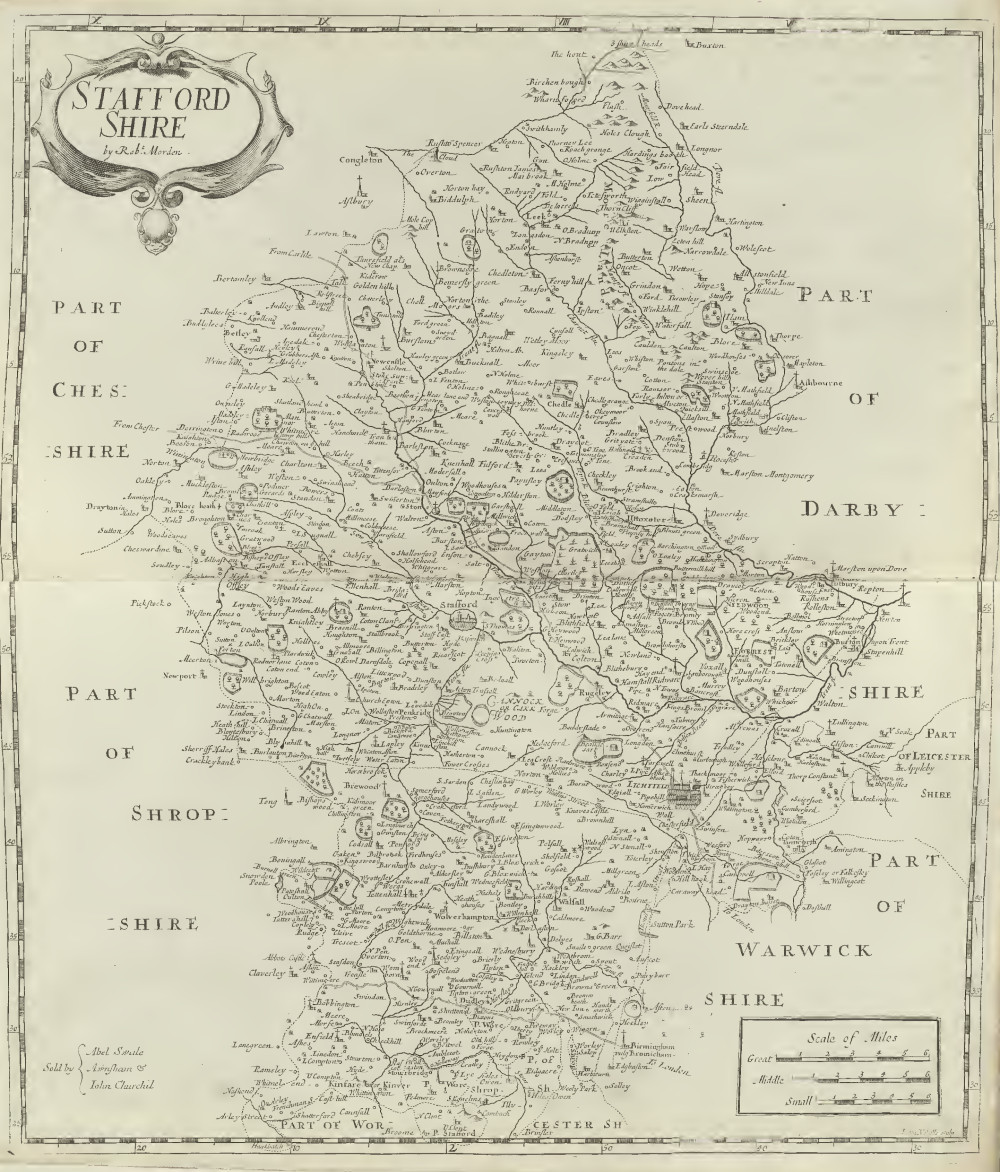
Illustration: Staffordshire
(Click here for larger version)
the third part of that country inhabited by the Cornavii, now Staffordshire, in Saxon Stafford-Scyre (the people whereof, as living in the heart of England, are called in Bede Angli Mediterranei, is bounded on the East by Warwickshire and Derbyshire, on the South by the county of Worcester, and on the West by Shropshire;) lies from South to North almost in the form of a rhombus, being broad in the middle, but narrow and contracted towards the ends of it. The North part is mountainous, and less fertile; but the middle, which is watered by the Trent, is fruitful, woody, and pleasant, by an equal mixture of arable and meadow grounds; so is also the South, which has much pit-coal and mines of iron; but whether more to their loss or advantage, the natives themselves are best judges; and so I refer it to them.
in this South part next to Worcestershire on the river Stour stands Stourton Castle, sometime appertaining to the Earls of Warwick, the place of the nativity of Cardinal Pole, stands first Dudley Castle, built by Dudo or Dodo, a Saxon, about the year 700, and so called from him. In William the First's time, (as it is in his survey-book) it belonged to William the son of Ausculphus; afterwards it fell to those of Somery; and at last to Sir Richard Sutton knight descended from the Suttons of Nottinghamshire, by marrying an heiress of the Somerys, whose posterity, called from that time barons of Dudley but first summoned to parliament by K. Henry 6, grew up to a very honorable family. Here is situated Pensneth Chase, in former times better stored with game than at present; where are found many coal-pits, in which (as it hath been related to me) there as yet continueth a fire began by a candle long since by the negligence of a certain grover or digger. The smoke of this fire, and sometimes the flame, is seen; but the scent oftener smelt. And other places of the like nature were showed to me not far off. On the confines of Shropshire, to the North-west, I saw Patshull, a seat of the Astleys, descended from honorable progenitors; and Wrottesly, an habitation of a race of gentlemen so surnamed; out of which Sir Hugh Wrottesly, on the account of his singular valour, was chosen by K. Edw. 3 Knight of the Garter at the first institution; and therefore esteemed as one of the founders of the said honorable order.
after this, we find memorable in this tract, Chillington, a very fine seat, and the manor of that ancient and famous family the Giffords, given to Peter Gifford in the reign of Hen. 2 by Peter Corbuchin, to whom also Richard Strongbow, who conquered Ireland, gave Tachmelin [St. Mullins] and other lands in that country. Wolverhampton, so called from Vulfruna, a very pious woman, who built a monastery in the town which before had the name of Hampton; and hence for Vulfrunes-Hampton, it is corruptly called Wolverhampton; which is chiefly remarkable for the college there, annexed to the dean and prebendaries of Windsor. Theoten Hall, that is to say, a house of pagans, now Tettonhall, where many of the Danes were cut off in the year 911 by Edward the Elder. Weadesburg, now Wednesbury, heretofore fortified by Ethelfleda governess of the Mercians, and Walsall are none of the meanest market towns. Near this lies the course of the river Tame, which rising not far off, runs for some miles on the East side of this county toward the Trent, passing at some small distance by Drayton Basset, the seat of the Bassets, who are descended from one Turstin Lord of this place in the reign of Hen. 1, and grown up into a numerous and famous family. For this is the stock, from which the Bassets of Willesden, Wycombe, Sapcott, Cheadle, and others of them, are propagated. But of these Bassets of Drayton, Ralph was the last, a very eminent Baron, who married the sister of John Montfort Duke of Bretagne, and died without issue in the reign of Rich. 2.
from hence the Tame passing through the bridge at Fazeley, over which an ancient Roman way lay, runs by the lower part of Tamworth, in Saxon Tamapeord, in Marianus Tamawordina, so situated between the borders of the two shires, that the one part of it which formerly belonged to the Marmions, is counted in Warwickshire; the other, which belonged to the Hastings, is reckoned in this county. It takes its name from the river Tame which runs by it, and the Saxon word weorth, which signifies a yard or farm, and also a river-island, or any place surrounded with water; as, Keyserswert and Bomelsweort, in Germany, signify Caesar's Island and Bomelus's Island. In the time of the Mercian kingdom, this was a royal seat, and, as it is in the Ledger-book of Worcester, a very eminent place. Afterwards it was destroyed in the Danish wars, but rebuilt by Ethelfleda the Mercian, and Editha the daughter of King Edgar, who declining marriage for the love of chastity, is calendared among the she-saints, and founded a little house for nuns here; which was some few years after translated to Polesworth by the Marmions of Normandy, when they built a collegiate church here, wherein some of their tombs are still extant, having had the town given them by William the Conqueror. Here likewise they built a neat castle, which from them went by the Frevilles to the Ferrars, a family descended from a younger brother of the barons Ferrars of Groby. These Marmions (as 'tis in history) were hereditary champions to the kings of England. For upon every coronation of a new King of England, the heir of this family was bound to ride armed in complete harness into the King's hall, and in a set form challenge any man to duel, that would dare to withstand the King's right. And this is certain from the public records, that Alexander Freville, in the reign of Edward 3 held this same castle by that kind of service. Yet the Frevilles lost this honour in the coronation of Rich. 2, when Baldwin Freville inhibited his petition for the same, it was adjudged from this family to Sir John Dymoke his competitor, descended also from Marmion, and producing more authentic records and evidences. Which went by marriage to the family of Dymokes in Lincolnshire.
but now to return. At the bridge of Fazeley already mentioned, Watling Street, that military Roman way which I have often before spoke of, and shall have occasion still to take notice of hereafter, enters this county, and crossing it almost in a straight line, runs westwardly to Shropshire. I surveyed it very accurately, in hopes of finding Etocetum, which Antoninus makes the next station after Manvessedum: and with good luck I have at last found it; and must ingenuously own myself to have been quite wrong heretofore. For at that distance which Antoninus makes between Manvessedum and Etocetum, I happened to meet with the ruins of an old city near this way, scarce a mile southward from Lichfield, eminent for the bishop's see there. The name of the place is at this day in English, Wall, from the remains of the walls there extant (which encompass about two acres of ground) called the Castle Croft, as if one should say, the castle field. Near this stood another ancient little city on the other side the way, which was demolished before William the Conqueror's time, as the inhabitants, from an old tradition, tell us; and they show the place where the temple stood, guessing it to be so from the greatness of the foundation; and produce many coins of the Roman Caesars, which are always the most infallible proofs of antiquity. But that which mainly makes for this point is, that the military way continues from hence very fair, plain, and almost without any breach, till 'tis crossed and interrupted by the river Penk, and hath a stone bridge built over it at Pennocrucium, so called from the river, and standing at the same distance which Antoninus has made. The town has not quite lost that name at this day, being for Pennocrucium called Penkridge. At present, 'tis only a small village, famous for a horse-fair, which Hugh Blunt, or Flavus the lord of it, obtained of King Edward 2. At a small distance from thence is Brewood, a market town, where the bishops of the diocese had a seat before the Conquest, and then near Weston is that clear and pretty broad lake near Weston, by which the way continues in a direct line to Oakengates in Shropshire.
And now for the middle-part of the county, watered by the Trent; in describing of which, my design is to trace the river from its first rise, following its course and windings.
the Trent, which in comparison is the third best river in England, springs from two neighbouring fountains in the North part of this shire, and amidst the moors or marshes, in the upper part of this county to the westward. Some ignorant and idle pretenders do imagine that name derived from the French word trente, and upon that account have feigned thirty rivers all running into it, and likewise so many kinds of fish swimming in it, the names of which, the people thereabouts have comprised in English rhyme. Neither do they stick to ascribe to this river what the Hungarians attribute to their Tibiscus, namely, that it consists of two parts water, and the third fish. From the rise of it, it first runs southward, with many windings, not far from Newcastle-under-Lyme, so called upon the account of an older castle which formerly stood not far from it at Chesterton-under-Lyme, where I saw the ruinous and shattered walls of an old castle, which first belonged to Ranulph Earl of Chester by the gift of King John, and after, by the bounty of Henry 3 to the house of Lancaster. Then by Trentham, heretofore Tricingham, a little monastery of that holy and royal virgin Werburga; from whence it hastens to Stone, a market town, which had its rise in the Saxon time, and its name from those stones which our ancestors were accustomed yearly to heap together to denote the place where Wolpherus, that most heathen King of the Mercians, barbarously slew his sons, Vulfald and Rufin, for turning Christians. At which place, when after ages had consecrated a little church to their memory, a town presently grew up, which the History of Peterborough tells us was called Stone from these stones. From Stone the Trent runs smooth and easy by Sandown, formerly the seat of the Staffords, a knightly and very famous family, but of late of Sampson Erdeswicke by inheritance, a very eminent man, who has nicely enquired into the venerable matters of antiquity, and is no less memorable upon this account, than for being directly in the male line descended from Hugh de Vernon, Baron of Shipbrooke, this name being varied by change of habitation, first into Holgrave, and after that into Erdeswicke.
here the Trent turns towards the East, with Cannock Wood on the South of it, which is every way of great extent; and at last receives the River Sow on the left. This river rises near Heighley Castle, built by the barons of Aldelegh or Audley, to whom this place was given by Harvey de Stafford, as likewise Aldelegh itself by Theobald de Verdon: and from these spring the family of the Stanleys Earls of Derby. Strange it is to read, what lands King Henry 3 confirmed to Henry Audely, which were bestowed on him through the bounty of the peers and even of private gentlemen, not only in England, but also in Ireland, where Hugh Lacy Earl of Ulster gave him lands, together with the constableship of Ulster; so that without doubt he was either a person of singular virtue, or a very great favourite, or an able lawyer, or perhaps was endued with all these qualifications. His posterity were all linked in marriage with the heirs of the Lord Gifford of Brimsfield, of Baron Martin Lord of Keimeis and Barnstaple; as also a younger brother of this house with one of the heirs of the Earl of Gloucester, who was by King Edward 3 created Earl of Gloucester. About which time James Lord Audley acquired a very great reputation on the account of his valour and skill in war-like affairs, who (as it is related by French historians) being dangerously wounded in the battle of Poitiers, when the Black Prince with many high commendations had given to him a pension of 400 marks per annum, bestowed it immediately on his four esquires, that always valiantly attended him, and satisfied the prince, doubting that his gift might be too little for so great service, with this answer, gratefully acknowledging his bounty: these my esquires saved my life amidst my enemies; and God be thanked, my ancestors have left me sufficient revenues to maintain me in your service. Whereupon the prince approving this prudent liberality, both confirmed his donation to his esquires, and besides assigned to him lands to the value of 600 marks yearly. But by his daughter, one of the co-heirs to her brother, the title of Lord Audley came afterward to the Tuchets, and in them continueth. I must not go on here without taking notice of that house called Gerards Bromley, both upon the account of its magnificence, and also because 'tis the chief seat of Thomas Gerard, whom King James in the first of his reign created Baron Gerard of Gerards Bromley.
the Sow keeps like a parallel line at equal distance from the Trent, and runs by Chebsey, which formerly belonged to the Lords Hastings, reckoned among the principal noblemen in the time of King Edward the First; and then not far from Eccleshall, the residence of the Bishop of Lichfield; and Ellenhall, which formerly was the seat of the Noels, a famous family, who founded a monastery here at Ranton: from them it descended hereditarily to the Harcourts, who are of an ancient and noble Norman race, and flourished for a long time in great dignity. Of the male line of these Noels is Andrew Noel of Dalby an eminent knight, and the Noels of Wellsborough in the county of Leicester, and others remaining at this day. From hence the Sow runs by Stafford, heretofore Statford, and first of all Bethany, where Bertelin with the reputation of great sanctity lived formerly an hermit. Edward the Elder in the year 914 built a tower upon the North side of the river here. When William the First took his survey of England, as it is said in Domesday Book, the King had only eighteen burgesses here belonging to him, and twenty mansions of the honour of the Earl; it paid for all customs nine pounds in deniers and had 13 canons-prebendaries, who held in frank-almoin. In another place; the King commanded a castle to be made there, which was lately demolished. But at that time, as it is at this day, Stafford was the chief town of this county, which owes its greatest glory to Stafford, a castle adjoining to it, which the Barons of Stafford, of whose progeny were the Dukes of Buckingham, built for their own seat: who prevailed with King John to erect it into a borough with ample liberties and privileges, caused to be partly enclosed with a wall, and founded a priory of Black Canons in honour of St. Thomas of Canterbury. Below this the Sow is joined by a little river called Penk, which gives name to Pennocrucium an ancient town, of which we have already made mention. Near the confluence of the Sow and the Trent stands Tixall, where the family of the Astons dwell, which for antiquity and kindred, is one of the best families in these parts.
with these waters the Trent glides gently through the middle of the county to the eastward, having Chartley Castle at two miles distance on the left of it, which from Ranulph Earl of Chester who built it, fell to the Ferrars, by Agnes his sister who was married to William de Ferrars Earl of Derby, from whom descended and flourished the lords Ferrars of Chartley; and Anne the daughter of the last of them, brought this honour with her as a portion to Walter Devereux her husband, from whom is Robert Devereux Earl of Essex, and Lord Ferrars of Chartley. On the right side of this river, almost at the same distance, stands Beaudesert, most delicately seated among the woods, formerly the house of the Bishops of Lichfield, but afterwards of the barons Paget. For William Paget, (who for his great prudence and knowledge of the world, being eminent both at home and abroad, was in great favour with Henry the Eighth and King Edward the Sixth) having got a large estate, was created Baron Paget of Beaudesert by Edward the Sixth. He was (as it may be collected from his epitaph) Secretary and Privy Counsellor to King Henry 8, and constituted by his testament Counsellor and Adjutant to King Edward the Sixth during his minority; to whom he was Chancellor of the Duchy of Lancaster, Comptroller of the Household, and by him created (as I have already intimated) Baron and Knight of the Garter, as also by Queen Mary, Lord Privy Seal. His grandson Thomas, the fourth Baron, flourishes now at this day, who by his virtue, and progress in the best kinds of learning, is a grace and ornament to his whole family, and in this respect but justly distinguished by an honourable mention here.
from hence the Trent visits Lichfield, scarce four miles distant from the right side of it. Bede calls it Licidfeld, which Rous of Warwick renders a field of carcasses, and tells us that many Christians suffered martyrdom there under Diocletian. The city stands low, is pretty large and neat, and divided into two parts by a kind of lough or clear water which is but shallow: however, they have communication with one another by two causeways made over it, which have each of them their respective sluices. The South part, or that hithermost, is by much the greater, divided into several streets, and has in it a school, and for the relief of poor people a pretty large hospital dedicated to St. John. The further is the less, yet beautified with a very sightly church, which with the fine walls (that castle like surround it) those fair neat houses for the prebendaries,<299> and the bishop's palace, all about it, makes an incomparable show, with those three lofty pyramids of stone in it. This was a bishop's see many ages since. For in the year of our redemption 606 Oswy King of Northumberland having conquered the pagan Mercians, built a church here for the propagation of the Christian religion, and ordained Duina the first bishop, whose successors were so much in favour with their princes, that they not only had the pre-eminence among all the Mercian bishops, and were enriched with very large possessions, Cankwood or Cannock a very great wood, and other exceeding rich farms, being given them: but the see also has had an Archbishop, namely Eadulph, to whom Pope Adrian gave the pall, and made all the bishops of the Mercians and the East Angles subject to him, being induced to it by the golden arguments of Offa King of the Mercians, out of envy to Jeambert or Lambert Archbishop of Canterbury, who offered his assistance to Charles the Great if he would invade England. But this archiepiscopal dignity expired with Offa and Eadulph. Among the bishops the most eminent is Chad, who was canonized for his sanctity, and, as Bede says, when the prelacy was not as yet tainted with excess and luxury, made himself a house to live in not far distant from the church, wherein with a few others, that is, with seven or eight of his brethren, he was wont privately to read and pray as often as he had leisure from his labour and administering of the word of God. In that age Lichfield was but a small village, and in populousness far short of a city. The country about it is woody; and a little river runs near it. The church was but of small circuit, according to the meanness of those ancient times. When in a synod 1075 'twas prohibited that bishop's sees should be in obscure villages, Peter Bishop of Lichfield transferred his seat to Chester. But Robert of Limesey his successor, removed it to Coventry. A little after, Roger Clinton brought it back again to Lichfield, and began a very fine church in 1148 in honour to the Virgin Mary and St. Chad, and repaired the castle, which is quite decayed, and nothing of it to be seen at this day. The town within the memory of our fathers was first incorporated under the name of bailiffs and burgesses by K. Edward the Sixth. It is 52 degrees and 42 minutes in latitude; and in longitude 21 degrees, 20 minutes.
This lake at Lichfield is at first pent up into a narrow compass within its banks, and then it grows wider afterwards, but uniting itself at last into a channel, it presently falls into the Trent, which continues its course eastward till it meets the river Tame from the South; in conjunction with which it runs through places abounding with alabaster. To the northward, that it may sooner receive the River Dove, and almost insulate Burton, formerly a remarkable town, for the alabaster-works, for a castle of the Ferrars built in the Conqueror's time, for an ancient monastery founded by Ulfric Spot Earl of the Mercians, and for the retirement of Modwena an Irish woman. Of the abbey, the Book of Abingdon speaks thus; a certain servant of King Ethelred's, called Ulfric Spot, built the abbey of Burton, and endowed it with all his paternal estate, to the value of 700l. And that this gift might stand good, he gave King Ethelred 300 marks of gold for his confirmation to it, and to every bishop five marks, besides the town of Dumbleton over and above to Aelfric Archbishop of Canterbury. So that we may see from hence, that gold was predominant in those ages, and that it swayed and byassed even in spiritual matters. In this monastery Modwena, eminent for her sanctity in these parts, lies buried, and on the tomb these verses were inscribed for her epitaph:
ortum Modwennae dat Hibernia, Scotia finem.
anglia dat tumulum, dat Deus astra poli.
prima dedit vitam, sed mortem terra secunda,
et terram terrae tertia terra dedit:
aufert lanfortin quam Terra Conallea profert,
foelix Burtonium virginis ossa tenet.
by Ireland life, by Scotland death was given,
a tomb by England, endless joys by heaven.
one boasts her birth, one mourns her hopeless fate,
and one does earth to earth again commit.
lanfortin ravished what gave,
and pious Burton keeps her sacred grave.
near Burton, between the rivers Dove, Trent, and Blyth (which waters and gives name to Blithfield, the delicate house of an ancient and famous family of the Bagots) stands Needwood, a large forest, with many parks in it, wherein the gentry hereabouts frequently exercise themselves with great labour and application in the pleasant toils of hunting. So much for the inner parts.
the North part of the county gently shoots into small hills, which begin here, and as the Apennines do in Italy, run through the middle of England in one continued ridge, rising higher and higher from one top to another, as far as Scotland, but under several names. For here they are called Moorland, after that Peak, then again Blackstone Edge, anon Craven, next Stanmore, and last of all, when they branch out apart into horns, Cheviot. This Moorland (which is so called because it rises into hills and mountains, and is unfruitful, which sort of places we call in our language moors) is a tract so very rugged, foul, and cold, that snow continues long undissolved on it; so that of a country village here called Wotton, seated at the bottom of Weaver Hill, the neighbours have this verse among them, intimating that God never was in that place:
Wotton under Weaver,
where God came never
nevertheless in so hard a soil it brings forth and feeds beasts of a large size.
'Tis observed by the inhabitants here, that the West wind always causes rain; but that the East wind and the South wind, which are wont to produce rain in other places, make fair weather here, unless the wind shift about from the West into the South; and this they ascribe to their small distance from the Irish Sea. From these mountains rise many rivers in this shire; the chief are the Dove, the Hamps, Churnet, Tean, Blithe, and Trent which receives them all, and carries them with it into the sea. The Dovus or Dove, banked with hard limestone, which they burn to manure their fields with, runs swiftly for a great way along the East part of this county, severing it from Derbyshire by its white clayish channel, without any shelves of mud in it. Lying in a limestone soil, it sucks in such richness from it, that in the very middle of winter the meadows on both sides of it look fresh and green; and if it overflows and lays the meadows afloat in April, like another Nile, it makes them so fruitful, that the inhabitants thereabouts joyfully tell you their common rhyme;
in April Dove's flood
is worth a King's good.
this river will swell so much in twelve hours time, that to the great terror of the inhabitants thereabouts, it will wash off sheep and cattle, and carry them along with it; yet falls again within the same time, and returns to its old bounds: whereas the Trent, being once over the banks, keeps the field in float four or five days together. But now for those rivers which run into it: the first is Hamps, which dipping under ground, breaks out again three miles off. The next that joins it is the Churnet, which runs by Dieu-La-Cres Abbey, built by Ranulph the third of that name, Earl of Chester, Leek noted for its market; and then Alton, formerly the castle of the barons de Verdon who founded here the abbey of Croxden, from whom by the Furnivals it descended to the Talbots Earls of Shrewsbury. A little lower, the Tean, a small river, runs into the Dove, which rising not far from Cheadle, the ancient seat of the Bassets, descended from the Bassets of Drayton, runs on in a course so uneven and winding, that in a mile's riding I had it to cross four times. Near this, in Checkley churchyard, stand three stones raised spire-like, two of which have little images cut out in them; and that in the middle is the highest. The inhabitants talk of an engagement between two armies there, the one with weapons, the other without, and that three bishops were slain in that battle, in memory of whom these stones were erected. What historical truth may be veiled under this story, I am not as yet sensible. As for Blyth, it hath in this moorland a little castle named Caverswall, which Sir William Careswell built; with great ponds having their heads made of square stones; and Draycott, which gave a surname to a family of great antiquity in this country.
now the Dove after it hath received Tean runs under a firm stone bridge to Uttoxeter, in Saxon Uttok-Cester, seated upon a hill of easy ascent, and rather rich upon the account of its fine meadows and cattle, than neat and handsome in respect of building. Before I saw it, I took it for Etocetum, being induced to this opinion by the affinity of the two names. But now time has furnished me with more certainty in this matter. Afterwards where the Dove draws towards the Trent it sees Tutbury Castle, formerly very large, and also called Stutesbury, commanding as it were the lower country by its high situation on an alabaster hill; built (with the little monastery) by Henry de Ferrars a noble Norman, to whom William the First gave large possessions in this county, which were all lost by Robert de Ferrariis Earl of Derby, upon his second revolt from Hen. 3. For though after the many troubles he had raised in the Barons' War, he was received again into favour by the King, and then bound by a strict oath to be faithful to him for the future; yet the restless temper of this man (that he might make fortune comply by force since he could not by caress and courtship) soon after hurried him again into arms against his sovereign; and being at last took, that I may use the words of the record, according to the form of his obligation he suffered this great loss of his whole estate and honour. There is a lake some where in this shire, if Necham does not deceive us, into which no wild beast will enter upon any account: but since the place is uncertain, and indeed the thing more, I will only subscribe these verses of Necham's about it, entitled by him
de lacu in Staffordia.
rugitu lacus est eventus praeco futuri,
cujus aquis fera se credere nulla solet.
instet odora canum virtus, mors instet acerba,
non tamen intrabit exagitata lacum.
Of a Lake in Staffordshire
a lake that with prophetic noise does roar,
where beasts can ne'er be forced to venture o'er.
by hounds, or men, or fleeter death pursued,
they'll not plunge in, but shun the hated flood.
of another lake also in this county, Gervasius Tilburiensis, in his Otia Imperialia to Ocho the Fourth, writes thus; in the bishopric of Coventry, and in the county of Stafford, at the foot of the mountain Mahull, so called by the inhabitants, there is a water like a lake very broad, in the out-grounds of a village which they call Magdalea. There is great store of wood all along upon the lake, the water of which is very clear, and so effectual in refreshing, that when the hunters have given chase to a stag or other wild beast till their horses are spent and weary, if they drink of this water in the scorching heat of the sun, and likewise water their horses with it, they recover their strength to run again to that degree, that one would think they had not run at all.
as for the title of Stafford, it has continued from Robert of Stafford (whom William the Norman enriched with great possessions,) in his posterity, till our times. A family exceeding eminent and old: and which has undergone several turns of fortune. For first they were barons of Stafford, then few of them earls, viz. Ralph created by K. Edw. 3. Earl of Stafford, who married the heiress of Hugh Audley Earl of Gloucester; Hugh his son, who died in pilgrimage at Rhodes, and his three sons successively, Thomas and William both without issue, and Edmund who took to wife the daughter and heiress of Thomas of Woodstock Duke of Buckingham. Afterward, three of them were Dukes of Buckingham, and Earls of Stafford, &c. As it hath been before declared. By the attainder of the last of them, those ample inheritances, &c. Then earls, after that Dukes of Buckingham and Earls of Stafford. And now 'tis their ill fortune to be fallen back to their old title of Baron only; and those great estates which they have gained by their most honourable marriages, are as it were fled and scattered. In lieu whereof, they enjoy a happy security, which never cohabits with greatness and great men.
there are 130 parishes in this county.
additions to Staffordshire.
as Staffordshire has the advantage of two ancient ways running through it, which have secured to us some considerable remains of Roman antiquity; so is it remarkable for several engagements and revolutions relating to the Saxon and Danish times. For the British, it is not altogether so considerable; though there want not some small footsteps of that people, which the discovery of such weapons as we know they formerly used, point out to us. But whatever curiosities or rarities it might have afforded, the world must have been in a great measure strangers to them, if it had not fallen under the search of the learned Dr. Plot, both as to its natural history, and also its antiquities, which he has given us by way of appendix, without mixing them with the body of his work. The latter of these is our business at present, wherein he must be our greatest guide whilst we travel over this county.
to begin with Mr. Camden; Dudley Castle, he tells us, descended from Fitz-Ausculph to the Somerys; but between these two were the Paganals, whereof Gervase Paganal founded a priory there. From that family it next descended, by an heiress, to the Somereys; from whom, by a co-heir, it came to Sir John Sutton, descended from the Suttons of Nottinghamshire: afterwards the Dudleys were possessed of it, from whom it passed, by the daughter and heir of Sir Ferdinando Dudley (son and heir of the last Lord Dudley) to Humble Lord Ward of Birmingham.
more towards the North is Wolverhampton, which had by K. Hen. 3 a fair granted to it upon the eve and day of St. Peter and St. Paul; and also a market weekly on Wednesdays. There is in it a free-school founded by Sir Stephen Jennings, sometime Lord Mayor of London.
from hence passing by Tettenhall, we go to Wrottesley, eminent for the remains of some old British or other antiquity, whether fortification or city; though my author inclines to the latter, because of the several partitions like streets running divers ways, within the limits of it, as also the large hinges which have been found there, and some of the stones squared. The whole contains in circuit about 3 or 4 miles; and stones of a vast bigness have been found hereabouts, whereof one made 100 loads; another, after 10 loads of stone were hewn off it, required 36 yoke of oxen to draw it, and made the great cistern in the malt-house at Wrottesley, which, though left very thick both at bottom and sides, will yet wet 37 strikes<317> of barley at a time. If the historical account of the Danes here in England can assert this monument to them, I have nothing to object against it; but so far as that opinion is grounded upon Mr. Camden's interpretation of Theoten Hall (which is near,) it is very false: for that name implies no more than the hall or palace of a Lord, without any necessary relation to heathens or Christians. If the construction of paganorum aedes were true, the argument were certainly undeniable, since everybody knows, that the Danes, in all our historians, go under the name of pagani.
seisdon, upon the edge of Shropshire, offers itself next to our consideration, near which, at a place called Abbots, or Apewood Castle, there is an ancient fortification, standing on a lofty round promontory, with a steep ridge for a mile together, having hollows cut in the ground, over which 'tis supposed anciently they set their tents. The hills at each end, which seem to have been the bastions, make it probable that the whole has been one continued fortification. Whether it be Roman or British is not so easily determined; only, we know of no signal action hereabouts; which makes it more probable that 'tis British, because if it had been Roman, their histories might perhaps have left us some account of it. And Tacitus makes it plain that the Britons did fortify as well with earth cast up, as stones, when he tells us that the Iceni chose a place septum agresti aggere, aditu angusto, ne pervius equiti foret; where the agrestis agger does most probably signify a bank of earth.<318>
towards the South-east from hence, is King's Swinford, in which parish, upon Ashwood Heath, there is a large entrenchment, that measures about 140 paces over; which notwithstanding its distance from the way, is yet, in the opinion of the learned Dr. Plot, really Roman, i.e. a tent or castrametation; made at that distance on the account of their being drawn off from their ways and ordinary quarters, to skirmish with the enemy as occasion might require. In this parish likewise, at Barrow Hill, are two uniform barrows or tumuli all rock; which notwithstanding, Dr. Plot thinks to have been earth at first, and turned into stone by subterraneal heats.
at the utmost South borders of this county, lies Clent, famous for the death of St. Kenelm, slain at seven years of age by the contrivance of his sister Quendred.
not far from whence is Kinver or Kinfare, where is an old fortification of an oblong square, about 300 yards long, and 200 over. The name will answer either a Danish or Saxon original; so that to conclude upon either barely from that, is a false bottom. And the signification does not imply that anyone was killed there. For fare, though it signifies a going, an expedition, or journey; yet I am confident it never denotes passing into another world. I should rather believe that some King in his march had stoped there, or made that his head-quarters, and so derived the name upon it.
going to Watling Street, we meet with Hints; near which place is a large Roman tumulus, now (like those at Barrow Hill) turned into a hard rock. There are more Roman barrows upon this street; one at Cat's Hill, two on Calf Heath, another near Great Saredon.
on the edge of Warwickshire, is Tamworth, which the Saxon annals call Tamanpeorthige. In the year 781, it appears to have been the palace of the Mercian kings, by a grant of Offa to the monks of Worcester, which is dated from his royal palace there. A square trench is still remaining by the name of King's Ditch, which is very large. That there was a castle before Ethelfled's time, is very plain; because, she only repaired it after it had been demolished by the Danes: but by whom it was first made a place of strength, does not appear.
a little further towards the North lies Elford, where is a Roman tumulus, the description whereof, after a curious examination, Dr. Plot has given us. Level with the surface of the ground about it is a moist blackish sort of earth without any mixture of gravel or stones, about 2 yards diameter, and a foot and half deep in the middle, lying much in the same form with the tumulus itself; on the edge whereof, the same author observed ashes and charcoal in their true colours, and several pieces of bones in the middle of it so friable, that they would crumble betwixt the fingers. Which plainly proves it to be Roman, unless (which does not appear) the Saxons or Danes ever burnt their dead bodies.
upon the Roman way near Lichfield, we find a village called Wall, which is supposed to have taken that name from the fragments of an old wall upon the North side of Watling Street. Mr. Camden does rightly suppose it to be the Etocetum of Antoninus, and the two ancient pavements wherein there appear Roman bricks, with the remains of antiquity discovered at Chesterfield on the other side of the way, put it beyond all dispute.
the next station in this county is Pennocrucium, which Mr. Camden had encouragement enough, both from Antoninus's distances, and the affinity of the old and new names, to settle at Penkridge; and yet one objection (its lying from the great way at least two miles) considering the design of these stations, goes very hard against it. Stretton (as Dr. Plot has settled it) which has the advantage of standing upon the way, may, no doubt, lay a juster claim to it. The name too favours the conjecture; for a little experience will teach anyone thus much, that where street or chester is part of the name, a man shall seldom lose his labour in the search after antiquities.
a little below the way southward, near Featherstone in the Parish of Breewood, was found a brass head of the bolt of a catapult; another was likewise discovered at Bushbury, a third in the biggest of the lows upon the Morridge, and a fourth at Handsworth; all of brass, and much of the same form; which Dr. Plot has given us in the 5th figure of his 33rd table. From this it is certain, that all these are Roman tumuli, and probably places of some action.
from the directions of the way, let us pass to the head of the great river Trent, near which is Newcastle-under-Lyme, built in Hen. 3's time by the Earl of Lancaster, and so called, in respect of another at a little distance, Chesterton-under-Lyme, where Mr. Camden found an old castle half demolished; but now nothing but some very obscure remains are to be seen.
from hence the river leads us to Darlaston; where in a place called Burybank, on the top of a hill, are the ruins of a large castle fortified with a double vallum and entrenchments, about 250 yards diameter. This, according to tradition, was the seat of Ulfere King of Mercia, who murdered his two sons for embracing Christianity. The whole passage at large see in Dr. Plot's History of Staffordshire, p. 407. The next place we meet with memorable, is Cank or Cannock Wood, upon the edge whereof, in the park at Beaudesert, there remains a large fortification called the Castle Hill, encompassed with a double agger<319> and trench, which are in a manner circular, except on the South-east side. What Dr. Plot conjectures, is highly probable, that it was cast up by Canute, when he made such dismal waste of those parts, as our historians talk of.
Our next guide is the river Sow, about the head whereof is Blore Heath, where a stone, set up in memory of James Lord Audley, deserves our notice. He was slain in that place fighting against the Earl of Salisbury in the quarrel of Hen. 6, in which battle no less than 2400 were slain upon the spot.
from hence this river directs us to Eccleshall, the castle whereof was either built from the foundation, or at least repaired, by Walter de Longton Bishop of Lichfield and Lord High Treasurer of England, in the reign of Edw. 1. Not far from which is Wotton, where is a high-paved way, which Dr. Plot imagines to have been a Roman via vicinalis, or by-way from one town to another.
going nearer to Stafford, we meet with Ellenhall, famous for the family of the Noels; of the male heirs whereof are still remaining those of Hilcote hard by, as also Baptist Earl of Gainsborough, and some others.
nearer the Trent, upon the same river, lies Stafford, where Ethelfled the Mercian Queen built a castle, whereof there is nothing remaining; that upon the hill, at a mile's distance from the town, being built by Ranulph or Ralph the first Earl of Stafford, a long time after. And Mr. Erdswick concludes, he only re-edified the castle, and not new built it, because he had seen a certain deed dated from the castle near Stafford long before the days of Earl Ralph. But Dr. Plot is of opinion, that the old castle there mentioned might rather stand within the entrenchment at Billington, which perhaps (says he) may be only the remains of this castle; the lands wherein these entrenchments are, being not far distant, and still remaining a part of the demesne land of the barony of Stafford.
near the meeting of Sow and Trent is Tixall; not far from whence stands Ingestre, an ancient seat of the family of the Chetwynds; the last owner of which (who died without issue A.D. 1693.) was Walter Chetwynd Esq. a gentleman eminent, as for his ancient family and great hospitality, so for his admirable skill in antiquities, the history of Staffordshire receiving great encouragement from him. He was likewise a person of a charitable and public spirit, as appeared by new building the parish church of Ingestre after a very beautiful manner, and also adding to the vicarage such tythes as remained in his hands.
about four miles from the Trent lies Lichfield, where a thousand Christians (who had been instructed by St. Amphibalus in a place called Christianfield) were martyred, and their bodies left unburied to be devoured by birds and beasts; from whence the city bears for their device, an escutcheon of a landscape with many martyrs in it, in several manners massacred. This place, since our author's time, has given the honourable title of Earl, first to Bernard Stewart, youngest son of Esme Duke of Lennox and Earl of March, created in the 21th year of Charles the First. Being slain at the battle at Rowton Heath in Cheshire, he was succeeded by Charles Stewart his nephew, who died ambassador in Denmark in 1672. About two years after, the title was conferred upon Edward Henry Lee, created June 5. 1674 Baron of Spellesbury, Viscount Quarendon, and Earl of Lichfield.
not far from hence is Streethay, the name whereof seems to be taken from its situation upon the old way, called Icknield Street; and its distance from Stretton (another town lying upon the same road, and claiming the same antiquity on account of its name) being about 12 miles, makes it reasonable enough to suppose that these two might be stations for the reception of the armies in their march. Upon the East side of the road, between Streethay and Burton, stands Eddinghall where is a raised way, pointing towards Lullington in Derbyshire, which Dr. Plot is of opinion might probably be one of the Roman viae vicinales, or by-roads, which they had beside their great highways, for the convenience of going between town and town.
more to the West is Blithfield, the seat of the Bagots, as Mr. Camden tells us. It came into this family by the marriage of the daughter and heir of Blithfield, in the reign of Edward the Second. Before which time they were seated at the neighbouring village of Bagots Bromley. From this family were also descended the ancient barons of Stafford, afterwards Dukes of Buckingham. Further northward, and not far from Checkley, by a small brook called Peak, are the stately ruins of Croxden Abbey, formerly a monastery of Cistercian monks, founded by Theobald de Verdon, a Norman Baron, about the time of Henry the Second.
continuation of the Lords.
after Edward Stafford last Duke of Buckingham of that name, there were three of that family, who enjoyed the title of Lord Stafford, Henry, Edward, and another Henry: the daughter of the last being married to William Howard, son of Thomas Earl of Arundel and Surrey. King Charles the First created this her husband, Nov. 1640, Viscount and Lord Stafford.
more rare plants growing wild in Staffordshire.
<131>
the mountainous part of this country, called the Moorlands, produceth the same plants with the Peak country of Derbyshire. The more depressed and level parts, with Warwickshire.
at a village called Warton in this county, about two miles distant from Newport in Shropshire, grow in plenty the abies Ger. Park. foemina, sive elate geleia J.B. The Female or Yew-Leaved Fir Tree: which whether they were native of this place, or anciently planted here, is some question. That they were natives Dr. Plot gathers not only from their disorderly natural situation, and excessive height, to which planted trees seldom arrive, but chiefly from the stools or stumps of many trees which he suspects to have been firs found near them, in their natural position in the bottoms of mosses and pools, (particularly of Shebben Pool) some of the bodies whereof are daily dug up at Loynton, and in the old peewit pool in the same parish where these now grow.
sorbus pyriformis D. Pitt. The Pear-like Service. I have already declared my opinion, that this is no other than the common Service Tree. Dr. Plot tells us that it grows in the Moorlands at many places.
sambucus fructu albo Ger. Park. fructu in umbella viridi C.B. acinis albis J.B. White-Berried elder. In the hedges near the village of Combridge plentifully. Dr. Plot Hist. Nat. Staff.
tripolium minus vulgare. The Lesser Sea Starwort. Said to grow in the grounds of Mr. Chetwynd of Ingestre, within two miles of Stafford, in a place called the Marsh, near the place where the brine of itself breaks out above ground, frets away the grass, and makes a plash of salt-water. Dr. Plot. Hist. Nat. Staff.