Camden's Britannia

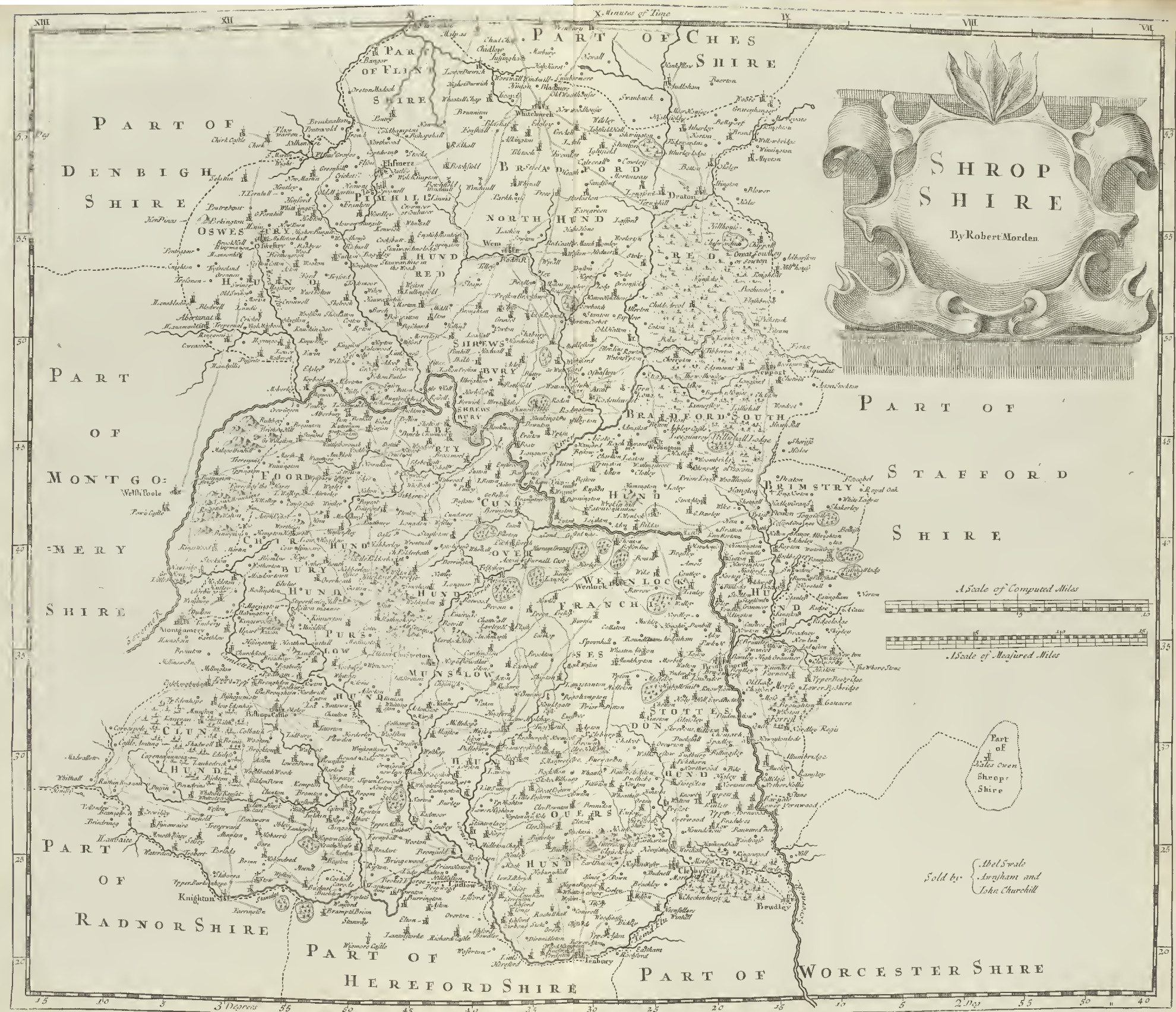
Illustration: Shropshire
(Click here for larger version)
The fourth division of that country which (as 'tis generally believed) the Cornavii did inhabit, was known in the Saxons' time by the name of Scrobbes-byrig-scyre, and Scrobb-scire; as by the later writers Scropscire, and Salopschire; and others nearer our times, Schropshire, Sciryp-scyre and Shrobbe-scyre, which we call Shropshire, and the Latins Comitatus Salopiensis. It much exceeds the rest in compass, and is not inferior to any of them in the fruitfulness of its soil, or the pleasure it affords. 'Tis bounded on the East by Staffordshire, on the West by Montgomeryshire and Denbighshire, on the South by Worcestershire, Herefordshire, and Radnorshire, and northward by Cheshire. 'Tis environed on every side with towns and castles, being a frontier county, or (as Siculus Flaccus words it) ager arcifinius, of great use in checking the excursions of their Welsh neighbours; from whence, the borders of it towards Wales were called in the Saxon language the Marches, being the limits between them and the English. In this country some noblemen were intitled Barones Marchiae, Lords Marchers, who exercised within their respective liberties a sort of Palatinate jurisdiction Palatinate jurisdiction, and held courts of justice to determine controversies among their neighbours, and prescribed for several privileges and immunities; one of which was, that the King's writs should not run here in some causes. But notwithstanding that, whatever controversy arose concerning the right of Lordships, or their extent, such were only determinable in the King's courts of justice. We find these styled formerly Marchiones de Marchia Walliae, Marquesses of the Marches of Wales, as appears by the Red Book in the Exchequer, where we read, that at the coronation of Queen Eleanor, consort to Henry the Third, these Marquesses, or Lords Marchers of Wales, viz. John FitzAlan, Ralph de Mortimer, John de Monmouth, and Walter de Clifford, in behalf of the Marches, did claim in their right, to provide silver spears, and bring them this privilege of supporting the square canopy of purple silk at the coronation of the kings and queens of England. But peaceful times and kingly power has by degrees abolished the private rights of these lords which they enjoyed and insolently exercised over the poor inhabitants in the Marches; and the right to support the canopy belongs (amongst other immunities and privileges) to the inhabitants of the Cinque Port towns. Yet I would not be understood (therefore I use it as a caution) that all this country belonged to the Cornavii, but so much only as lies on this side the Severn. That on the other side, was peculiar to the Ordovices, who spread themselves far; some part of whose country (as also some small parcels on this side Severn, which belonged to the Lords Marchers) were laid to this shire not long since by Act of Parliament. This division of the whole shire is the more proper and convenient, because the river Severn parts it from the West, to the South-east point. 'Tis bounded on the South side of Severn by the River Teme, in Welsh, Tifidiauc, which at some distance is joined by the River Clun, in Welsh Colunwy, and riseth higher up in the country, not far from a well-frequented little town, called Bishop's Castle, because it belonged to the bishops of Hereford, whose diocese takes in a great part of this shire. It gives denomination to Clun or Clune Castle, which was built by the FitzAlans, who were descended from one Alan the son of Flaold a Norman, and were afterwards Earls of Arundel, at such time as they were Lords Marchers here, and annoyed the Welshmen with their frequent inroads: but where it meets the River Teme, among several dangerous fords, ariseth a hill of great antiquity, called Caer Caradoc, because about the year of our Lord 53, Caratacus a renowned British King, environed it with a bulwark of stone, and defended it gallantly against Ostorius and the Roman legions; till they, by making a breach with no great difficulty in so slight a stone-work, (some ruins of which are yet to be seen) forced the disarmed Britons to betake themselves to the tops of the mountains. The King himself escaped by flight, but his wife, daughter, and brethren were taken prisoners; yet was not his escape successful, (there being no security against ill destiny,) for afterwards he was delivered up to Ostorius by Queen Cartismandua (with whom he had intrusted himself) and carried to Rome; where, notwithstanding he had engaged the Romans in so tedious and toilsome a war, he procured his pardon and his family's of Claudius Caesar by no base or precarious solicitation, but by a noble and majestic freedom of address. For the taking this hill, and Caratacus prisoner, a triumph was decreed to Ostorius; nor did the captive King seem a less prize to the senate, than the two royal prisoners, Syphax, whom P. Scipio, and Perses, whom L. Paulus presented to the Romans. And notwithstanding our sorry historian has omitted both the account of this battle, and this gallant Britain, yet is not his memory, nor the story, extinct among the country people. They tell us, that a King was beaten upon this hill, and in the Welsh-book called Triades, amongst three of the most renowned British heroes, Caradauc Urichfras is the chief, who to me seems undoubtedly to have been this very Caratacus.
Next stands Ludlow, in Welsh Dinan, and Lys-Twysoc, that is, the prince's palace; 'tis seated upon a hill, at the joining of the Teme with the River Corve, a town of greater beauty than antiquity. Roger de Montgomery first built a castle here, beautiful and strong, upon the River Corve; and from thence enclosed it with a wall, about a mile in compass. This, when his son Robert was banished, King Henry the First held, and defended against King Stephen, who laid close siege to it; where Henry son of the King of Scots, being lifted from his horse by an iron-hook, had like to have been drawn within the walls, had not King Stephen himself assisted him, and brought him off by his singular courage. Afterwards King Henry the Second gave this castle, with the vale below it along the Corve (commonly called Corvedale) to Fulk de Dinan; next it came to the Lacys of Ireland, and by a daughter, to Geoffrey de Jenevile a Poitevin, or (as some say) of the house of Lorraine, from whose posterity it descended again by a daughter to the Mortimers, and from them it fell hereditarily to the crown. Afterwards, the inhabitants themselves erected a fair church in this place, upon the highest ground in the heart of the town, the only one they have; and from this time we may date its reputation and eminence beyond any hereabouts. Though King Stephen, Simon de Montfort, and Henry the Sixth did damnify it much by their civil wars, yet it always recovered itself; but more especially, ever since King Henry the Eighth established the Council of the Marches, not unlike the French parliaments; the Lord President whereof doth keep his courts here, which seldom slacken in business; whether it be owing to the sovereign jurisdiction here exercised, or the litigious temper of the Welsh people. This council consists of a Lord President, and as many Counsellors as the King pleases, a Secretary, an Attorney, a Solicitor, and the four Justices of the counties of Wales.
lower upon the River Teme we see Burford, which from Theodoric Say's posterity descended to Robert de Mortimer, and from his heirs to Geoffrey de Cornubia, or Cornwall, of the lineage of Richard Earl of Cornwall and King of the Alemans; whose heirs, even to our days, have bore the honourable title of barons, but were not such barons as might sit in Parliament. Burford is held of the King, to find five men towards the army of Wales, and by the service of a barony, as appears by the inquisition. But, observe by the way, those who held an entire barony were formerly reputed barons, and some sages of the common law will have Baron and barony, to have been conjugates, like earl and earldom, duke and dukedom, king and kingdom.
Teme here leaves Shropshire, and by its northern banks arise some hills of no difficult ascent, called Clee Hill, famous for producing the best barley, and not without some veins of iron; at the bottom of which, in a little village called Cleobury, Hugh de Mortimer built a castle, which immediately King Henry the Second so entirely demolished, finding it a nursery of rebellion, that scarce any remains of it are visible at this day: and Kinlet, a seat of the Blunts, a name very famous in these parts, denoting their golden locks, blunt signifying yellow hair, in the Norman tongue. This is a very ancient and honourable family, and hath spread its branches far. Then we see Brugmorfe, commonly called Bridgnorth, on the right hand bank of the Severn, so called of burgh and Morfe a forest that adjoins to it, before called Burgh only; a town enclosed and fortified with walls, a ditch, a castle, and the river Severn, which with a very steep fall, flows in amongst the rocks. It stands secure upon a rock, through which the ways that lead into the upper part of the town, were cut. 'Twas first built by Edelfleda, Lady of the Mercians, and walled round by Robert de Belism Earl of Shrewsbury, who relying upon the strength of the place, revolted from Henry the First, as likewise did Roger de Mortimer from Henry the Second, but both with ill success; for they were forced to surrender, and so were quieted. At the siege of this castle (as our chronicles say) King Henry the Second had like to have lost his life by an arrow, which being shot at him, was intercepted by a truly gallant man, and lover of his King, Hubert de Saint-Clere, who saved the King's life, by being accessory to his own death. At this place formerly Ralph de Pichford behaved himself so gallantly, that King Henry the First gave him the little Brug near it, to hold by the service of finding dry wood for the great chamber of the castle of Brug, against the coming of his sovereign Lord the King.
Willey is not far off, the ancient seat of the Warners of Willey, from whose posterity by the Harleys and Peshall it came to the famous family of the Lacons, much advanced by intermarriage with the heir of Passelew, and lately improved by the possessions of Sir J. Blunt of Kinlet, Kt.
other castles and towns lie scattering hereabouts, as, Newcastle, Hopton Castle, Shipton, and Corfham upon the River Corve, the gift of K. Hen. 2 to Walter de Clifford; Broncroft, and Holgot commonly called Holdgate, which formerly belonged to the Mandutes, then to Robert Burnel Bp. of Bath, and afterward to the Lovells.
up higher stands Wenlock, now famous for limestone, but formerly in King Richard the Second's time for a copper-mine; yet most remarkable in the Saxons' time, for a very ancient nunnery, where Milburga lived a devout virgin, and was buried: it was repaired, and filled with monks, by Earl Roger de Montgomery . Acton Burnell, a castle of the Burnells, and afterwards of the Lovells, was honoured with an assembly of parliament in Edward the First's reign. The family of the Burnells was very honourable and ancient, and much enriched by the bishop before-mentioned; but it became extinct in Edward the Second's reign, when Maud the heiress married John Lovell her first husband, and John Haudlow her second, whose son Nicholas took the name of Burnell; from whom the Ratcliffes Earls of Sussex, and some others, derive their pedigree. Scarce a mile off is Langley, lowly situated in a woody park, the seat of the Leas, one of the most ancient and honourable families in these parts . Next is Condover, formerly a manor of the Lovells, and lately of Tho. Owen, one of the justices of the Common Pleas, a very great lover of learning; but since deceased, and has left behind him a son, Sir Roger Owen, a general scholar, and altogether worthy of so excellent a father. It appears by record, that this is holden of the King in chief, to find two foot-soldiers for one day towards the army of Wales, in time of war. A remark, that I think proper once for all to make, for a general information, that the gentry of these parts held their estates of the King of England by tenure, to aid him with soldiers, for defence of the Marches, whensoever a war broke out between the English and Welsh. Near this is a little village called Pitchford, which formerly gave its name to the ancient family of the Pitchfords; but now is in the possession of R. Oteley. Our ancestors called it Pitchford, from a spring of pitchy water; for in those days, they knew no distinction between pitch and bitumen. And there is a well in a poor man's yard, upon which there floats a sort of liquid bitumen, although it be continually scummed off; after the same manner as it doth on the lake Asphaltites in Judaea, and on a standing pool about Samosata, and on a spring by Agrigentum in Sicily: but the inhabitants make no other use of it than as pitch. Whether it be a preservative against the falling-sickness, or be good for drawing and healing wounds (as that in Judaea is) I know no one yet that has made the experiment. More eastward stands Pulverbatch Castle now ruinated, formerly called Purle Bache, the seat of Ralph Butler, the younger son of Ralph Butler of Wem; from whom the Butlers of Woodhall, in the county of Hertford, derive their pedigree. Below this, Huckstow Forest fetches a great compass between the mountains; where at Stiperstones Hill, great heaps of stones, and little rocks (as it were) appear very thick: the Welsh call them Carneddau Tewion; but I dare not so much as guess that these, among others, were the stones which Giraldus Cambrensis describes in this manner. Harald, the very last foot-soldier, with a company of foot, lightly armed, and stocked with such provision as the country afforded, marched both round the whole county of Wales, and through and through it; insomuch that he scarce left any alive behind him: in memory of which total defeat, he threw up many hillocks of stones, after the ancient manner, in those places where he obtained victories; which bear this inscription: HIC FVIT VICTOR HARALDVS "At this place Harald was conqueror."
More to the North Caus Castle is situated, the barony of Peter Corbet, from whom it came to the barons of Stafford ; and near it Rowton, very ancient, upon the western borders of the shire, not far from the Severn, which formerly belonged to the Corbets, but now to the ancient family of the Listers. Some time before, John L'Estrange of Knockin had it; out of ill will to whom, Leolin Prince of Wales razed it to the ground, as we read in the life of Fulk Fitzwarren. We find it flourishing by the same name in the Romans' time, but called Rutunium by Antoninus: nor can it be a mistake, since the name, and the distance which he describes it to be from the famous town Uriconium, exactly concur. Near this is Alberbury Castle, and Watlesbury, which from the Corbets came to the Leightons, knights, of an honourable family . It seems to have taken its name from that consular-way and King's high-road called Watling Street, which leads by this place into the farthest parts of Wales (as Ranulphus Cestrensis says) through two small towns, that are called from it Strettons, between which, in a valley, some ruins are to be seen of an ancient castle called Brocards Castle, surrounded with green meadows, that were formerly fish-ponds. But these castles with some others, which are too many to reckon up here, owing their decay to length of time and uninterrupted peace, and not to the fury of war, are a great part of them ready to drop to the ground.
now, passing over the River Severn, we come to the second division proposed, which lay on this side the Severn, and (as is said) belonged to the Cornavii. This likewise is divided into two by the River Tern, which flows from North to South, and has its name from a large pool in Staffordshire, where it rises; such as we call tarns. In the hithermost or eastern parts of these divisions, near the place where tern and Severn join, stood Uriconium; for so Antoninus called it, though Ptolemy would have it Viroconium, and Nennius Caer Vruach; the Saxons called it Wreake-ceaster, but we Wreckceter and Wroxeter. It was the metropolis of the Cornavii, and built probably by the Romans, when they fortified the bank of the Severn, which is only here fordable, and not any where lower towards the mouth of it: but this being shattered by the Saxon war, was quite destroyed in that of the Danes, and is now a very little village, inhabited only by country people, who frequently plough up ancient coins, that bear witness of its antiquity. Here is nothing to be seen of it, but a very few relics of broken walls, called by the people the old works of Wroxeter, which were built of hewn stone, and laid in seven rows , arched within, after the fashion of the Britons. That where these are, was formerly a castle, is probable from the unevenness of the ground, heaps of earth, and here and there the rubbish of walls. The plot where this city stood (which is no small spot of ground) is a blacker earth than the rest, and yields the largest crops of the best barley. Below this city, went that Roman military highway called Watling Street, either through a ford, or over a bridge, to the Strettons before mentioned, (which name imports they were towns seated by the highway;) the foundation of which bridge was lately discovered a little above, in setting a weir (for so they call a fishing dam) in the river: but now there is no track of the way. This ancient name of Viroconium is more manifestly retained by a neighbouring mountain, called Wrekin Hill, by some Gilbert's Hill, which gradually falls into a pleasant level, and yields an entertaining prospect of the plains about it . This hill shoots itself out pretty far in length, is well set with trees; and under it, where Severn visits it with its streams, at Buldewas, commonly called Buildwas, was formerly a noted monastery, the burying-place of the Burnells, a famous family, and patrons of it. Above it is a lodge, called Watling Street from its situation upon the public street or military highway; and hard by are the relics of Dalaley Castle, which upon the banishment of Richard Earl of Arundel, King Rich. 2 by Act of Parliament did annex to the principality of Chester, which he had erected. Not far from the foot of this hill, in the depth of the valley, by that Roman military highway, is Oakengates, a small village, of some note for the pit-coal; which, by reason of its low situation, and that distance which Antoninus says Us-Ocona is both from Uriconium and Pennocrucium, undoubtedly must be the same with Us-Ocona. Nor does the name make against the conjecture; for it is compounded of the word ys, which in Welsh signifies low, and seems to be added to express its lowly situation. On the other side under this hill appears Charlton Castle, anciently belonging to the Charltons Lords of Powys: and more eastward towards Staffordshire is Tonge Castle, formerly Toang, repaired not long since by the Vernons, as likewise was the college within the town, which the Penbridges (as I have read) first founded. The inhabitants boast of nothing more, than a great bell, famous in those parts for its bigness. Hard by stands Albrighton, which in the reign of King Edward 1 was the seat of Ralph de Pitchford, but now belongs to the Talbots, who are descended from the Earls of Shrewsbury .
on the other side of the River Tern, lies Drayton, upon the very banks of it; where, during the civil wars between the houses of Lancaster and York, was a battle fought, 1459, very fatal to the gentry of Cheshire; for though victory neither turned her balance on the one side or the other, yet they being divided, and adhering to both parties, were cut off in great numbers. Lower down, and pretty near the Tern, lies Hodnet, formerly inhabited by gentlemen of that name; from whom, by the Ludlows, it hereditarily fell to the Vernons. It was formerly held of the Honour of Montgomery, by the service of being Steward of that Honour. The Tern, after that, passing by some small villages, is joined by a rivulet called Roden; and after it has run a few miles further, near Uriconium (before spoken of) it falls into the Severn. Not far from the head of this river Roden, stands Wem, where may be seen the marks of an intended castle. It was the barony of William Pantulph about the beginning of the Norman times: from whose posterity it came at length to the Butlers; and from them, by the Ferrers of Ouseley and the barons of Greystoke, to the Barons Dacre of Gilsland . A little distant from this, upon a woody hill, or rather rock (which was anciently called Radcliff) stood a castle, upon a very high ground, called from the reddish stone, Red Castle, and by the Normans Castle Rous, heretofore the seat of the Audleys, by the bounty of Maud the Stranger or Lestrange; but now there is nothing to be seen but decayed walls . Scarce a mile off, is a spot of ground where a small city once stood, the very ruins of which are almost extinct; but the Roman coins that are found there, with such bricks as they used in building, are evidence of its antiquity and founders. The people of the neighbourhood call it Bery, from Burgh; and they affirm it to have been very famous in King Arthur's days .
after that, upon the same river, appears Moreton Corbet , a castle of the Corbets; where, within the memory of man, Robert Corbet, to gratify the fancy he had for architecture, began a noble piece of building , for his future magnificent and more splendid habitation; but death countermanding his designs, took him off, so that he left his project unfinished . The family of these Corbets is ancient, and of great repute in this shire, and held large estates by fealty of Roger de Montgomery Earl of Shrewsbury, about the coming in of the Normans; viz. Roger Corbet the son, held Huelebec, Hundeslit, Actun, Fernleg, &c. Robert Corbet the son held lands in Ulestanston, Rotlinghop, Branten, Udecot . More to the South lies Ercoll, a seat of the Newports knights; and in its neighbourhood is Haughmond Abbey, which was well endowed, if not founded, by the FitzAlans. Not much lower, is pleasantly situated upon the Severn the metropolis of this county (risen out of the ruins of old Uriconium) which we call Shrowsbury, and nowadays more softly and smoothly, Shrewsbury. Our ancestors called it Scrobbes-Byrig, because the hill it stands on was well wooded. In which sense the Greeks named their Bessa, and the Britons this city Penguerne, that is, the brow of alders, where likewise was a noble palace so named: but how it comes to be called in Welsh Ymwithig, by the Normans Scropesbery, Sloppesbury, and Salop, and in Latin Salopia, I know not; unless they be derived from the old word Scrobbes-Berig differently wrested. Yet some critics in the Welsh tongue imagine 'twas called Ymwithig (as much as Placentia) from the Welsh mwithau, and that their bards gave it that name because their princes of Wales delighted most in this place. It is situated upon a hill, the earth of which is of a reddish colour: the Severn is here passable by two fair bridges, and embracing it almost round, makes it a peninsula, as Leland, our poet and antiquary, describes it.
edita Pinguerni late fastigia splendent,
urbs sita lunato veluti mediamnis in orbe,
colle tumet modico, duplici quoque ponte superbit,
accipiens patria sibi lingua nomen ab alnis.
far off its lofty walls proud Shrewsb'ry shows,
which stately Severn's crystal arms enclose.
here two fair bridges awe the subject stream,
and alder-trees bestowed the ancient name.
'Tis both naturally strong, and well-fortified by art; for Roger de Montgomery, who had it given him by the Conqueror, built a castle upon a rising rock in the northern parts of this town, after he had pulled down about 50 houses; whose son Robert, when he revolted from King Hen. 1 enclosed it with walls on that side where the Severn does not defend it; which were never assaulted, that I know of, in any war but that of the barons against King John. When the Normans first settled here, 'twas a well-built city, and well frequented; for as it appears by Domesday Book , it was taxed 7l. 16s. to the King, yearly. There were reckoned 252 citizens; 12 of whom were bound to keep guard when the kings of England came hither, and as many to attend him whenever he hunted; which I believe was first occasioned by one Edric Sueona, a Mercian Duke, but a profligate villain, who not long before had waylayed Prince Alfhelm, and slain him as he was hunting. At which time (as appears by the same book) there was a custom in this city, that what way soever a woman married, if a widow, she should pay to the King 20 shillings, but if a virgin, 10 shillings, in what manner soever she took the husband. But to return; this Earl Roger not only fortified it, but improved it much by other useful buildings both public and private; and founded a beautiful monastery dedicated to St. Peter and St. Paul, and endowed it liberally; as he did likewise St. Gregory's church, upon these conditions, (so a private history of this monastery expresses it) that when the prebendaries thereof should die, the prebends should go to the monks.<299> From which arose no small contest; for the prebendaries' sons sued the monks, to succeed their fathers in those prebends; and at that time prebendaries and clerks in England were not obliged to celibacy, but it was customary for ecclesiastical benefices to descend hereditarily to the next of blood. But this controversy was settled in Henry 1's reign, that heirs should not inherit ecclesiastical benefices: about which time laws were enacted, obliging clergymen to celibacy. Afterwards other churches were here built; and to pass by the covents of Dominican, Franciscan, and Augustine friars, sounded by the Charltons, Nevilles, and Staffords, there were two collegiate churches erected, St. Chad's with a dean and ten prebendaries, and St. Mary's with a dean and nine minor prebends. At this day, 'tis a fine city, well inhabited, of good commerce; and by the industry of the citizens, their cloth-manufacture, and their trade with the Welsh, very rich; for hither all Welsh commodities are brought, as to the common mart of both nations. Its inhabitants are partly English, partly Welsh; they use both languages; and this must be mentioned in their praise, that they have set up one of the largest schools in England for the education of youth; for which, Thomas Aston, the first head school-master, a man of great worth and integrity, provided by his own industry a competent salary.
At this city, when Henry Percy the younger rebelled against Henry the Fourth, and was resolutely bent to attack its walls, which that King had made exceeding strong; by a turn of fortune, he was prevented, and his measures broken in a trice; for the King himself was suddenly at his heels with an army: whom the rash youth engaging, after a long and sharp dispute , despairing of success, exposed himself wilfully to death. The place, from this battle, is yet called Battlefield, where the King afterwards built a chapel, and settled two priests to pray for the souls of the slain. This Shrewsbury is 20 degrees and 37 minutes distant from the Azores, and 52 degrees, and 53 minutes from the Equator.
I know not whether it is worth my while, and not foreign to my purpose, to tell you, that out of this city came the sweating-sickness in the year 1551, which spread itself throughout the whole kingdom, and was particularly fatal to middle-aged persons: such as had it, either died or recovered in the space of 24 hours. But there was a speedy remedy found out, that those who were taken ill in the day time, should immediately go to bed in their clothes, and those that sickened in the night should lie out their four and twenty hours in bed, but were not to sleep at all. The most eminent physicians are puzled about the cause of this distemper; there are some who ascribe it to the nature of chalky grounds in England, which yet are very rare to be found here. They tell you, that in some certain moist constitutions, the subtle but corrupt steams that evaporate from that sort of soil, which are very piercing and contagious, either infect the animal spirits, or the thin frothy serum of the blood; but be the cause what it will, 'tis most certain, there is some analogy between it and the subtle parts of the blood, which occasions in so small a space as 24 hours, either the expiration of the patient or disease. But let others make their discoveries; for my part, I have observed it thrice in the last age rife throughout the whole kingdom of England, and I doubt not but it has been so before, though we cannot find it chronicled. I observe it first in the year 1485, when Henry the Seventh began his reign, some time after a great conjunction of the superior planets in Scorpio; secondly, less violent (though accompanied with the plague) in the 33rd year after, in the year 1518, after a great opposition of the same planets in Scorpio and Taurus, at which time it was likewise rife in the Low Countries and Germany; and lastly, 33 years after that, in the year 1551, after another conjunction of the same planets in Scorpio had exerted its malignant influences. But enough has been said of this, which may be little regarded by such as have no appetite to this sort of experimental learning.
near this city the river Severn has a great many windings, but especially at Rossall, where it fetches such a compass that it almost returns into itself. Hereabouts are those old-fashioned boats, called in Latin rates, i.e. floats, made of rough timber planks, joined together with light ribs of wood, which with the stream convey burdens. The use and name of them was originally brought by the English from the Rhine in Germany, where they bear the same name of flotes. Near the river stands Shrawardine, a castle formerly of the Earls of Arundel, but afterwards belonged to the most honourable Thomas Bromley, who was sometime since Chancellor of England: and Knockin, built by the Lords L'Estrange, from whom it came by inheritance to the Stanleys Earls of Derby. And not far off is Ness, over which there hangeth a craggy rock, with a cave in it of some note; this place, together with Cheswardine, King Henry the Second gave to John L'estrange from whom are descended the most noble families of the L'Estranges of Knockin, Avindelegh, Ellesmere, Blakemere, Lutheham, and Hunstanton in Norfolk. But from those of Knockin (by the death of the last of them without issue male) the inheritance descended by Joan, a sole daughter and the wife of George Stanley, to the Earls of Derby.
At a greater distance from the river, towards the western bounds of this county, lies Oswestry or Oswaldstre, in Welsh Croix Oswalde, a little town enclosed with a wall and a ditch, and fortified with a small castle. 'Tis a place of good traffic, for Welsh cottons<320> especially, which are of a very fine, thin, or (if you will) of a slight texture; of which great quantities are weekly vended here. It derives its name from Oswald King of the Northumbrians (but more anciently 'twas called Maserfield) whom Penda the pagan prince of the Mercians (after he had slain him in a hot engagement) tore limb from limb with inhuman barbarity; which gave occasion to those verses of a Christian poet of some antiquity:
cujus & abscissum caput, abscissosque lacertos,
et tribus affixos palis pendere cruentus
Penda jubet; per quod reliquis exempla relinquat
terroris manifesta sui, regemque beatum
esse probet miserum: sed causam fallit utramque.
ultor enim fratris minime timet Oswius illum,
imo timere facit, nec rex miser, imo beatus
est, qui fonte boni fruitur semel, & sine fine.
whose head all black with gore and mangled hands,
were fixed on stakes at Penda's curst commands,
to stand a sad example to the rest,
and prove him wretched who is ever blessed.
vain hopes were both! For Oswy's happier care
stoped the proud victor, and renewed the war.
nor him mankind will ever wretched own,
who wears a peaceful and eternal crown.
it seems to have been first built upon a superstitious conceit; for the Christians of that age looked upon it as holy: and Bede has told us, that famous miracles were wrought in the place where Oswald was killed. It was built by Madoc the brother of Mereduc (according to Carodocus Lancabernensis) and the FitzAlans (Normans) who afterwards were lords of it, and Earls of Arundel, enclosed it with a wall. It is observable, that the eclipses of the sun in Aries, have been very fatal to this place; for in the years 1542 and 1567 when the sun was eclipsed in that planet, it suffered very much by fire; but after the last eclipse of the two, a fire raged so furiously here, that about 200 houses in the city and suburbs were consumed. Below this, to the northwest, there is a hill entrenched with a triple ditch, called Hen Dinas, that is, the ancient palace. The inhabitants thereabouts think it to be the ruins of a city, but others judge it to have been the camp of either Penda, or Oswald. Scarce three miles off stands Whittington, not long since a castle of the FitzWarins, who derive their pedigree from Warin de Metz, a Lorainner: he took to wife the heiress of William Peverell, who is said to have built it, and had issue by her Fulk, the father of the renowned Fulk FitzWarin, whose strange and various fortune in war, was very much admired by our ancestors . In Henry the Third's reign, there was a commission to Fulk FitzWarin to fortify the castle of Whittington sufficiently, as appears by the close-rolls in the fifth year of that King's reign. The barony of these FitzWarins expired in a female, having in the last age passed from the Hankefords to the Bourchiers, now Earls of Bath. Below this castle, Wrenoc the son of Meuric, held certain lands by the service of being latimer between the English and Welsh, that is, an interpreter. This I have remarked from an old inquisition, for the better understanding of the word latimer, which few are acquainted with, though it is a name very famous in this kingdom. Upon the northern bounds of this shire, first stands Shenton, a seat of the Needhams , a famous family ; and next, Whitchurch, or the white monastery, famous for some monuments of the Talbots, but more particularly for that of our English Achilles John Talbot, the first Earl of Shrewsbury; of this family whose epitaph I here insert, not that it comes up to the character of such an hero, but only for a specimen, how the style of every age varies in framing their monumental inscriptions.
orate pro anima praenobilis domini, domini Ioannis Talbot qvondam comitis Salopiae, domini Talbot, domini Fvrnivall, domini Verdon, domini Strange de Blackmere, et mareschalli Franciae, qvi obiit in bello apvd Bvrdews vii. Ivlii Mccccliii.
that is, "pray for the soul of the right honourable Lord, Lord John Talbot, sometime Earl of Shrewsbury, Lord Talbot, Lord Furnivall, Lord Verdon, Lord Strange of Blackmere, and Marshal of France, who died in battle, at Bordeaux, 7th of July, 1453."
these Talbots many years ago had the inheritance of the barons L'Estrange of Blackmere (who were sometimes called extranei, that is, foreigners) in right of their wives. For they were Lords Marchers in this county; and their seat in this neighbourhood called Blackmere, from a lake of blackish water, is now almost quite ruined. This family was much ennobled, and their estates increased, by intermarriage with a daughter and coheir of John Gifford of Brimsfield, of an honourable and ancient family in Gloucestershire, whose wife Maud was the only daughter of Walter Clifford the third.
more to the East lies Ellesmere, a small tract of rich and fertile ground, which (according to the Chester Chronicle) together with the small castle, King John settled upon Llywelyn prince of North Wales, when he made up the match between him and his natural daughter. Afterwards it came to the L'Estranges, or the extranei; but at present it has its Baron Thomas Egerton, who for his singular wisdom and integrity, was by Queen Elizabeth made Lord Keeper, and afterwards by King James advanced to the highest dignity of the long robe,<321> by being made Lord Chancellor, and created Baron of Ellesmere.
now to say somewhat briefly of the Earls of Shrewsbury: Roger de Belleme or Montgomery, was created by William the Conqueror first Earl of Shrewsbury; who also had the greatest share of lands given him in this kingdom of any of his soldiers. His eldest son Hugh immediately succeeded him, but was afterwards slain in Wales, leaving no issue behind him. Next was Robert, another of his sons, a man barbarously cruel both towards his own sons, and his hostages, whose eyes he pulled out, and then gelded, with his own hands. But at last being attainted of high treason, he was punished by King Henry the First with perpetual imprisonment, where his sufferings were answerable to the heinousness of his crimes. The revenues of the Earldom were transferred to Queen Adelizia for her dower. Many ages after, King Henry the Sixth, in the twentieth year of his reign, conferred this honour upon John Lord Talbot, who by a natural genius, as well as choice of profession, seems to have been destined for military achievements. And in the 24th year of his reign, he increased his honours, by adding to his title of Earl of Shrewsbury and Wexford, that of Earl of Waterford, the Barony of Dungarvan, and Lieutenancy of Ireland. He was afterwards slain in a battle at Chastillon in Aquitaine, with his younger son John, Viscount L'Isle, after he had scattered the trophies of victory over the best part of France for four and twenty years together. His son John succeeded him (whose mother was a daughter and coheir of Thomas Neville Lord Furnivall) but espousing the interest of the house of Lancaster, he lost his life in the battle at Northampton. From him descended John the third Earl of Shrewsbury, and Gilbert, from whom the Talbots of Grafton are descended. Next succeeded George, and after him Francis his son, the father of George Talbot Earl of Shrewsbury, a statesman of untainted honour, and approved experience in the weighty affairs of government; whose son Gilbert at present not only supplies his ancestors' room, but supports the character too with great grandeur, and his own personal merits.
there are in this shire about 170 parishes.
additions to Shropshire.
Shropshire being the frontier between England and Wales, has had more castles in it than any other county in England. Insomuch that a late author says, it may seem on the West to be divided from Wales with a wall of continued castles; and Speed tells us, that beside several towns strongly walled, upon this occasion, 32 castles have been built in it.
of the more ancient castles, there seems to have been one at Chirbury, near the Severn: for Ethelfled, lady of the Mercians, is said to have built one at Cyricbyrig. Now as to the affinity between the old and new names, if we add the Norman h after c, the change is very easy and natural; and for the condition of the place, nothing can answer more exactly; for where should she more probably build it than here, when her main design was to secure her kingdom against the incursions of the Welsh?
from hence, toward the South-east, was fought that famous battle mentioned by our author, between Ostorius and Caratacus. And as the action was great and eminent, so are the remains of it to this day very considerable.
near Leintwardine, about the meeting of the rivers Tame and Clun, are two barrows, in which were found burnt bones and an urn. And a little way East of Tame, at Brandon, is a single square work with four ports, very commodiously situated, as having near it the river to serve them with water; a thing the Romans were always careful to secure, if possible. And these are the relics of the Romans.
as for the Britons; there is a camp of theirs about half a mile from Brampton, at a place called Coxall near Brampton-Bryan Castle: it is now covered with great oaks. From hence they seem to have been beaten: and about three miles towards the North, is that large British camp, Caer Caradoc. The trenches are very deep, and yet it is hard rock. The ramparts are walled, but the wall is now covered with earth, which if one remove a little, the stones appear. It is now vulgarly called the Gair, and situate upon the East point of a very steep hill, having no access to it, but from a plain on the West part thereof. It is three times as long as 'tis broad, having its entrance to the West fenced with a high treble rampart. There is also a narrow passage out of it towards the East, upon the very pitch of the hill. The North side of it is fortified with a deep and double trench; but on the South side it hath but a single trench, because the steepness of that side of the hill is of itself a very good defence.
on the South point of a high hill (a mile North of Clun) called Tongley, is a large fortification, somewhat larger than Caer Caradoc; it is made circular, and defended with 3 deep trenches drawn round it.
and a mile from Bishop's Castle towards Montgomery, is a place called the Bishop's Mote, where is a very steep and high hill, like the keep of a castle at the West end; and towards the East, near an acre of ground surrounded with an entrenchment. These are all the marks we have left of this memorable engagement.
keeping along the South coast of the county, we come to Cley Hill, where are still the remains of an ancient camp.
from whence, the Severn leads us to Bridgnorth; a name (as Leland has observed) but of late use, it being called in all ancient records, Bridge. But the most ancient name is that given it by the Saxon annals, Bricge; from which, by some of our later historians it is termed Brugge and Bruggenorth, that addition being made upon the building of some bridge over the Severn, south of this. So that our author (I think) is mistaken, when he says, it was formerly called simply Burgh, implying thereby some fortification. That castle built by the Danes an. 896, called in Saxon Cwatbricge, seems to be the very same; though our author and Mr. Somner are inclined to place it at Cambridge in Gloucestershire. For 1. 'Tis said expressly to be upon the Severn, whereas Cambridge is two miles distant; and beside, that was probably built to guard the passage over the Severn. 2. The Canterbury-copy reads it expressly Bricge, as the chronicle calls Bridgnorth, which is at this day commonly named Brigge. and 3. As to the former part of the word, there is a town about a mile distant called Quatford, and another at two miles distance called Quatt; so that one may reasonably imagine Cwatbricge should not be far off.
the forest Morfe mentioned by our author, is now a waste, with scarce a tree upon it; and the walls and castle he speaks of, quite ruinated. Northward from hence is Evelyn, from which place, the family of that name came into Surrey, some ages since, along with the Onslows and Hattons; where these three seated themselves near one another, and have remained a long time.
upon the edge of Staffordshire, is the well of St. Kenelm, to whom the kingdom of Mercia fell at seven years of age. But Quendred his sister practising with the young King's guardians, made him away.
more to the West is Acton Burnell, famous (as our author observes) for a parliament there. The House of Commons sat in a barn then belonging to the Abbot of the monastery of St. Peter and St. Paul, which is still standing, and belongs to Francis Prynce Esq.
next, the Severn carries us to the Uriconium of the ancients; the circumference of which city-wall was about 3 miles, built upon a foundation for the most part made of pebble-stones; about 3 yards thick, and a vast trench round it, which in some places appears exceeding deep to this day. Our author refers the decay of it to the Danish wars: and that it was burnt is indubitable; for the way the fire went is still discoverable by the blackness and rankness of the soil. But if we say this was done by the Danes, we seem to injure the antiquity of Shrewsbury, which rose out of the ruins of it. One of those things which argue the antiquity of the place, intimates it to be of a much more early date. The coins (I mean) discovered there; some whereof are of gold, though but rarely found; some of stone, red, green, blue, &c., others of silver, very commonly met with; and the rest of brass, copper, and mixed metals. They are called by the inhabitants dynders, and are so worn and decayed, that there is not one in ten found, the inscription whereof is perfectly legible, or the image distinguishable. Now amongst all these (as I have the account from a person who has been an eye-witness) there is not one but what is Roman; from whence we may infer, that the destruction of this city was before the coming over of the Saxons, or at latest, in their wars with the Britons; for if it had continued till the Danish times, there would certainly have been some of the Saxon coins mixed amongst the Roman. And the Saxon name Wrekenceaster (from whence the present Wroxeter flows) perhaps may imply that it was, when they came, wraeced, that is, wracked and destroyed; unless we say that this name is moulded out of the old Uriconium.
but whenever it was demolished, it has certainly been a place of great note and antiquity: for upon searching into their places of burial, there have been teeth taken out of the jaw-bones of men near 3 inches long, and 3 inches about; and thigh-bones have been lately found by the inhabitants of a full yard in length. Their way of burying the dead bodies here (when they did not burn the corpse and put the ashes in urns) has been observed to be this. First they made a deep wide grave, in the bottom whereof they fixed a bed of very red clay, and upon that laid the body. With the same sort of clay they covered it, fencing the clay with a sort of thin flats against the earth or mould, which otherwise would have been apt to break through it to the dead body. Lastly, they filled the grave, and covered it with great stones, sometimes 5 or 6 upon a grave, which are now shrunk into the earth. Some part of the bones thus interred, that have happened to lay dry in the dust or clay, remain pretty sound to this day.
as to the urns, there have several of them been found whole in the memory of man, when they have had occasion to dig 3 or 4 foot deep in their sandy land. For as the dead corpse here buried are in red clay, so are their urns lodged in a red sand.
our author observes that Watling Street went over a bridge a little way from the city. And 'tis true, there is yet discernable in the bottom of the Severn, at low-water, the foundation of a stone-work; which is probably enough the remains of a bridge. But certainly, the road went through the midst of the city, and so through the ford now called Wroxeter Ford, as is yet plainly to be discovered by the old strait-way pointing exactly upon it on each side of the river.
At some distance from hence is Shrewsbury, the castle whereof our author observes to be built upon a rock; and at the bottom of its foundation it may be so, but the bank appears outwardly to be nothing but a soft mould, for the most part sandy.
and he further takes notice, that in Hen. 1's time, that part was walled which was not secured by the river. Now it is walled quite round, though not very strongly; and where the river does not fence it (i.e. on the neck of the peninsula) is the castle built.
the school that is now there, is a fair stately stone building, erected and endowed by Qu. Eliz. having one master and three under-masters, with a very good library. The buildings and library are not inferior to many colleges in the universities: besides which there are very good houses for the schoolmasters belonging to it. At about 4 or 5 miles distance, at a place called Grinshill, there is another school-house built of the same white stone; whither the masters and scholars may repair, in case any contagious distemper, or other cause, should render it unsafe for them to stay in the town.
about Rossall, not far from this place, our author mentions the floats: but these are seldom seen of late. Here is much used by the fishermen a small thing called a coracle, in which one man being seated, will row himself with incredible swiftness with one hand, whilst with the other he manages his net, angle, or other fishing-tackle. It is of a form almost oval, made of split sally-twigs interwoven, (round at the bottom,) and on that part next the water covered with a horse-hide. It is about 5 foot in length, and 3 in breadth; and is so light, that coming off the water, they take them upon their backs, and carry them home.
upon the eastern border of this county is Oswestry, where is St. Oswald's church, a very fair leaded building, with a towered steeple: but it stands without the New Gate; so that no church is within the town. It was sometime a monastery called the White Minster, and was afterwards turned to a parish church.
about a mile from Oswestry is Caerhendinas, a hill every way rising, the form whereof is an oblong square, encompassed with three great works, one higher than another. The space within, is about seven acres; and the tradition is, that this place was the last retreat of the Britons.
continuation of the Earls.
Gilbert dying without issue male, was succeeded in this honour by Edward his brother; but he too died without issue surviving: and the chief branch of this noble family being thus extinct, George Talbot of Grafton in Worcestershire, lineal heir to Sir Gilbert Talbot, second son to the famous John, succeeded; who dying also without issue, his nephew John Talbot succeeded Earl of Shrewsbury; he dying, left Francis his eldest son Earl of Shrewsbury, father to this present Charles, who is lately created Duke of Shrewsbury, and Marquess of Alton.
more rare plants growing wild in Shropshire.
<131>
gramen juncoides lanatum alterum Park. Juncus alpinus capitulo lanuginoso, sive schoenolaguros C.B. Hare's-Tail Rush. On Ellesmere meres in great abundance. This is the same with the Gramen junecum montanum subcaerulea spica cambrobritannicum of Parkinson, who makes two plants of one: it is also the Gramen plumosum elegans Phyt. Brit.
persicaria siliquosa Ger. Codded Arse-Smart, or Touch-Me-Not. On the banks of the river Camlad at Marrington in the parish of Chirbury: also at Wernddu in the Parish of Churchstoke, half a mile from the foresaid river, among great alder-trees in the highway. Ger. p. 446.
rosmarinum sylvestre minus nostras improprie dictum cum cistyledon dicti potius species sit, quidam ad ericas referunt. At Birch in the moors of Ellesmere plentifully. It grows in all the countries near, viz. Cheshire, Lancashire, &c. in mosses and boggy places.